
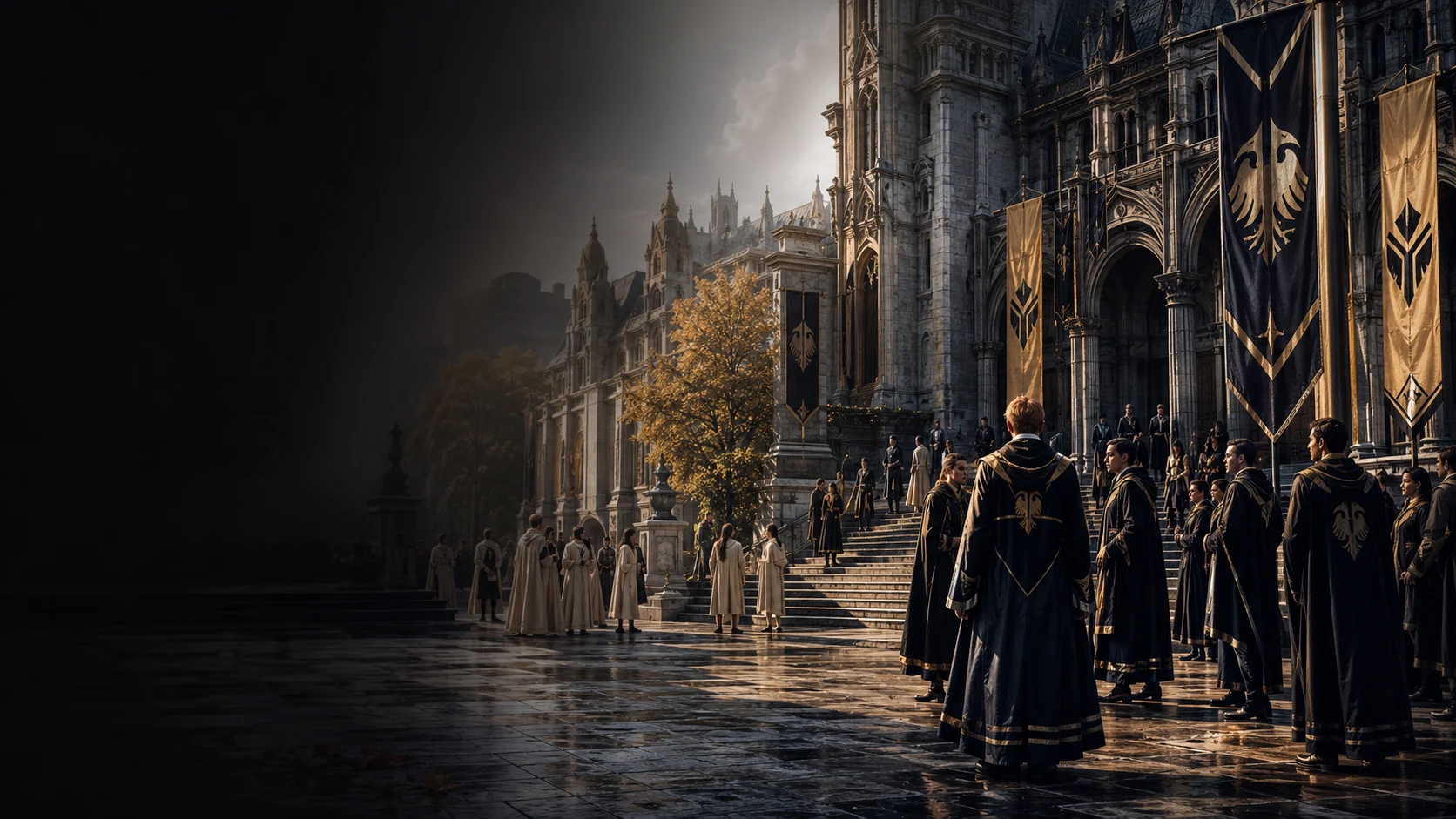
Featured image. Rival houses gather on opposite sides of a grand academy courtyard.
Give a fantasy academy two rival houses and something happens almost immediately: readers start comparing them. One house becomes disciplined, another reckless. One values tradition, another ambition. Colors appear, symbols appear, old victories are remembered, and new students inherit group identities they did not create.
Very quickly, a fictional institution stops feeling like a building full of individuals and starts feeling like a social world. The device works because group identity is one of the fastest ways to make abstract worldbuilding personal.
People do not need much information to start thinking in groups
Social psychology has repeatedly shown that group boundaries can become meaningful even when the groups themselves begin with very little meaningful difference. In the classic minimal-group paradigm associated with Henri Tajfel and later research, people assigned to arbitrary categories can still show in-group preference.
These experiments are not a blueprint for fantasy fandom, and they do not prove that readers respond to fictional houses in exactly the same way participants respond to laboratory groups. They do, however, illuminate a useful mechanism: categorization can become socially meaningful surprisingly quickly.
Fantasy adds far more material than a laboratory label. A name, a color, a symbol, a reputation, and a few contrasting values may be enough to create the first sense of 'us' and 'them' before the reader knows centuries of history.
A house turns worldbuilding into identity
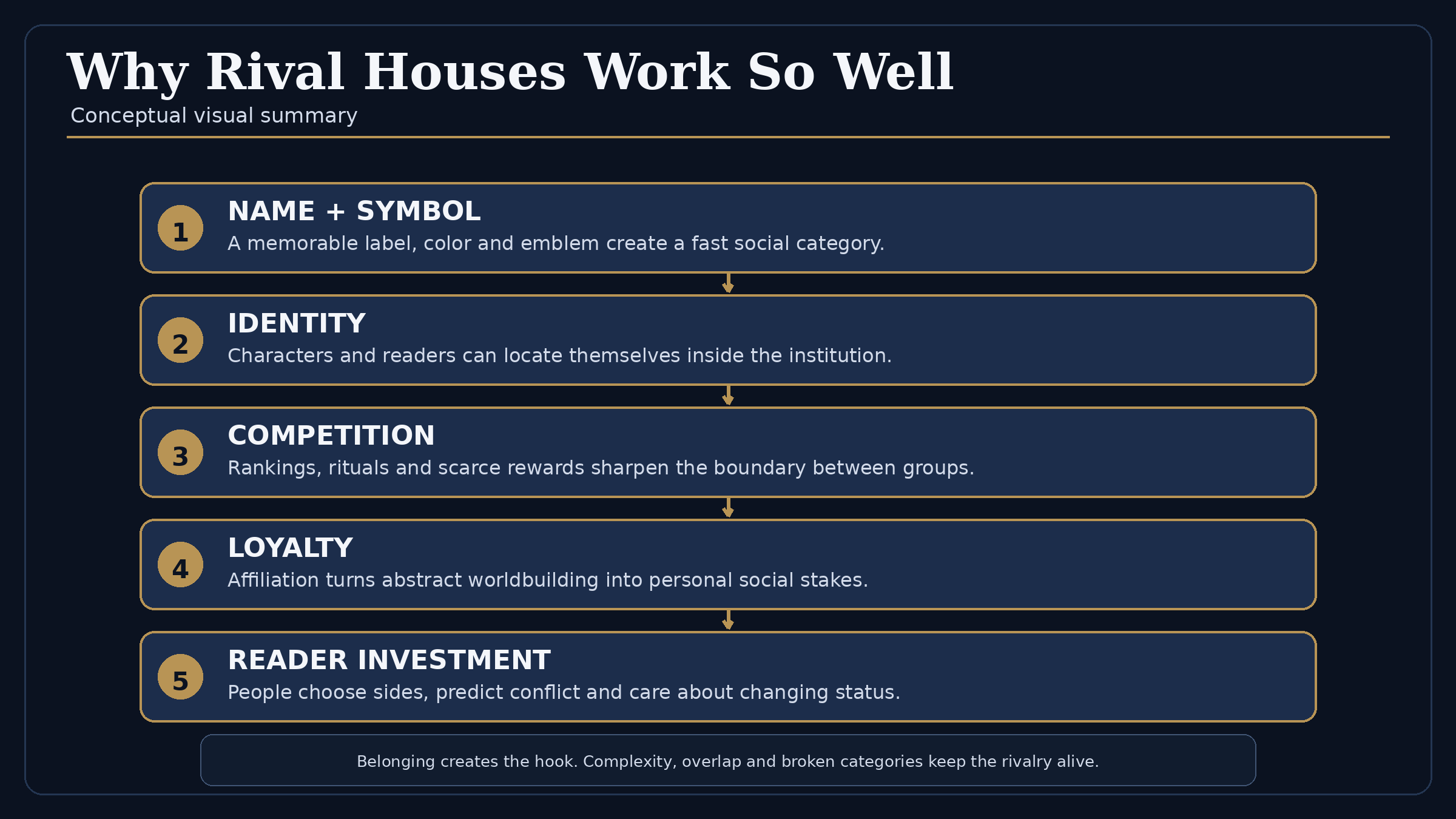
Figure 1. Rival houses turn abstract worldbuilding into identity, loyalty and reader investment.
A kingdom is large. A political system is abstract. A magical institution can be complicated. A house is small enough to belong to, and that changes how the reader processes the setting.
Instead of memorizing an organizational chart, the reader learns the institution through affiliation. Which students eat together? Which corridor belongs to whom? Which banner appears at the tournament? Which reputation follows a character before they speak? The house system compresses a complicated institution into social categories that can be understood at a glance.
Symbols make that identity visible. Colors, uniforms, rooms, banners, ceremonies, songs, animals, jewelry, and architecture allow a group to be present even when none of its members are speaking. A crest above a door or an empty table at dinner can communicate social information before exposition does.
Competition sharpens the boundary
Rivalry becomes much stronger when the groups want something that cannot be equally shared. The Robbers Cave field study is one famous example of how intergroup competition can intensify hostility: two groups developed distinct identities, conflict deepened under competition, and later shared goals that required cooperation helped reduce that hostility.
Again, fiction is not a field experiment. But the structure is narratively useful. A tournament, ranking, scholarship, throne, magical resource, or political appointment gives group identity something concrete to act upon. The other house is no longer simply different; it can prevent your house from winning.
That creates instant stakes without requiring a villain. Two houses can want incompatible outcomes for understandable reasons. A rival can be irritating, dangerous, admirable, and occasionally correct at the same time, which produces more durable conflict than simple good-versus-evil sorting.
Categories create expectations - and characters become interesting by breaking them
Once houses exist, every new character arrives with an extra question: where do they belong? A ruthless character placed in the supposedly honorable house becomes interesting because the category and the person do not align. A gentle student in the feared house complicates the stereotype. A transfer, outsider, or mixed-lineage heir creates tension simply by crossing boundaries.
This is where house systems become more than personality labels. The category creates an expectation, and the character becomes interesting by fulfilling, resisting, or rewriting it.
The same categories create a built-in social map. Alliances can be understood through seating arrangements. Political change can be shown through who trains together. A betrayal becomes more significant when it crosses an established group line. A friendship feels risky because it forms between people whose institutions expect hostility.
The reader is not memorizing a diagram. They are watching relationships move across a diagram they already understand.
Rivalry can carry conflict at several scales at once
A good house system can generate personal, institutional, and political conflict simultaneously. Two students compete for first place; their houses compete for status; academy leadership depends on the houses remaining balanced; their families may have supported opposite sides of an old war. One duel can therefore carry more meaning than the duel itself.
Competition can also strengthen loyalty inside a group. Research on intergroup relations suggests that identification and comparison with an out-group can, under some conditions, increase cooperation with fellow group members. Fantasy makes that contradiction easy to dramatize.
Characters who dislike one another personally may still protect the house in a tournament. Internal arguments stop when the rival faction enters the room. Someone who criticizes their own group constantly may become furious when an outsider does the same. Group loyalty is not the same thing as liking every member of the group.
The best rivalries contain admiration
Pure hatred is surprisingly limiting. Rival houses become more interesting when each group possesses something the other lacks. One may be more disciplined, another more inventive. One produces brilliant strategists; another survives because its members improvise under pressure.
Admiration creates a problem hatred does not. If the rival is competent, defeating them matters more. If the rival is sometimes right, identity becomes harder to protect. The conflict can then change a character rather than merely give them somebody to insult.
A common enemy can redraw the map
The Robbers Cave research is remembered not only for conflict but for what happened when both groups faced goals neither could solve alone. Cooperation became possible because a larger problem temporarily made a larger identity more useful.
Fantasy uses this constantly for good reason. Two rival houses can spend half a novel fighting over rank and then cooperate when the academy itself is threatened. The old identity does not disappear; another one becomes more important. House becomes academy. Academy becomes kingdom. Kingdom becomes humanity.
That flexibility lets a story change the scale of conflict without discarding earlier relationships. Yesterday's enemy can become today's ally without the earlier rivalry feeling fake.
The system fails when houses become personality quizzes
There is a weak version of the trope: every clever person goes into one house, every cruel person into another, every brave person into a third, and nobody meaningfully contradicts the category. That may be easy to understand, but it flattens both character and culture.
Convincing groups contain internal disagreement, status differences, hypocrites, reformers, loyalists, opportunists, and people who simply inherited membership. A believable fantasy house should be able to contain people who would never choose one another as friends.
History should work the same way. Ancient feuds add depth only when they alter present behavior. Readers do not care that two houses fought in 812 unless that history changes who gets invited, who is trusted, who inherits authority, who can marry whom, or which version of the past is taught. The best lore has consequences before an appendix explains it.
Why readers start choosing sides
House systems invite participation. A reader can ask almost instantly, 'Which one would I belong to?' That question turns observation into self-placement. The reader is no longer only watching the world; they are imagining a position inside it.
Minimal-group research suggests that categorization alone can sometimes produce preference. Fantasy then adds aesthetics, values, characters, victories, humiliations, inherited stories, and moral arguments. By the time the first major rivalry arrives, the categories may already feel emotionally loaded.
That is also why the strongest house systems resist making one side obviously superior. Choosing becomes interesting when every affiliation offers something desirable, costly, or compromised.
The real power of rival houses is belonging
Rivalry is what makes the system visible. The deeper power is belonging. A house tells characters where they sleep, who expects something from them, which reputation they inherit, and which people they are supposed to oppose.
Then the story begins asking whether those boundaries deserve to survive. That is why rival houses work so well in fantasy: they turn a world into groups, and then turn those groups into choices.
Sources & further reading
- Fischer et al. (2016), Royal Society Open Science - meta-analysis of in-group bias across 18 societies and the minimal-group paradigm: https://pmc.ncbi.nlm.nih.gov/articles/PMC4723375/
- Dunham (2013), PLOS ONE - Balanced Identity in the Minimal Groups Paradigm: https://pmc.ncbi.nlm.nih.gov/articles/PMC3877254/
- Cikara, Botvinick & Fiske (2011), Psychological Science - social identity and intergroup competition: https://pmc.ncbi.nlm.nih.gov/articles/PMC3833634/
- APA Dictionary of Psychology - Robbers Cave experiment, competition and superordinate goals: https://dictionary.apa.org/robbers-cave-experiment
- Van Lange et al. review discussion of superordinate goals and prosocial behavior: https://pmc.ncbi.nlm.nih.gov/articles/PMC9932976/