
Featured image. An interstellar command hall studies a network of distant star systems.
Science fiction loves the interstellar empire. One capital. Hundreds of worlds. Orders issued from the center. Fleets dispatched to distant systems. Governors waiting for instructions. Rebels hunted across the stars.
The image is so familiar that it can feel almost inevitable. If humanity eventually reaches other star systems, why would politics not simply expand with us?
There is one problem: distance changes what government means.
The nearest star to the Sun, Proxima Centauri, is a little over four light-years away. A message sent from Earth cannot arrive there in less than about four years because information cannot outrun light. A reply cannot return in less than another four.
That means a simple question-and-answer cycle with our nearest stellar neighbor would take more than eight years even if communication were perfect.
At interstellar scale, the first enemy of empire is not rebellion. It is latency.
The speed of light becomes a political law
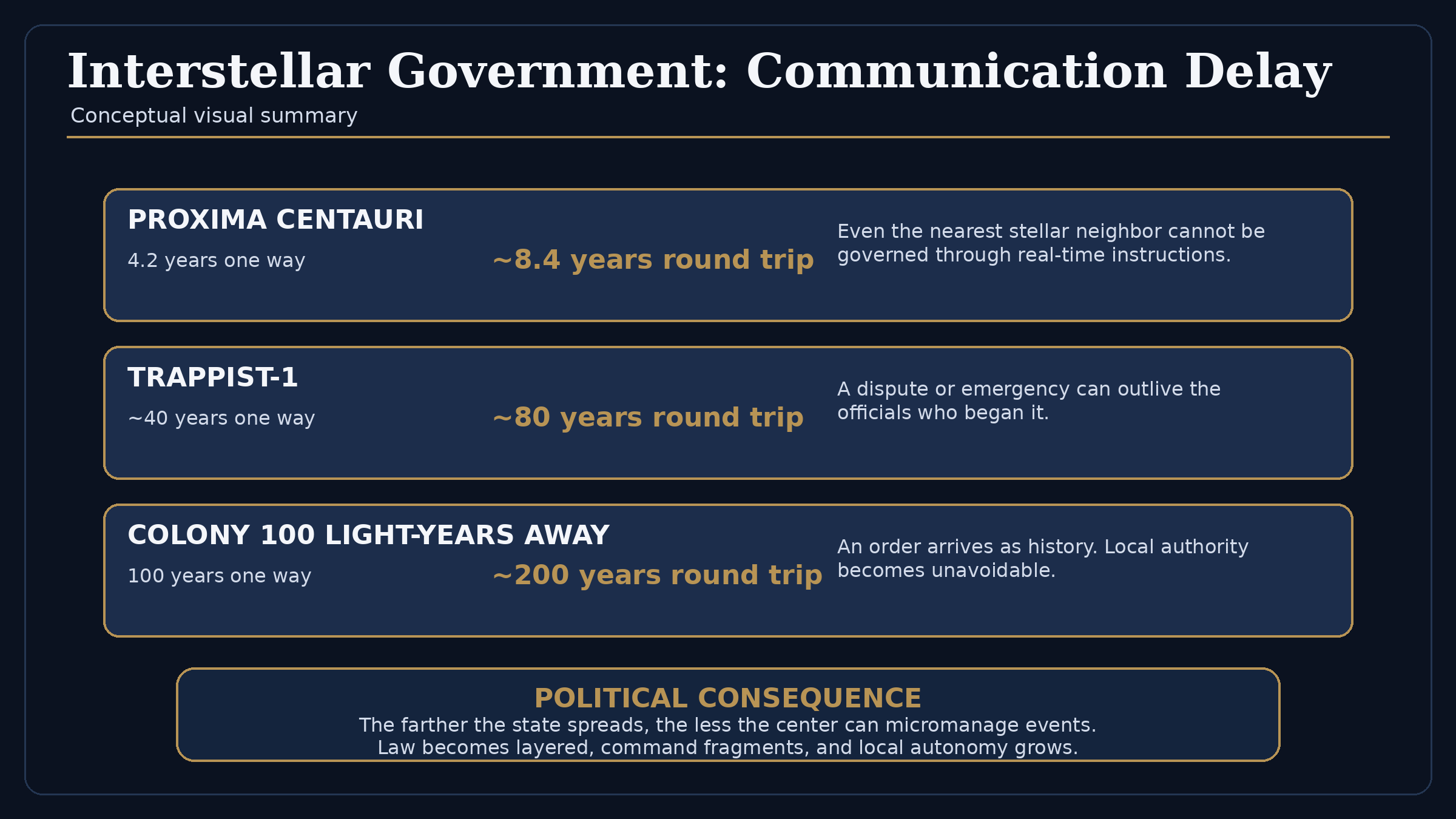
Figure 1. At interstellar distances, communication latency turns distance into a structural political problem.
NASA describes communication latency as a direct consequence of the universal speed limit imposed by light. Even inside our own solar system, the delay already matters. Depending on the positions of Earth and Mars, one-way communication can take roughly four to 24 minutes.
Voyager makes the point even more brutally. When NASA sent a command to Voyager 2 in 2023, the one-way light time was about 18.5 hours. Mission controllers had to wait roughly 37 hours to learn whether the command had worked.
Those delays are tiny compared with interstellar distances.
Proxima Centauri is about 4.2 light-years away. The TRAPPIST-1 system, home to seven roughly Earth-size planets, is about 40 light-years away. A message sent there today would arrive around 2066. A reply sent immediately would not return until roughly 2106.
No faster computer fixes this. No larger bureaucracy fixes it. No better encryption fixes it. Unless physics allows a way to send information faster than light - something current physics does not provide - political decisions are trapped by geography.
A central government could not govern in real time
Most modern states depend on rapid information. Elections, markets, military orders, court decisions, tax systems, emergency responses and public administration all assume that the center can learn what is happening and respond while the event is still politically relevant.
An interstellar capital cannot do that.
Imagine a colony four light-years away reports a constitutional crisis. Earth receives the message four years later. The cabinet debates for a month and sends instructions. Those instructions arrive four years after that.
By the time the answer appears, the crisis is at least eight years old.
The government that requested help may no longer exist. The governor may be dead. The rebels may now be the elected administration. The economic conditions that caused the crisis may have disappeared. A child born when the first message was transmitted could be approaching adolescence when the response arrives.
Central command becomes historical correspondence.
The farther the empire spreads, the stranger authority becomes
At ten light-years, a round-trip exchange takes at least twenty years. At forty light-years, roughly eighty. At one hundred light-years, a government can send instructions whose consequences it may never personally observe.
This makes the usual science-fiction hierarchy difficult to sustain. A planetary governor cannot realistically ask the capital for permission every time a crisis occurs. A military commander cannot wait decades for revised orders. Courts cannot appeal routine disputes to a supreme tribunal several star systems away if the decision returns after the people involved have died.
Local autonomy stops being an ideological preference. It becomes infrastructure.
Any durable interstellar political system would have to give distant worlds enormous authority to govern themselves.
So what would the center actually control?
Probably fewer things than the word empire suggests.
A central interstellar authority might still define broad constitutional principles, citizenship rules, scientific standards, trade protocols, navigation law, shared defense commitments or a common currency framework.
But the daily machinery of government would have to be local.
The center could publish rules that travel outward slowly. Member worlds could send reports inward slowly. What disappears is continuous supervision.
That pushes an interstellar empire toward something that behaves more like a federation, confederation, religious network, dynastic alliance or standards organization than a modern centralized state.
The capital may remain symbolically powerful while being operationally distant.
Law would split into layers
One plausible solution is legal layering.
Local law handles almost everything that must be decided quickly: crime, property, health, infrastructure, education, civil disputes and ordinary politics.
System-level law coordinates planets or habitats orbiting the same star, where communication delays might be seconds or minutes instead of years.
Interstellar law governs the small set of questions that can survive long delays: treaties, recognition of governments, long-term trade rules, scientific protocols, navigation rights and perhaps shared military obligations.
That would make law slower as it becomes more important.
A constitutional amendment sent across a 40-light-year realm might require the better part of a century to complete a full cycle of debate and ratification.
Taxation becomes awkward when the budget crosses generations
Empires need resources, but interstellar taxation creates a bizarre timing problem.
A capital can demand money or goods from a distant colony. But what is the tax paying for? If the request takes 20 years to arrive and the response takes another 20, the political bargain is no longer immediate.
A colony might be funding a defense policy designed by leaders who died before the payment was collected. The capital might receive resources generated under economic conditions that no longer exist.
Physical taxation is even harder. Moving bulk goods between stars is vastly slower and more expensive than transmitting information.
The most realistic interstellar 'tax' may therefore be local contributions to agreed institutions: each world funds its own defense, builds infrastructure to shared standards, maintains communication relays or contributes knowledge rather than shipping wealth back to a remote capital.
Military command may fragment first
Military science fiction often imagines admirals directing campaigns across many star systems from one headquarters.
With multi-year communication delays, that model breaks immediately.
A fleet entering another system would need broad mission authority before departure. Once committed, commanders would operate independently because the political leadership at home would always be responding to an outdated situation.
The result is dangerous. The more autonomy a commander needs, the less direct control the center has over the use of force.
An interstellar government might solve that by placing strict constitutional limits on commanders, dividing forces among local governments, requiring multi-party authorization, or designing military systems that are deliberately incapable of certain actions without local consensus.
In other words, communications latency does not merely slow war. It changes civil-military relations.
Rebellion would be difficult to distinguish from normal politics
A distant colony does not need to defeat the capital in battle to become functionally independent.
It may simply stop waiting.
If local institutions already make every meaningful decision, independence can begin as a procedural fact before it becomes a declaration. The colony changes a trade rule. Then a citizenship law. Then a defense agreement. The center learns years later.
By the time an objection arrives, the new system may have operated successfully for a decade.
This creates a strange political reality: every remote province is always partly sovereign because the center cannot continuously enforce its will.
Culture could hold together what bureaucracy cannot
If administration weakens with distance, identity becomes more important.
A civilization spread across stars might remain unified through language, shared history, religion, education, scientific institutions, rituals or myths of common origin.
Those things travel slowly too, but they do not require immediate correction.
A world can feel part of a civilization even if it has not received a message from the capital for years.
This may be the most believable form of interstellar empire: not a government controlling every decision, but a civilization that agrees on what it means to belong.
The capital itself becomes a message from the past
There is another consequence that science fiction can use beautifully.
Distant worlds never know the capital as it currently exists.
A colony 40 light-years away receives news that is 40 years old. Its citizens may celebrate a ruler who has been dead for decades. They may obey a constitution already repealed at the center. They may mourn a disaster the capital has long recovered from.
The reverse is equally true. The capital sees its frontier in delayed snapshots.
An interstellar state is therefore not one political present. It is many different presents connected by old information.
The farther apart the worlds become, the less meaningful the phrase 'right now' becomes.
Could an interstellar empire exist anyway?
Yes - but probably not the kind we usually imagine.
A truly centralized empire spanning many light-years would be extremely difficult without faster-than-light communication. The physics favors local sovereignty, pre-delegated authority and very slow constitutional coordination.
The most plausible large interstellar polities may be loose federations, commonwealths, dynastic networks, trade leagues, religious civilizations or cultural unions whose members govern themselves.
The central government might set the story of the civilization more than its daily rules.
That does not make interstellar politics less interesting. It makes it stranger.
The best science-fiction empires should fear the clock
Writers often make distance dramatic by showing long voyages.
Communication deserves the same attention.
A four-year delay can turn diplomacy into archaeology. A 40-year delay can make an election result obsolete before another world hears it. A century-wide civilization may never share a single political moment.
That creates better conflicts than simply making every ship faster.
A rebellion can begin and end before the capital learns it happened. A governor can inherit emergency powers that were granted to a grandparent. A colony can receive an order from a government that no longer exists. Two worlds can remain loyal to the same constitution while interpreting it in completely different ways for generations.
The physics does not kill the interstellar empire.
It forces us to invent a more interesting one.
Sources & further reading
- NASA Science - Proxima Centauri is about four light-years away: https://science.nasa.gov/mission/hubble/science/science-behind-the-discoveries/time-travel-observing-cosmic-history/
- NASA - Space Communications: latency is limited by the speed of light; Mars one-way delay can be roughly 4-24 minutes: https://www.nasa.gov/missions/tech-demonstration/space-communications-7-things-you-need-to-know/
- NASA - Voyager 2 communications pause: about 18.5 hours one-way light time in 2023: https://www.nasa.gov/missions/voyager-program/voyager-2/nasa-mission-update-voyager-2-communications-pause/
- NASA Science - TRAPPIST-1 system is about 40 light-years away: https://science.nasa.gov/exoplanets/trappist1/
- NASA - Special relativity and light speed: https://www.nasa.gov/solar-system/three-ways-to-travel-at-nearly-the-speed-of-light/