
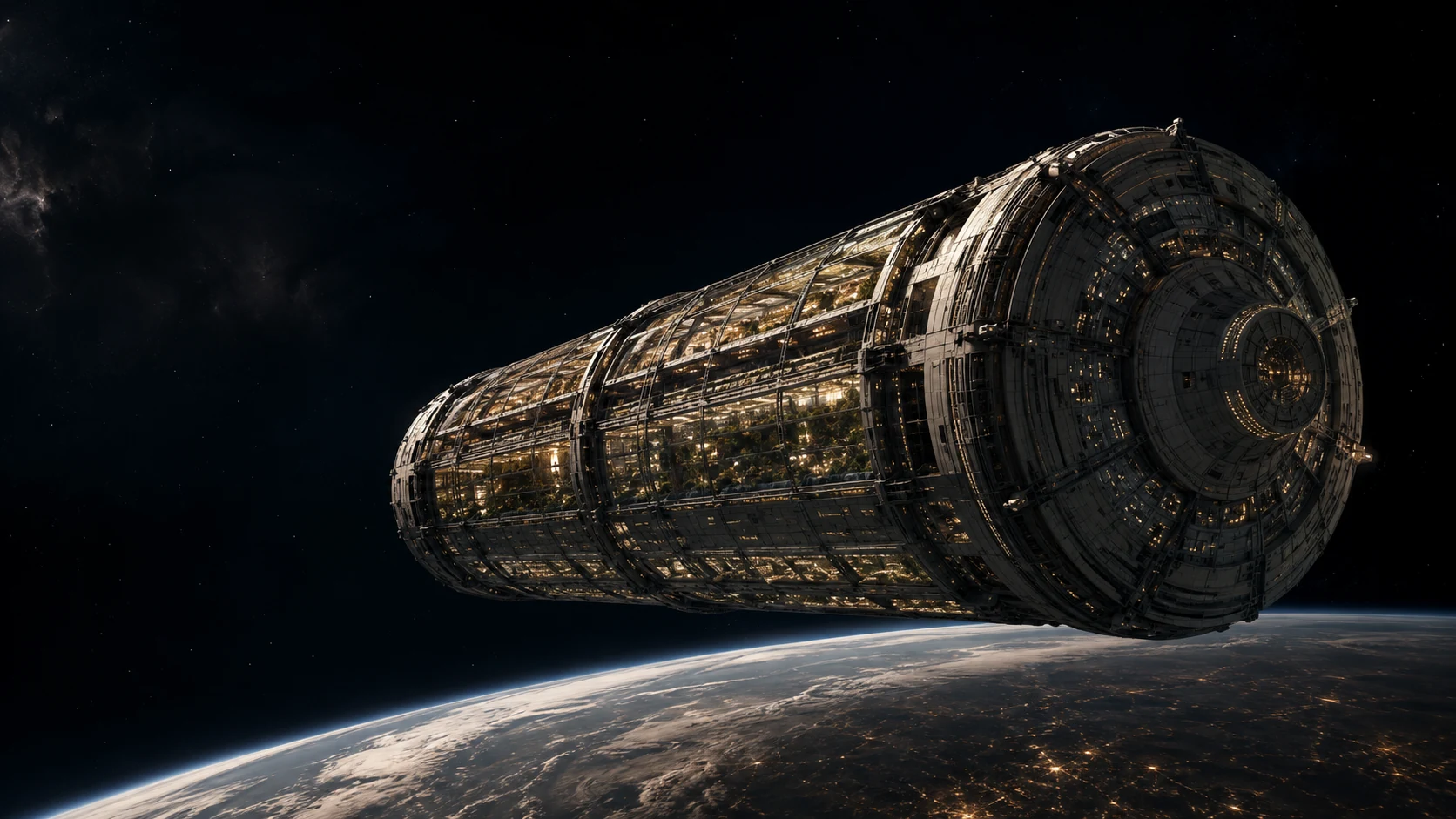
Featured image. An inhabited generation ship crossing deep space.
Imagine a spacecraft that leaves Earth knowing it will never come back. The people who launch it will not reach the destination. Their children probably will not either. The ship must keep moving for generations while the population eats, sleeps, falls in love, gets sick, raises families, repairs machinery, grows food and somehow keeps a small human civilization alive inside a sealed world.
That is the basic idea behind a generation ship: an interstellar spacecraft designed not for a crew on a mission, but for a society in transit.
Science fiction often treats the population number as the terrifying part. Ten thousand people sounds enormous. In reality, the number of passengers may be one of the easier problems. The harder question is whether the ship can remain a functioning ecosystem, hospital, power station, farm, factory and political community for centuries without a supply line to Earth.
The population problem may be surprisingly manageable
From a genetics point of view, 10,000 people is not a tiny founding population. HERITAGE agent-based studies have explored viable starting crews far below that number, but they do not produce one universal minimum. Different scenarios and assumptions have yielded different thresholds: a 2018 simulation found 98 people sufficient under tightly managed breeding rules for a very long voyage, while a 2025 extension found populations around 500 comparatively stable when genetic and phenotypic effects were modeled under favorable shielding conditions.
That does not mean any of those numbers is a real-world flight requirement. They are model outputs, not engineering standards, and the result depends heavily on fertility, mortality, mate selection, radiation exposure, social rules, stored genetic material, and the length of the voyage. The useful conclusion is narrower: a ship carrying 10,000 people would probably not fail simply because humanity ran out of genetic diversity.
It could fail because 10,000 people are difficult to feed, house, govern and protect when there is nowhere else to go.
A generation ship has to become an ecosystem
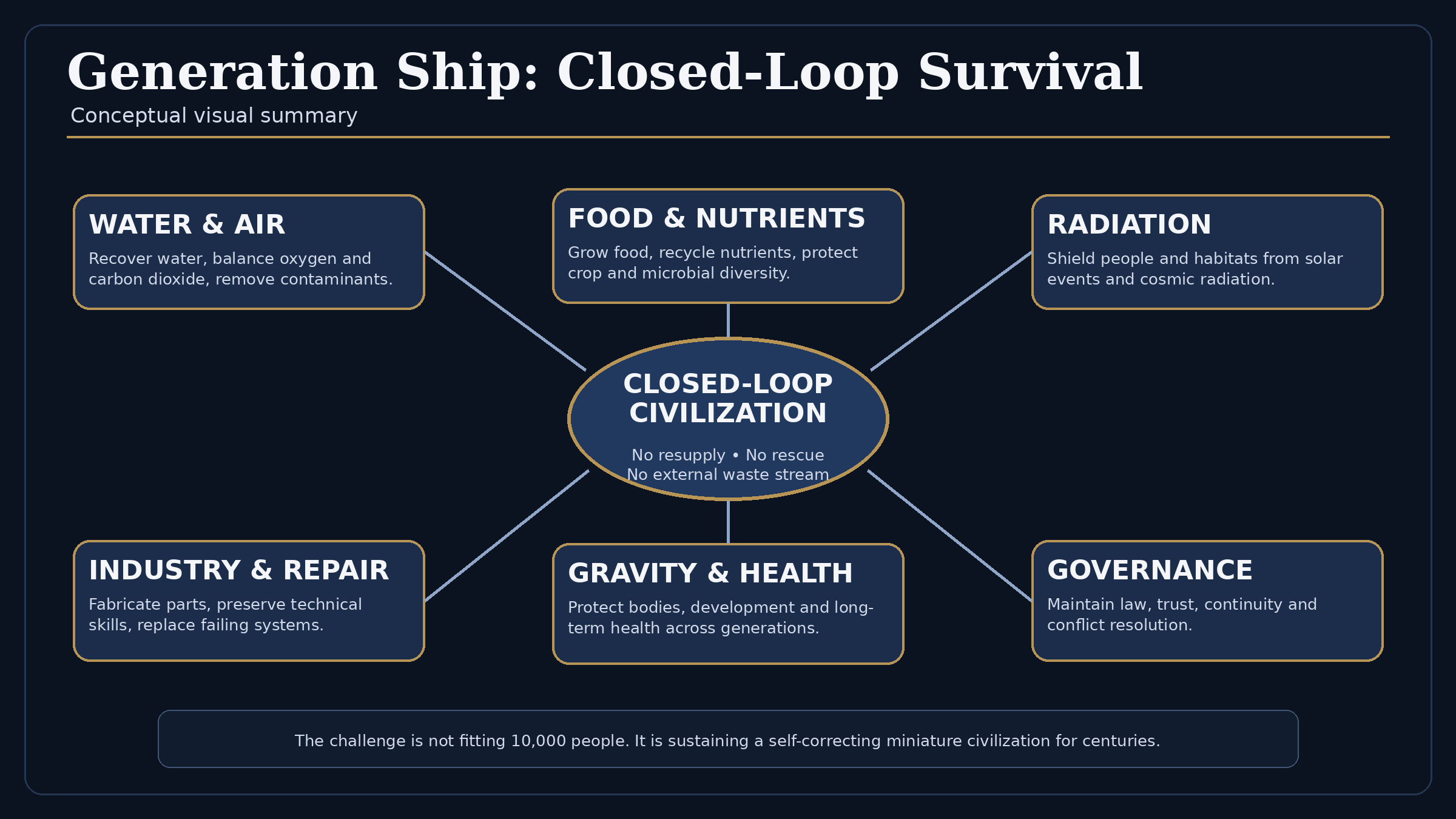
Figure 1. A generation ship is not just a vehicle. It has to function as a regenerative, closed-loop ecosystem.
Today’s spacecraft survive because Earth is still part of the system. The International Space Station receives hardware, food, experiments and replacement parts from the ground. A true generation ship cannot assume that help is coming.
NASA’s Environmental Control and Life Support System already recovers water from humidity, wastewater and urine, and the station has demonstrated total water recovery around 98 percent using its current processing hardware. That is extraordinary engineering. It is also not the same as running a closed civilization for two hundred years.
A generation ship would need to recycle water, recover nutrients, remove carbon dioxide, replenish oxygen, process waste and produce a meaningful share of its own food. ESA’s MELiSSA programme is built around exactly this broader idea: a regenerative life-support loop in which biological and engineering systems recycle waste into air, water and food.
The word that matters is regenerative. If every kilogram of food, fertilizer, filter material or spare chemical must be loaded at departure, the mission eventually becomes a countdown to depletion.
Food is harder than packing more meals
Stored food has limits. Nutrients degrade, packaging fails, tastes become monotonous and a centuries-long mission cannot be provisioned like a very long camping trip. People would need agriculture.
NASA is actively studying space crops because plants can contribute fresh food, psychological benefits and eventually bioregenerative life support. A generation ship would need to push that idea much further: multiple crops, seed reserves, pollination strategies, disease control, nutrient recycling and enough redundancy that one fungal outbreak does not become a civilization-ending event.
The farm would also be part of the atmosphere system. Plants use carbon dioxide and release oxygen; people do the reverse. In a carefully managed closed habitat, food production and life support begin to merge into the same infrastructure.
The nightmare scenario is not dramatic starvation after a single bad harvest. It is slow ecological drift: a nutrient gradually disappearing from the loop, a microbe becoming dominant, crop yields declining over decades, or a waste-processing subsystem losing efficiency faster than the community can understand why.
Radiation may be the most unforgiving engineering problem
Outside Earth’s protective magnetosphere, crews are exposed to galactic cosmic rays and solar particle events. NASA treats deep-space radiation as a major human-health risk because it can raise lifetime cancer risk and may affect the central nervous system and other tissues.
For a multigenerational mission, the problem becomes even more serious. The ship is not protecting a handful of astronauts for a few years; it is protecting children, pregnancies and entire family lines for centuries.
That pushes the design toward heavy shielding, protected storm shelters and possibly the use of water, fuel, structural mass or other materials around occupied areas. It also means shielding cannot be treated as a one-time launch feature. A generation ship must be able to inspect, repair and perhaps rebuild its protection after decades of impacts, fatigue and material degradation.
In other words, the hull is not just a wall. It is part of the public-health system.
Then there is gravity
Human bodies are adapted to gravity. Long exposure to microgravity produces changes in bone, muscle, cardiovascular function and other systems. For a ship where people will be born, grow up and age in space, simply accepting weightlessness would be an enormous biological gamble.
Artificial gravity is the obvious science-fiction solution, usually created by rotating a habitat so that centrifugal acceleration pushes occupants toward the outer wall. NASA has studied rotating-habitat concepts and artificial gravity as a possible countermeasure, but we do not yet have operational experience with a human community living for years inside a large rotating spacecraft.
A generation ship would therefore be less like today’s narrow spacecraft and more like a moving settlement: a rotating cylinder, ring or habitat large enough that people can walk, sleep, raise children and work under a familiar gravitational load.
The ship also needs an industrial civilization
Life-support equipment fails. Pumps wear out. Electronics age. Seals leak. Bearings degrade. Software becomes obsolete. A ship that depends on one irreplaceable component is not a generation ship; it is a delayed emergency.
A viable design would need machine shops, raw materials, manufacturing systems, diagnostic tools and a culture capable of preserving technical knowledge across generations. Some parts might be fabricated on demand. Others would require carefully maintained stockpiles. Critical systems would need redundancy not only in hardware but in expertise.
That creates an unusual educational problem. The people who understand the reactor, habitat structure or water chemistry at launch may be dead a century before arrival. Their knowledge has to survive them.
A generation ship therefore needs schools for reasons far more practical than cultural continuity. Education is part of the maintenance system.
Ten thousand people still have to live together
Engineering alone does not keep a society alive.
NASA already studies the behavioral effects of isolation, confinement, communication delays and team conflict in long-duration missions. Those challenges become qualitatively different when the mission lasts longer than a human lifetime.
The founding generation chooses the voyage. Later generations do not. They are born into a moving world whose destination was selected by people they never met.
Who controls reproduction if population size must remain within ecological limits? Who decides how scarce resources are allocated? Can someone refuse a dangerous maintenance job if the whole ship depends on it? What happens when a community questions the mission itself? What political system is stable when there is no external territory, no rescue and no realistic way to leave?
These are not side questions. On a generation ship, governance is a life-support technology.
So, could 10,000 people survive?
Possibly — but not with anything close to the infrastructure we can build today.
A population of 10,000 gives a hypothetical generation ship enormous advantages: genetic diversity, specialization, cultural depth, redundancy of skills and a much larger buffer against random demographic losses. But every additional person also increases food demand, heat rejection, living volume, waste processing and system complexity.
The central challenge is not fitting 10,000 people inside a sufficiently large spacecraft. It is constructing a closed civilization that can repair itself faster than it decays.
Water recycling must work for centuries. Agriculture must remain productive. Radiation exposure must stay within tolerable limits. Gravity must be addressed. The ship must manufacture parts, preserve expertise, manage disease and keep its society stable through generations of people who never volunteered for the original mission.
If humanity ever builds a real generation ship, the breakthrough may not be a faster engine.
It may be learning how to build a world small enough to carry with us.
Why science fiction keeps returning to generation ships
Generation ships are compelling because they turn the spaceship itself into a world.
They let stories ask what remains of a mission after nobody remembers Earth firsthand; whether history becomes religion; whether maintenance manuals become sacred texts; whether a destination still matters to people born halfway there; and whether a society designed for survival can remain recognizably human.
The physics gets the ship moving. The real story begins when the first generation dies.
Sources & further reading
- NASA — Environmental Control and Life Support Systems (ECLSS): https://www.nasa.gov/reference/environmental-control-and-life-support-systems-eclss/
- NASA — Achieves Water Recovery Milestone on the International Space Station (98% recovery demonstration): https://www.nasa.gov/missions/station/iss-research/nasa-achieves-water-recovery-milestone-on-international-space-station/
- NASA — Space Radiation / Human Research Program: https://www.nasa.gov/hrp/radiation/
- NASA — Behavioral Health Risk: https://www.nasa.gov/directorates/esdmd/hhp/behavioral-health-risk/
- NASA — Team Risk: https://www.nasa.gov/directorates/esdmd/hhp/team-risk/
- NASA Science — Space Crops and bioregenerative life support: https://science.nasa.gov/biological-physical/space-crops/
- ESA — MELiSSA regenerative closed-loop life support: https://www.esa.int/Enabling_Support/Space_Engineering_Technology/Melissa/Targets_Scientific_domains
- ESA — Advanced Closed Loop System: https://www.esa.int/Science_Exploration/Human_and_Robotic_Exploration/Research/Advanced_Closed_Loop_System
- Marin, Beluffi-Marin & Fischer - HERITAGE multigenerational population simulations (model assumptions produce different minimums): https://arxiv.org/abs/1806.03856 ; https://arxiv.org/abs/2502.07559
- NASA NTRS — Artificial Gravity evidence and concepts: https://ntrs.nasa.gov/archive/nasa/casi.ntrs.nasa.gov/20150009486.pdf