
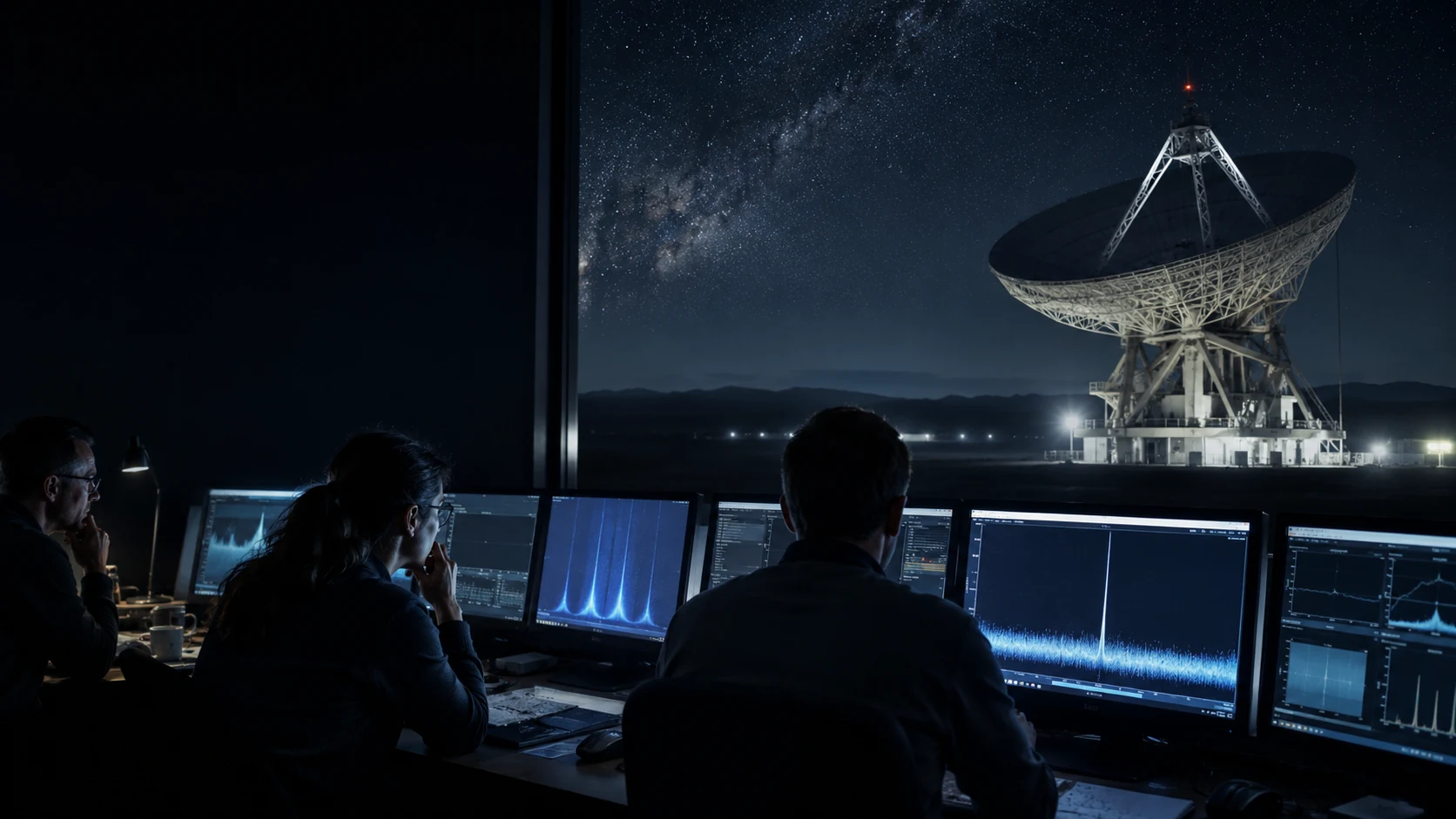
Featured image. Astronomers study an unusual signal in a radio observatory at night.
If humanity ever discovers extraterrestrial intelligence, the first moment may look painfully unimpressive: a line in a dataset, a narrow radio signal, a pulse of laser light, an atmospheric chemical that should not be there, or a pattern in starlight strange enough to make one researcher stop scrolling and look again.
No ship has to appear over a capital city. Nobody has to shake hands with an ambassador. The first stage of first contact would probably be doubt.
First contact may be a technosignature, not a visitor
NASA uses the term technosignature for observable evidence of technology beyond Earth. Radio and laser transmissions are obvious examples, but researchers also consider unusual atmospheric chemicals, waste heat, or large artificial structures that might alter the light we receive from a distant star.
That broadens the meaning of contact. Humanity might discover a technological civilization without receiving a message deliberately addressed to us. We could detect evidence that intelligence exists - or once existed - without knowing anything about its language, biology, politics, or intentions.
The first job would be proving the signal is not ours
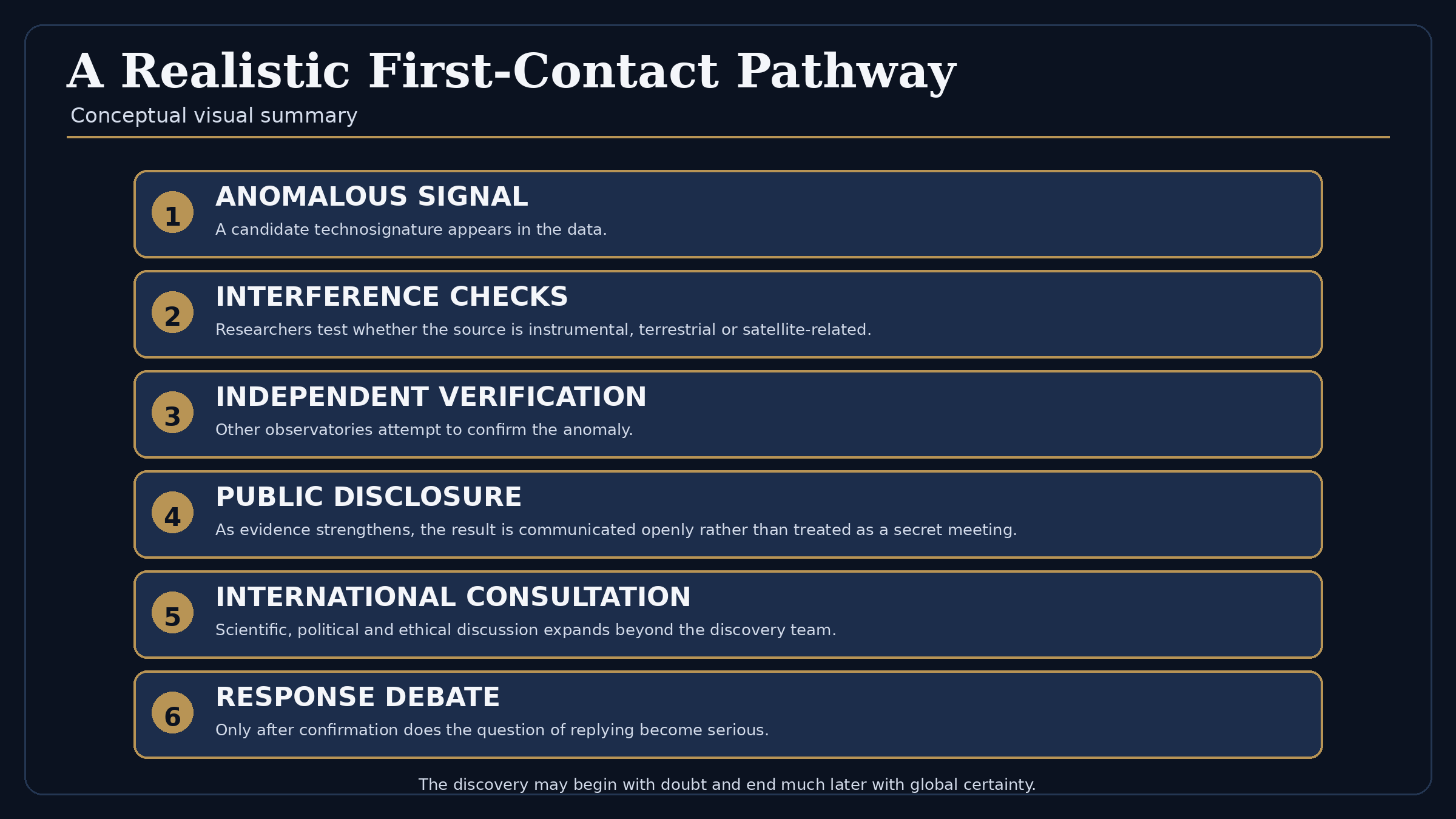
Figure 1. A realistic first-contact event would likely unfold as a process of verification, disclosure and international debate.
SETI observations encounter enormous amounts of human-made interference. Satellites, aircraft, terrestrial transmitters, spacecraft telemetry, and electronic equipment can all create signals that look interesting before they are understood.
The SETI Institute's 2026 search of the interstellar object 3I/ATLAS illustrates the scale of that filtering problem: about 74 million initial radio detections were reduced to roughly 200 candidates, and all of them were ultimately traced to human-made interference rather than extraterrestrial technology.
That is why a strange signal is not first contact. It is a candidate, and the discovery only becomes interesting if ordinary explanations keep failing.
Independent verification would matter immediately
The International Academy of Astronautics updated its SETI detection principles in June 2026. Their central logic is scientific caution: candidate evidence should be examined rigorously, natural and human-made explanations should be tested, and independent observers or institutions should help verify the result before a detection is treated as confirmed.
The dramatic moment may therefore belong to several telescopes rather than one. The strongest evidence would be something different teams can detect independently, from different locations, with different instruments and methods.
Good science is full of boring alternatives. A strange pattern might turn out to be a satellite, software bug, instrument artifact, known astronomical source, reflection, calibration problem, or equipment close to the telescope. Eliminating those possibilities is not scientists trying to kill the discovery; it is how the discovery becomes credible.
The world might hear about the candidate before certainty exists
Older first-contact stories often imagine scientists quietly confirming a discovery before anyone else knows. That becomes harder in a world of social media, open datasets, leaks, screenshots, livestreamed research, and AI-generated misinformation.
The 2026 IAA principles explicitly address this changed information environment by emphasizing accurate, timely communication and clear distinctions between confirmed evidence and speculation. In practice, humanity's first experience of possible contact could be messy: a rumor may trend before verification is complete, fake signal plots may circulate beside real ones, and people may confidently explain evidence they have never seen.
The scientific problem and the communication problem would begin at the same time.
Confirmation would favor openness, not a secret meeting
The current SETI principles call for a confirmed detection to be communicated openly to the public and scientific community and reported to the Secretary-General of the United Nations. Relevant data should be preserved and made available for further analysis.
That does not mean every government or institution would react identically. These are scientific principles, not a global emergency law. Their logic is simpler: a claim this important becomes stronger when many qualified people can inspect the evidence.
Then comes the question everyone asks: should we answer?
Detection and response are two different decisions. The current IAA principles call for appropriate international consultation over whether any reply should be sent and what it should contain; pending such consultation, no reply should be transmitted.
That matters because an answer would not belong only to the observatory that found the signal. It would claim, in some sense, to speak from Earth. Who gets to do that - a nation, the United Nations, scientists, a coalition of states, or the public? Humanity has no universally accepted institution designed specifically to answer that question.
A reply might not become a conversation
Science fiction often turns first contact into dialogue within minutes. Distance makes that unlikely. Communications are limited by the speed of light, and NASA notes that even messages within our own solar system accumulate measurable delay.
If a civilization were 40 light-years away, a message transmitted from Earth would take about 40 years to reach it. A reply sent immediately would need another 40 to return. An 80-year question-and-answer cycle is not a conversation in the ordinary human sense.
We might be hearing from a civilization's past
Light-speed delay creates another strange consequence. A signal arriving from 100 light-years away carries information that left its source roughly a century ago. The civilization may still exist, may have changed completely, or may have stopped transmitting decades before we first detect it.
First contact could therefore be partly archaeological. We might discover intelligence before we discover whether that intelligence is still there.
The signal may not contain a message
A technosignature is evidence of technology, not necessarily communication. A laser pulse might be deliberate; an industrial atmospheric signature might not be. Waste heat from enormous engineering could reveal technology without anyone attempting to announce themselves.
That distinction changes the ethics of response. There is a large difference between answering a beacon and deliberately transmitting toward a civilization that never contacted us. First contact may begin with observation rather than conversation.
Understanding a message would be its own scientific problem
Even if a signal were clearly intentional, recognizing meaning would be difficult. A repeating mathematical pattern might establish artificial origin without telling us much else. A more complex transmission would raise questions about encoding, reference frames, shared concepts, and whether the signal was designed for unknown receivers.
A message could be perfectly intelligent and still be incomprehensible. Detecting technology would not automatically hand us a Rosetta Stone.
The first-contact team would be much larger than astronomers
Once a detection is credible, astronomy stops being the only relevant discipline. The updated 2026 post-detection framework anticipates interdisciplinary involvement, including science, ethics, law, social science, and communications expertise.
That makes sense. A confirmed technosignature would create immediate questions about public communication, misinformation, religion, markets, law, diplomacy, education, and the ethics of response. First contact would begin as an astronomical discovery and almost immediately become a human institutions problem.
The first real shock may be certainty, not conversation
For centuries, humans have debated whether intelligence exists elsewhere. A confirmed technosignature would change that question from philosophy into fact.
Even if the signal contained no message, came from hundreds of light-years away, and could never produce a practical exchange, one fact would remain: technology happened twice. The universe produced another civilization capable of leaving an observable trace.
That alone would count as first contact in the broadest sense - not meeting someone, but discovering that humanity is not the only technological story the universe has written.
What first contact would probably feel like
Not one cinematic moment, but a sequence: a strange signal, a skeptical second look, other observatories checking, human interference being eliminated, arguments over confidence, rumors leaking, data being released, confirmation, governments reacting, scientists explaining, and people asking whether we should answer.
Somewhere inside all of that, a line that once looked like noise becomes evidence that another intelligence exists. The movies usually begin after that. Reality would begin before anyone was sure.
Sources & further reading
- International Academy of Astronautics / SETI Institute - 2026 updated Principles for verification, announcement, post-detection analysis and response: https://www.seti.org/research/seti-101/protocols-for-an-eti-signal-detection/
- IAA SETI Committee protocols index: https://iaaseti.org/en/protocols/
- SETI Institute - June 2026 overview of updated post-detection framework and modern misinformation challenges: https://www.seti.org/news/beyond-disclosure-day/
- NASA Science - Searching for Signs of Intelligent Life: Technosignatures: https://science.nasa.gov/universe/search-for-life/searching-for-signs-of-intelligent-life-technosignatures/
- SETI Institute - 3I/ATLAS technosignature search and filtering of human-made interference: https://www.seti.org/news/seti-institute-looks-for-signs-of-technology-in-interstellar-visitor-3iatlas/
- NASA - Space Communications: latency is limited by the speed of light: https://www.nasa.gov/missions/tech-demonstration/space-communications-7-things-you-need-to-know/