
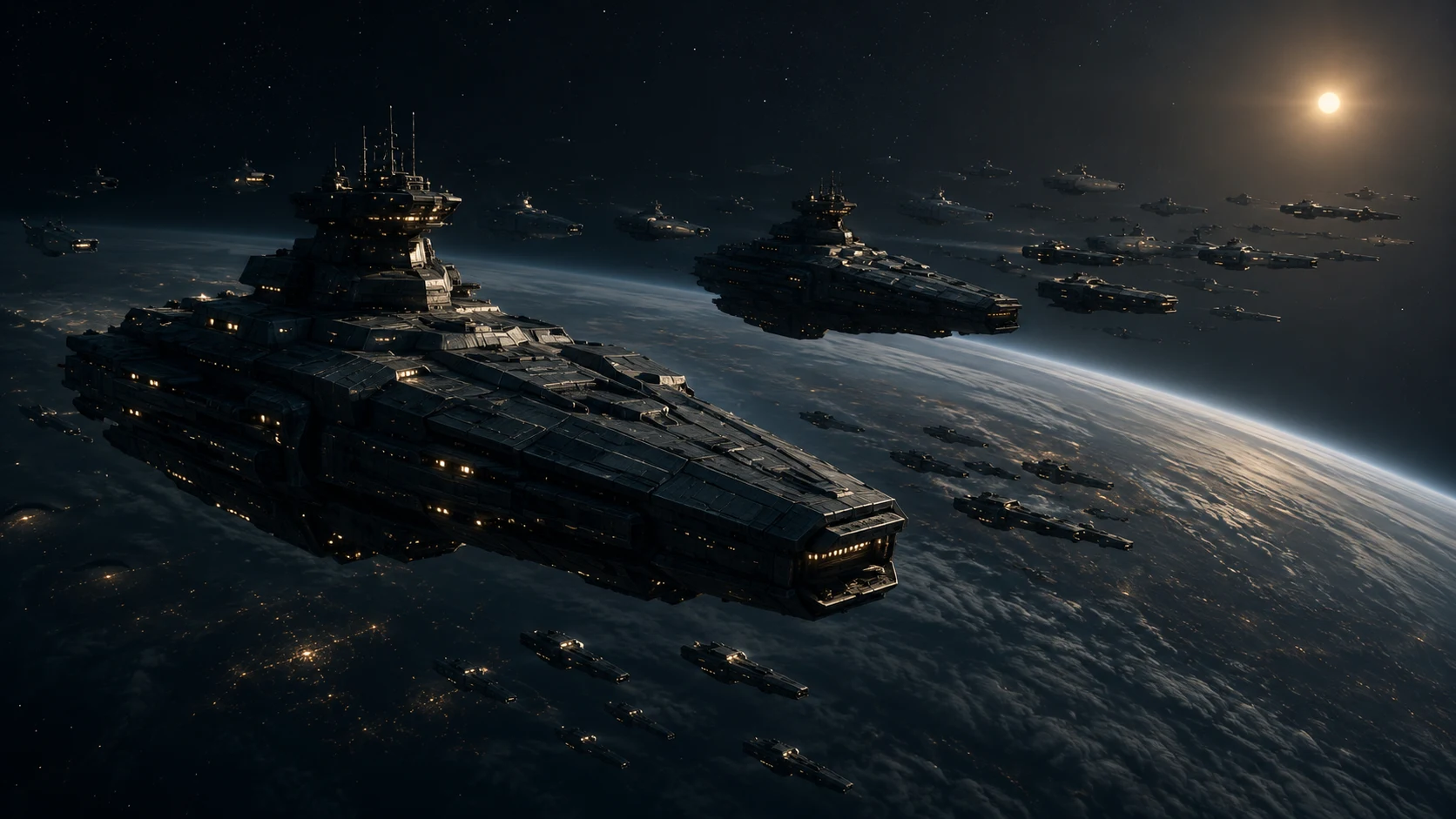
Military space opera is science fiction that combines the large canvas of space opera with the structures and pressures of military life. Fleets, stations, contested systems, empires, alliances, or interstellar wars may provide the scale, but the genre becomes distinctly military when command, training, doctrine, logistics, hierarchy, and responsibility materially shape what characters can do.
Space opera supplies the scale
Space opera is built for breadth: distant worlds, political blocs, dramatic technologies, large conflicts, and consequences that can reach beyond one crew or one planet. It does not have to be military. A space opera can centre explorers, diplomats, traders, families, or rebels.
The military branch asks what happens when that scale is navigated through organised forces. Orders travel down chains of command. Information may arrive late or incomplete. A captain can save a ship and still lose the strategic objective. A cadet can master procedure without understanding the political purpose behind it.
Why command matters
The strongest military science fiction is rarely just a sequence of battles. Command creates ethical and practical problems: who decides, who obeys, who carries blame, and how much uncertainty is acceptable when lives depend on the answer.
Common elements
- Fleets, task groups, academies, military governments, or structured chains of command.
- Strategic decisions operating at a larger scale than a single duel or firefight.
- Training, rank, doctrine, discipline, and the difference between procedure and judgement.
- Political goals that do not always match the immediate military problem.
- The cost of incomplete information, secrecy, propaganda, or erased history.
- Characters who must act before they can know whether the decision was right.
Military science fiction and military space opera
“Military science fiction” is the broader term. It can be tightly focused on one unit, one campaign, or near-future warfare. “Military space opera” usually implies a wider interstellar or imperial canvas and a stronger sense of political scale. Many books comfortably belong to both.
Two different entry points at Wonders Workshop
The Pale Sequence is presented as a six-book military space opera mystery about returned warships, erased wars, and the struggle over who controls history. Its military structure is tied to investigation and institutional memory.
Orbital Command Academy approaches military science fiction through formation: cadets, command, loyalty, pressure, strategy, and imperial conquest. One series begins with the consequences of a military past; the other begins inside the institution that creates future commanders.
What readers can look for
A useful test is whether the military system changes the story. If the same plot could happen with the ranks and institutions removed, the military element may be mostly cosmetic. When doctrine, authority, responsibility, and strategic consequence continually shape character choices, the genre is doing its real work.