
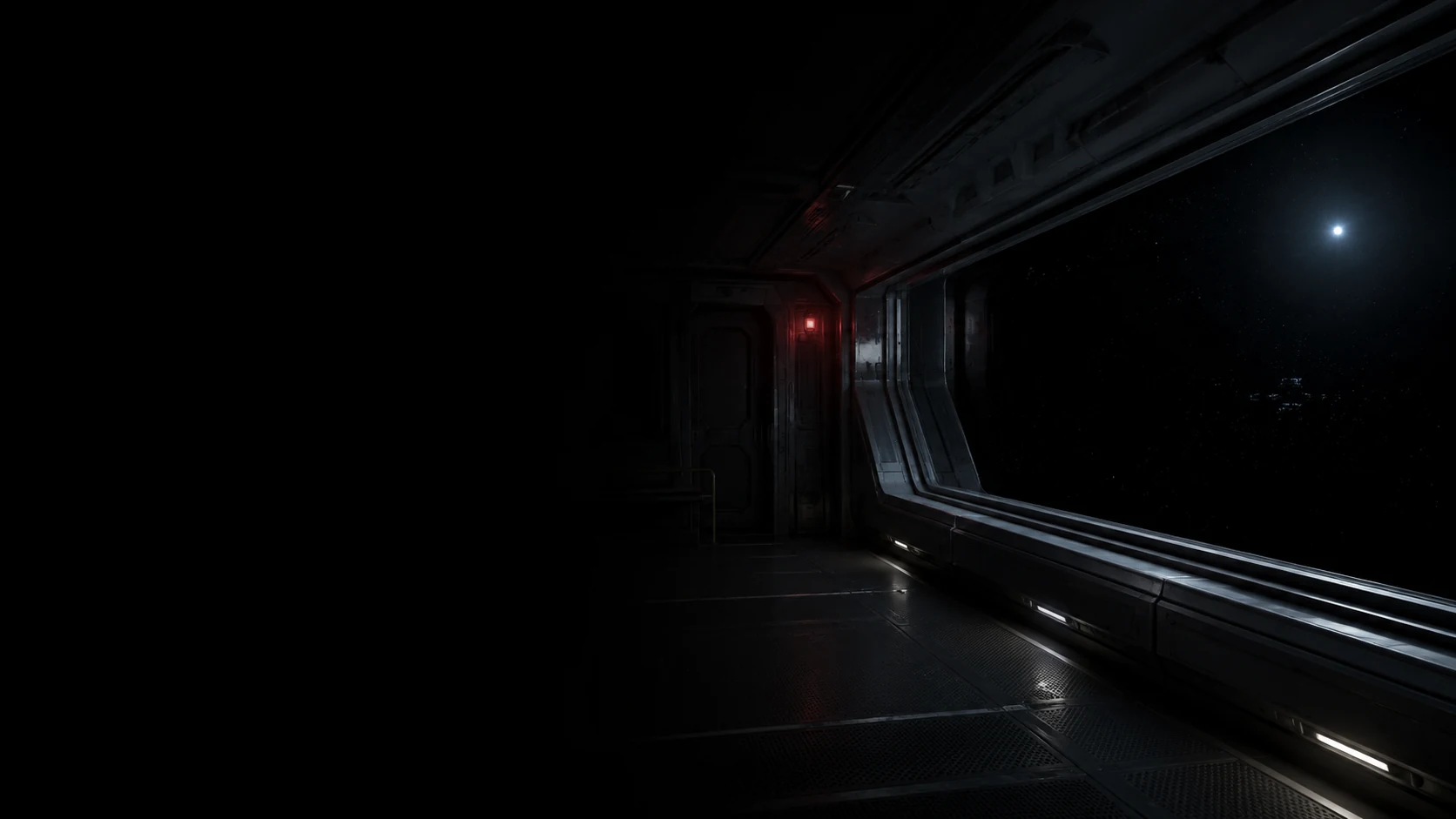
Featured image. An empty deep-space corridor faces the blackness outside.
A monster is reassuring in one very specific way: it gives fear a shape. You can point at it, run from it, lock a door, fire a weapon, count its footsteps, or at least understand where the danger is coming from.
Deep space can be more frightening when it refuses to do any of those things. The corridor is empty. The cameras show nothing. A warning light is real, but nobody knows why it is on. A message from home has not arrived. A system is using slightly more oxygen than it should.
Nothing is chasing you. The fear comes from having to act before you understand what is wrong.
Space is already hostile before horror adds anything
Horror stories set in ordinary places usually need to introduce danger. Space does not. A spacecraft is a small artificial environment surrounded by conditions humans cannot survive unprotected. Air, pressure, temperature, water, and radiation protection are not background conveniences; they are active systems keeping the crew alive.
NASA treats deep-space exploration as a combination of hazards that include isolation and confinement, distance from Earth, radiation, altered gravity, and hostile closed environments. That changes the emotional baseline of a story. In a haunted house, the building might contain something dangerous. In deep space, the building is the only reason you are alive.
That creates a perfect horror contradiction: the hull protects you from vacuum and radiation, but it also prevents you from leaving. The same sealed door can protect one compartment while cutting another person off. A locked hatch can mean safety or death depending on which side you occupy.
NASA's research on long-duration missions also treats isolation, confinement, and limited privacy as genuine behavioral-health concerns. Future deep-space crews may live together for years in environments with very little personal space. For horror, that matters because escape is not merely difficult. It may be physically impossible.
Distance removes the comforting idea of rescue
Many terrestrial horror stories preserve one hidden reassurance: somewhere beyond the immediate setting, normal life continues. A road exists. A town exists. Police and hospitals exist. Morning will bring other people.
Deep-space horror can erase that background. NASA has described distance from Earth and communication delay as fundamental problems for future exploration. Even a Mars crew cannot depend on an instant conversation with mission control; at interstellar distances, separation is measured in years rather than minutes.
That changes the meaning of an emergency message. A distress call is no longer a promise that help is coming. It may simply become a record of what happened. Communication still exists, but it stops feeling like conversation: you describe a crisis, and the answer may arrive after the crisis has changed.
The farther a crew travels, the more every message from Earth becomes a message from the past. In horror, that psychological distance matters almost as much as the physical one.
Silence becomes evidence
In ordinary life, silence often means nothing. On a spacecraft, machinery and people are expected to behave in patterns. Fans run. Pumps cycle. Computers respond. Crew members answer calls. When one expected signal disappears, absence becomes information.
The engine did not make the sound it usually makes. Another module did not acknowledge the check-in. A relay should have transmitted twelve minutes ago. None of those events proves danger, but each creates a gap that demands explanation.
This is why space horror does not need constant noise. Silence can function like a negative clue: something is frightening precisely because it failed to happen.
Uncertainty makes the audience do the terrifying work
Psychological research on intolerance of uncertainty helps explain why ambiguous threats can be emotionally potent. People differ in how strongly they react to uncertainty, but higher intolerance of uncertainty has been associated with greater threat expectancy and negative affect in ambiguous situations.
Horror exploits the same structure. A visible monster provides information: there is the threat. An unexplained system failure opens several incompatible possibilities. Is the sensor broken? Is the oxygen actually falling? Did someone alter the settings? Is there damage outside the hull? Is the crew misreading the data?
Every explanation demands a different response, so uncertainty keeps all of them alive at once. The audience begins scanning the dark window, listening to the radio static, watching the background of the frame, and noticing the empty chair. Before a creature appears, the viewer supplies possible creatures, accidents, conspiracies, and failures from their own imagination.
That is why an empty corridor can hold tension for so long. The corridor itself is not frightening. The unresolved possibility space is.
The black outside the window has no useful scale
Space also attacks one of the tools humans use to feel oriented: scale. A room has walls. A street has buildings. Mountains provide distance cues. Even the ocean has a horizon. Deep space can look almost featureless.
A star may appear as a point whether it is relatively nearby or incomprehensibly distant. Blackness does not tell the eye where it ends because, in any useful human sense, it does not. The ship is measurable; everything outside it is not.
Horror thrives on that mismatch. A familiar, engineered object is surrounded by an environment too large to emotionally process, and the window becomes less like a view than a reminder of how little of the setting can ever be controlled.
Isolation makes small problems feel enormous
NASA studies isolation and confinement because long missions can affect sleep, morale, decision-making, team cohesion, and psychological well-being. That does not mean astronauts inevitably become unstable; real crews are selected, trained, and supported precisely because these challenges are known and actively managed.
Fiction can still use the underlying reality. When six people are the only available technicians, doctors, witnesses, and friends, an ordinary disagreement carries more weight. You cannot leave the workplace, change social circles, or call someone from outside to settle the argument. A minor conflict remains trapped in the same habitat as everyone involved.
Isolation also makes ambiguous danger harder to disprove. One crew member hears a sound nobody else heard. A sensor reports a value that returns to normal before it can be checked. A camera drops three frames. A message seems slightly different from the sender's usual tone. Any one event can be dismissed; a pattern may exist, or a frightened person may be creating one.
The setting offers no independent stranger who can simply walk in from outside and resolve the uncertainty. That makes verification itself part of the suspense.
Systems can fail without becoming villains
One of the strongest forms of space horror is completely impersonal. A seal degrades. A filter clogs. Software behaves unexpectedly. Radiation damages equipment. A micrometeoroid strikes something nobody can easily reach.
There is no evil intelligence behind any of it, and that can make the situation more disturbing rather than less. A villain can sometimes be negotiated with, understood, escaped, or defeated. Physics does not care whether the protagonist deserves to live.
There is also an irony in creature-based space horror: once the monster becomes the central threat, the universe contracts around it. The problem is now in this corridor, this ventilation shaft, this laboratory. The audience gains a tactical map.
When the threat remains unknown, the scale stays open. The problem could be inside the ship or outside it, mechanical or psychological, biological or simply the consequence of being too far from help. Nothing has closed the possibility space yet.
Good space horror makes normal procedure frightening
The genre becomes especially effective when it corrupts routine rather than abandoning realism. A checklist is frightening because one item does not match yesterday's result. A scheduled communication is frightening because nobody answers. A maintenance hatch is frightening because it must be opened even though the crew does not know what caused the pressure drop behind it.
Normal procedure gives the audience a baseline. Horror begins when reality deviates from that baseline by one small degree.
This also sharpens what 'fear of the unknown' really means. The important question is not simply what might be out there. It is what information the characters need in order to act, and why they cannot obtain it. They need to know whether the warning is real, why the signal stopped, whether the sound came from inside or outside the hull, and whether the remaining-time estimate can be trusted.
The horror comes from being forced to make irreversible decisions before uncertainty disappears.
Nothing is chasing you - and that is the point
A creature can be terrifying, but space does not need one. Deep-space horror already contains confinement, distance, fragile life-support systems, delayed communication, incomplete information, and an environment indifferent to human survival.
Remove the visible monster and those things stop being background scenery. They become the threat. The empty corridor matters. The unanswered message matters. The black window matters.
And when nothing appears behind the glass, the story leaves one final possibility open: maybe there was never anything out there. Maybe space itself was enough.
Sources & further reading
- NASA - Risk of Behavioral Changes and Psychiatric Disorders: https://www.nasa.gov/reference/risk-of-behavioral-changes-and-psychiatric-disorders/
- NASA Human Research Program - Hazard: Isolation and Confinement: https://www.nasa.gov/hrp/hazard-isolation-and-confinement/
- NASA - About Human Factors and Behavioral Performance: https://www.nasa.gov/reference/about-human-factors-and-behavioral-performance/
- NASA - Human Spaceflight Hazards overview, including isolation, distance from Earth and hostile/closed environments: https://www.nasa.gov/ochmo-hmta-human-spaceflight-hazards/
- Chen & Lovibond (2016), Behaviour Therapy - Intolerance of uncertainty, ambiguity and threat appraisal: https://pubmed.ncbi.nlm.nih.gov/26763496/
- Oglesby & Schmidt (2017), Behaviour Therapy - uncertainty and anticipatory anxiety: https://pubmed.ncbi.nlm.nih.gov/28577580/