
Featured image. A sealed manuscript waits inside a locked archive cabinet.
There is a door you are not allowed to open.
A book you are not supposed to read. A name that must not be spoken. A ritual deliberately removed from the official archive. A sealed room, a censored page, a map with one place scratched out, a question the oldest scholar refuses to answer.
Stories hardly need to explain why these things matter. The prohibition does most of the work.
As soon as a piece of information is marked forbidden, it changes. It is no longer simply unknown. It becomes a gap with a boundary around it - and boundaries make people notice what lies beyond them.
That is why forbidden knowledge is one of fantasy and horror's most durable engines. It turns curiosity into action and information into danger.
Curiosity begins with a gap
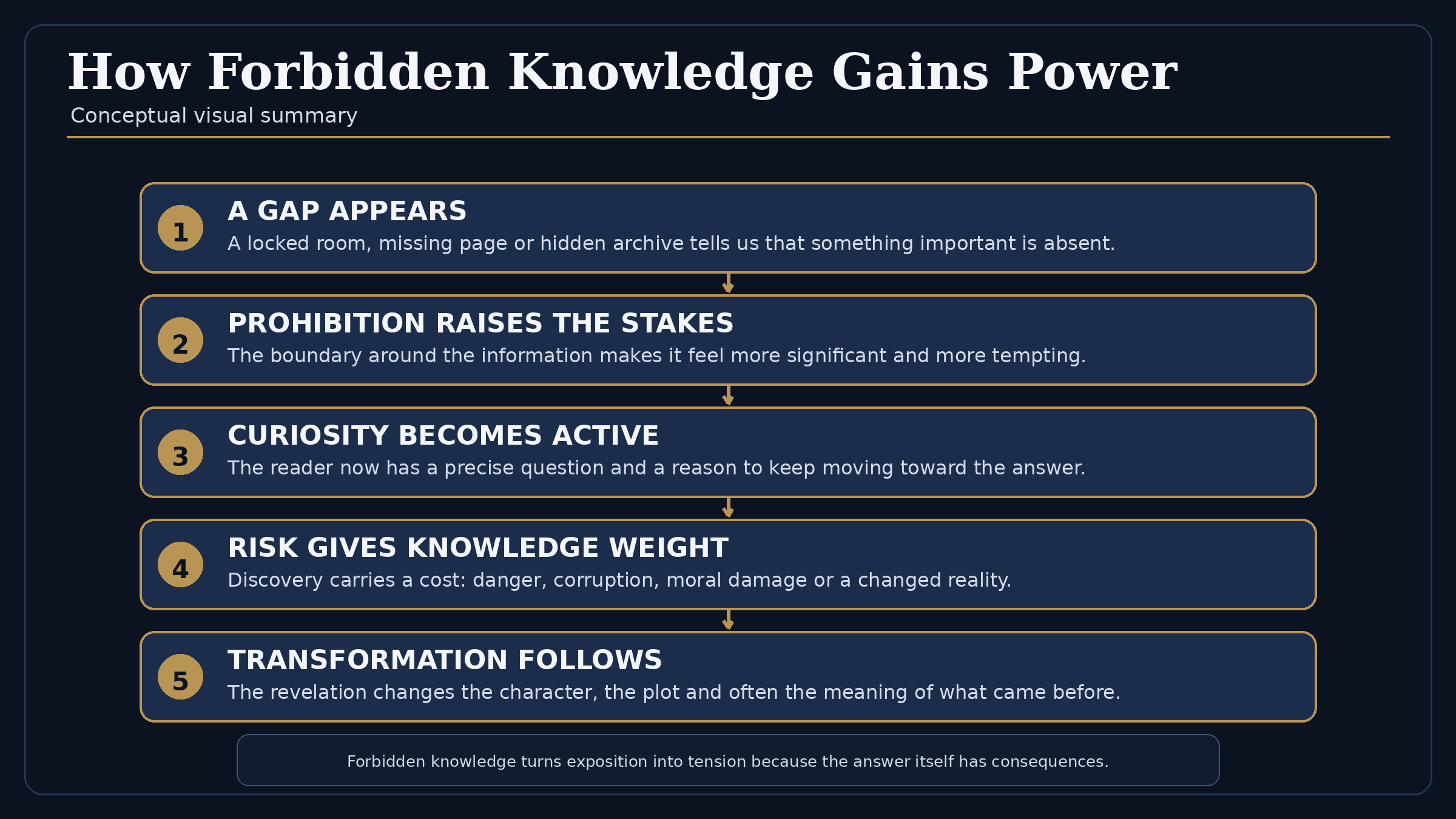
Figure 1. Forbidden knowledge becomes powerful when curiosity, prohibition, risk and transformation reinforce one another.
Psychologists often describe curiosity as a response to a perceived gap between what we know and what we want to know. George Loewenstein's influential information-gap theory argues that awareness of missing information can create a kind of cognitive tension that motivates us to close the gap.
That helps explain why a locked archive is more interesting than an empty wall.
The story gives us enough information to recognize that something is missing. We know there is a room. We know someone locked it. We know the key exists. We may even know that everyone becomes uncomfortable when the room is mentioned.
Now the gap has a shape.
A good forbidden-knowledge story does not hide everything. It reveals just enough to make ignorance feel incomplete.
The prohibition makes the missing information feel more important
Unknown information can be trivial. Forbidden information rarely feels trivial.
A warning acts like a label: this matters.
Do not read the last page. Do not ask what happened beneath the observatory. Do not translate the inscription. Never use the thirteenth name.
The prohibition quietly promises that the answer will change something.
This is one reason restrictions can intensify attention. Psychological reactance research examines how people respond when they feel a freedom is being limited. The effect is not a magical law that every ban makes everyone disobey, but restrictions can create resistance - especially when the restriction feels illegitimate or threatens autonomy.
Fiction turns that tension into a clean dramatic mechanism. The character is not merely curious. Someone has told them they are not permitted to know.
The forbidden room is older than modern horror
The pattern appears again and again in myth and folklore.
In the Bluebeard tale, the wife is given access to an entire castle except for one forbidden room. The forbidden room becomes the center of the story precisely because everything else is available.
Pandora's jar is a different structure but works through a related idea: a contained thing is opened, and knowledge or consequence cannot simply be put back.
These stories survive because they understand a powerful narrative fact: one boundary can reorganize an entire world.
The castle stops being a castle and becomes the place containing the forbidden room. The jar stops being an object and becomes the thing that must not be opened.
Forbidden knowledge promises transformation
Ordinary information adds to what a character knows.
Forbidden knowledge usually changes who the character can still be.
Once the detective learns the family secret, they cannot return to the earlier version of the case. Once the scholar understands the ritual, ignorance is gone. Once the protagonist discovers that the empire was built on a lie, loyalty becomes a choice rather than a default.
This irreversibility is essential.
A dangerous sword can be put down. A door can be closed. Knowledge is harder to return.
That gives forbidden knowledge a special kind of menace: the threat may not be what the information does to the world. It may be what knowing does to the knower.
Horror asks whether information itself can be dangerous
Some modern discussions use the term information hazard for information that can create harm simply by being known, distributed or acted upon. Real-world debates about sensitive scientific or technical information are obviously different from supernatural fiction, but the concept clarifies why horror is fascinated by dangerous truths.
A fictional information hazard might be a ritual that works once someone knows the sequence, a discovery that destabilizes society, a name that attracts something when understood, or a revelation that destroys a person's ability to perceive reality normally.
The fear is unusually intimate.
The monster does not need to break into the room. The dangerous thing is already in your mind.
The best forbidden knowledge has a price
If the secret produces no consequence, the prohibition eventually feels decorative.
A strong version creates a cost that is connected to the knowledge itself.
The cost might be social: the character becomes a traitor simply by knowing what the regime hid.
It might be psychological: a truth destroys a comforting identity.
It might be political: revealing the archive could start a war.
It might be metaphysical: understanding the forbidden theory changes what can perceive you.
Or the cost may be moral: the character can solve the problem only by using knowledge that should never become normal.
The point is not that curiosity must be punished. The point is that discovery should alter the available choices.
A forbidden archive is more powerful than a random secret
The archive is such an effective image because it implies selection.
A random secret might have been lost by accident. An archive suggests that someone decided what should be preserved, classified, hidden or erased.
That immediately adds a second mystery.
What is the secret?
And who decided that you should not know it?
This is where forbidden knowledge becomes political. Censorship, restricted libraries, erased histories and classified records all turn information into a question of authority.
The person controlling the archive is not only controlling facts. They are controlling which version of reality other people are allowed to build.
The reader becomes complicit
Forbidden-knowledge stories also exploit a delicious hypocrisy.
We can see that the character should probably stop.
We also want them to continue.
When the heroine reaches the locked room, readers rarely hope she respectfully walks away and spends the rest of the novel gardening.
We want the key in the lock.
That tension makes the audience complicit in the transgression. The protagonist's curiosity becomes ours, but the protagonist has to pay the cost.
Fantasy and horror can therefore give readers the pleasure of opening the forbidden door while keeping the consequences safely inside the story.
Why partial answers are often better than total explanations
Forbidden knowledge becomes weaker when it is explained too completely.
The first revelation should close one gap and open another.
The archive proves the king lied - but not why. The ritual works - but the notes end before the final consequence. The sealed room contains evidence - but the evidence points to a history larger than the room.
Curiosity research helps explain why this works. Curiosity needs enough knowledge for us to recognize what we do not know. If everything is completely opaque, there may be nothing specific to pursue. If everything is explained, the tension collapses.
The most effective forbidden knowledge lives between those states.
We understand enough to become afraid of the missing piece.
Forbidden knowledge turns exposition into conflict
Fantasy often needs to explain complex worlds: old wars, magic systems, extinct civilizations, hidden institutions, political history.
The danger is exposition that feels like homework.
Forbidden knowledge solves part of that problem by making information contested.
A history lesson becomes evidence someone tried to destroy. A magic-system explanation becomes a prohibited technique. A genealogy becomes proof that the wrong person sits on the throne. A scientific lecture becomes a theory the academy banned after an experiment disappeared.
The reader still learns about the world, but the learning is attached to desire, opposition and consequence.
Exposition becomes plot.
The unknown should not always be evil
There is a trap, however.
If every forbidden book contains demons and every banned ritual destroys the user, the story accidentally proves the censor correct.
More interesting worlds allow ambiguity.
Perhaps the knowledge was forbidden because it is genuinely dangerous. Perhaps it was suppressed because it threatens the people in power. Perhaps both are true.
That uncertainty matters because real ethical questions about knowledge are rarely solved by a simple rule that says either 'all information must be free' or 'dangerous questions must never be asked.' Philosophers of science continue to debate whether some research can create harms serious enough to justify restrictions, while also recognizing the importance of freedom of inquiry.
Fantasy and horror can dramatize that argument without pretending it has an easy answer.
The strongest version changes the meaning of what came before
A good revelation is not merely surprising.
It reorganizes earlier information.
The locked room explains why the father never entered the west wing. The hidden document changes the meaning of the academy's founding ceremony. The censored star map reveals that the missing system was not destroyed - it was removed from official memory.
Forbidden knowledge feels powerful because once it is revealed, the story cannot return to its previous interpretation.
The reader has crossed the boundary too.
That is why we keep opening the door
Forbidden knowledge works because it combines several forces at once.
There is a visible gap in what we know. A prohibition marks the gap as important. Restriction creates tension around choice. Discovery promises transformation. And the possibility of consequence makes information feel physical.
The best examples do not simply tell us that knowledge is dangerous.
They make us need to know why.
That is the trick behind the sealed archive, the forbidden room and the book nobody should read.
The warning is supposed to stop the story.
Instead, it starts it.
Sources & further reading
- Kidd & Hayden (2015), The Psychology and Neuroscience of Curiosity - review of information-gap theory and curiosity as motivation for information seeking: https://pmc.ncbi.nlm.nih.gov/articles/PMC4635443/
- Ryakhovskaya, Jach & Smillie (2022), Journal of Research in Personality - curiosity as interest vs. deprivation and links to information seeking: https://www.sciencedirect.com/science/article/pii/S009265662100101X
- Frontiers in Psychology (2015) - experimental work on psychological reactance under legitimate vs. illegitimate restrictions: https://www.frontiersin.org/journals/psychology/articles/10.3389/fpsyg.2015.00632/full
- Encyclopaedia Britannica / historical summary via Wikisource - Bluebeard and the forbidden-room structure: https://en.wikisource.org/wiki/1911_Encyclop%C3%A6dia_Britannica/Bluebeard
- Hesiod, Works and Days - Pandora and the jar (classical text translation): https://www.theoi.com/Text/HesiodWorksDays.html
- Kourany (2022), Philosophy of Science - contemporary debate over whether some knowledge/research may warrant restriction because of harms: https://www.cambridge.org/core/journals/philosophy-of-science/article/should-some-knowledge-be-forbidden-the-case-of-cognitive-differences-research/4D6C6733CC40B5A1646AF90659D07173