
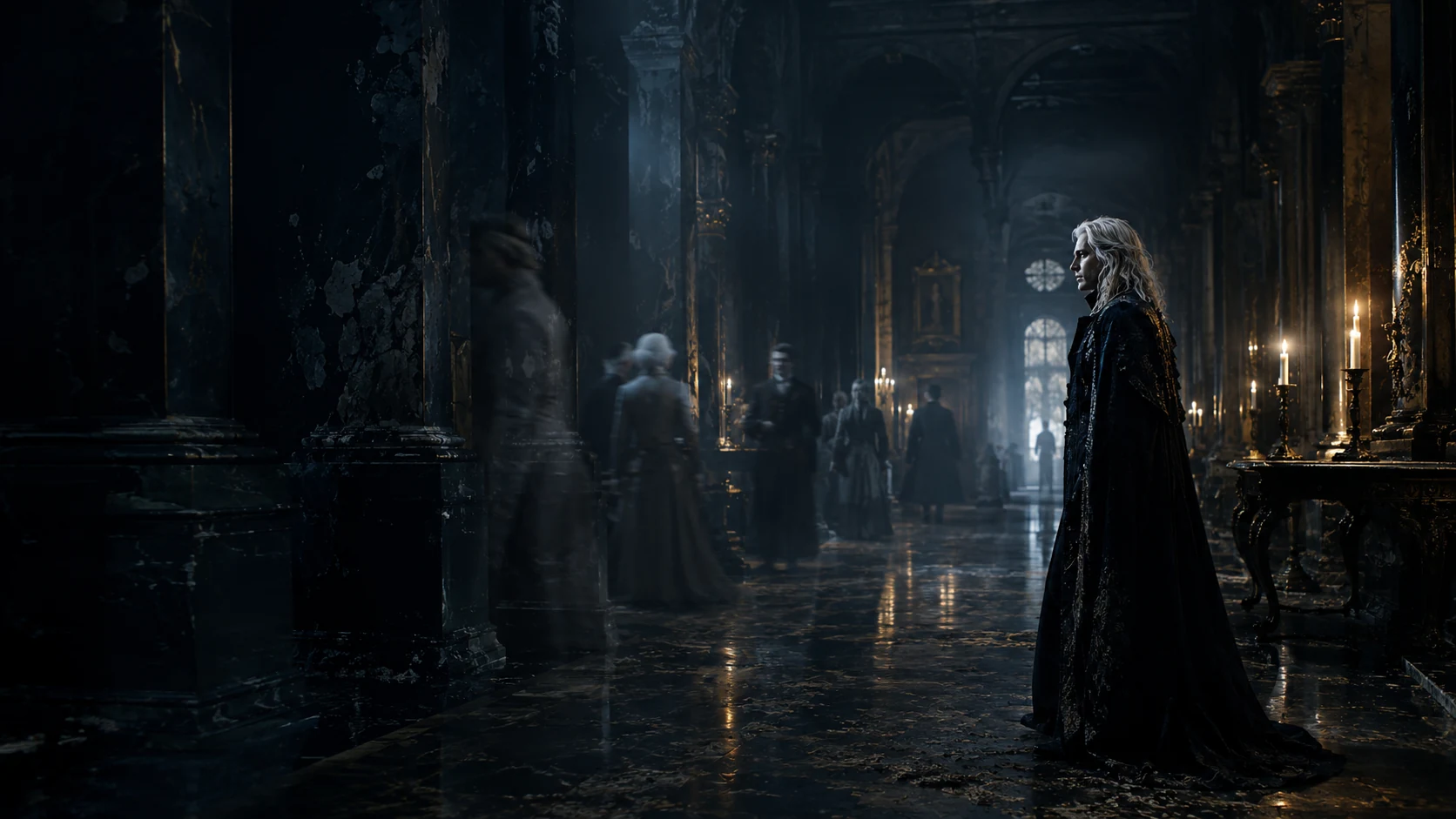
Featured image. An ageless figure remains while generations blur through an ancient hall.
Immortality should be the easiest fantasy to sell. No final illness. No last day. No deadline. Enough time to learn every language, cross every ocean, read every book, master every craft and wait for the future to become stranger than anything the present can imagine.
Yet stories are suspicious of eternal life. Again and again, the wish curdles. The immortal becomes lonely, bored, detached, monstrous, trapped or desperate for an ending that will not come.
That pattern is much older than modern fantasy. Ancient mythology already understood that “never dying” and “living well forever” are not the same gift. Philosophy later turned the same fear into a question: if a human life had no end, would it still feel like a human life at all?
Fiction keeps returning to immortality because it exposes something uncomfortable. Death is frightening—but limits are also part of what gives choices their weight.
The oldest warning: immortality is not the same as eternal youth
One of the clearest early warnings comes from the Greek story of Tithonus. The dawn goddess Eos asks Zeus to make her mortal lover immortal, but she fails to ask that he remain young. He continues to age even though he cannot die.
The horror of the story is almost administrative. The wish is technically granted. The wording is wrong.
That distinction still shapes modern stories. “Immortal” can mean many things: impossible to kill, unable to age, endlessly regenerating, resurrected after death, or simply excluded from the ordinary human lifespan. Each version creates a different nightmare.
A character who lives forever but still deteriorates fears the body. A character who heals forever fears imprisonment. A character who remains physically young fears time itself. The curse changes, but the structure is the same: remove death without solving the rest of human existence and the gift becomes unstable.
Everyone else becomes temporary
The most obvious cost of immortality is grief, but fiction makes it worse than ordinary grief. A mortal loses people and knows that loss is part of the same condition everyone shares. An immortal can become the only constant person in a world made entirely of departures.
Friends age. Lovers die. Children become old. Nations disappear. Languages shift. Houses are demolished. The street where a character grew up may vanish beneath a city that no longer remembers it existed.
Eventually attachment itself becomes dangerous. If every deep relationship is guaranteed to end while you continue, emotional distance can look like self-defense. That is why so many immortal characters become cold long before they become cruel.
The interesting version of the trope is not “living forever makes you evil.” It is “what habits would a person develop after surviving loss hundreds of times?” A monster may begin as someone who simply learned not to care because caring hurt too much.
Memory becomes a problem of identity
A human identity depends partly on continuity: the sense that the child, teenager, adult and older person are different versions of the same self. Stretch that continuity across five hundred years and the idea becomes harder to hold together.
An immortal might remember everything, in which case the past could become unbearably crowded. Or memory might work more like ours: selective, reconstructive and incomplete. Then the problem changes. What happens when a person has lived for a thousand years but can clearly remember only fragments of the first eight hundred?
At some point, the immortal may possess evidence of lives they no longer emotionally recognize as their own: portraits of forgotten lovers, letters written in a handwriting that is technically theirs, old crimes that feel as remote as history.
This is one reason immortality works so well in gothic and psychological fiction. It turns identity into an archive. The character is not only haunted by ghosts; they are haunted by previous versions of themselves.
Boredom is a philosophical problem, not just a plot device
The philosopher Bernard Williams famously argued that endless life could become intolerable if a person eventually exhausted the deep desires and projects that make continued life matter to them. The Stanford Encyclopedia of Philosophy summarizes the dispute as a major philosophical question: would immortality inevitably produce oppressive boredom, or could people continually develop new interests and remain meaningfully engaged?
There is no settled answer, which is exactly why fiction likes the problem.
A hundred extra healthy years is easy to imagine as valuable. Ten thousand years is harder. Eternity is different again. The issue is not simply running out of hobbies. It is whether novelty can continue to feel significant when there is always more time.
Urgency disappears. “Someday” becomes almost meaningless. A project delayed for twenty years has barely been delayed at all. A relationship can be postponed. A journey can wait another century. When time becomes unlimited, choosing now may become harder rather than easier.
A life without an ending may lose its shape
Stories have beginnings, middles and endings because shape creates meaning. Human lives are not novels, but we still understand them narratively: childhood, departures, commitments, turning points, consequences, legacies.
Philosophers of meaning have argued that an endless life might lose some of that shape. Even without boredom, an existence that simply continues forever risks becoming a sequence with no final form.
This is one reason fictional immortals often become obsessed with ritual. They collect objects, repeat anniversaries, revisit old places or preserve ancient rules. Ritual manufactures boundaries inside a life that no longer has a natural one.
The immortal needs chapters because time itself has stopped providing them.
Power accumulates faster than wisdom
Another reason immortality turns dark is practical: time is power.
Someone who can live for centuries can accumulate wealth, secrets, property, influence and specialized knowledge beyond any normal rival. Even a reasonably decent immortal could become socially dangerous simply because institutions are built around turnover. Kings die. Executives retire. Witnesses disappear. Political generations change.
An immortal does not.
Fantasy often turns this into the ancient ruler, hidden patron, vampire aristocrat or secret founder who has quietly shaped events for generations. The fear is not only supernatural strength. It is compounding advantage.
And long life does not automatically produce moral wisdom. A person can have five hundred years of experience while spending five hundred years reinforcing the same grievance.
The world stops feeling like home
There is another kind of horror that has nothing to do with boredom: displacement.
Imagine waking in the city where you were born and discovering that nobody speaks your first language. The religion of your childhood is a museum subject. The borders you understood disappeared centuries ago. Every song you loved sounds antique. Your name belongs to an era people romanticize incorrectly.
You are not traveling through history. History is traveling through you.
This can make the immortal one of fantasy’s loneliest figures: a person who survives every home they ever build. The longer they live, the more they become a foreigner everywhere.
Why immortals so often become monsters
The best immortal villains are not frightening because they cannot die. They are frightening because their relationship with consequence has changed.
Mortals know that time is scarce. We cannot undo everything. We cannot wait forever. We depend on other people because our abilities and lifespans are limited.
An immortal can begin to see mortal lives as brief events rather than equal lives. A fifty-year political plan may feel short. A human marriage may look temporary. A war that destroys one generation may appear survivable to someone who expects to witness five more.
That shift in scale can destroy empathy without requiring supernatural evil. The monster emerges when other people become temporary pieces in a game only one participant expects to finish.
The curse works because immortality exposes what mortality gives us
Fiction is not secretly arguing that death is wonderful. Most stories about immortality begin from the completely understandable wish for more life.
The curse appears because “more” eventually becomes “without limit,” and limits do more work than we notice.
They force priorities. They make promises costly. They make reunions precious. They make delay matter. They make a lifetime of devotion different from an afternoon of interest.
An immortal character allows a story to remove the deadline and watch what happens to meaning afterward.
Could immortality ever be a blessing?
Of course. Philosophers have pushed back against the idea that endless life must become boring. Human curiosity may be more renewable than pessimists assume. New people, art, science, relationships and worlds could create projects with no obvious endpoint.
Fiction can imagine healthy immortality too—but it usually has to solve several problems at once. The immortal needs a body that does not decay, a mind capable of adapting, relationships that are not condemned to one-sided loss, and enough change in the world to prevent eternity from becoming repetition.
In other words, the real fantasy is not immortality.
It is immortality without the consequences.
That is why the curse keeps returning
Immortality stories survive because they reverse one of humanity’s oldest wishes. They let a character receive exactly what everyone thinks they want, then ask whether the wish contained a hidden mistake.
Tithonus gets endless life without endless youth. The gothic immortal gets beauty without belonging. The ancient ruler gets time without equality. The lonely wanderer gets survival without home. The philosopher gets eternity and discovers that an infinite future may change the value of the present.
The question underneath all of them is not really “Would you like to live forever?”
It is harder than that.
What would have to remain human about you for forever to still feel like life?
Sources & further reading
- Stanford Encyclopedia of Philosophy — Death, section on whether never dying would be a misfortune: https://plato.stanford.edu/entries/death/
- Stanford Encyclopedia of Philosophy — The Meaning of Life, discussion of immortality, boredom, repetition and narrative shape: https://plato.stanford.edu/entries/life-meaning/
- Karl S. Guthke, Life without End — Cambridge University Press overview of literary immortality as blessing and curse: https://www.cambridge.org/core/books/life-without-end/5285604073B00D477456580A8D91B55A
- Theoi Classical Texts / Homeric Hymn to Aphrodite — Tithonus receives immortality without eternal youth: https://www.theoi.com/Text/HomericHymns3.html