
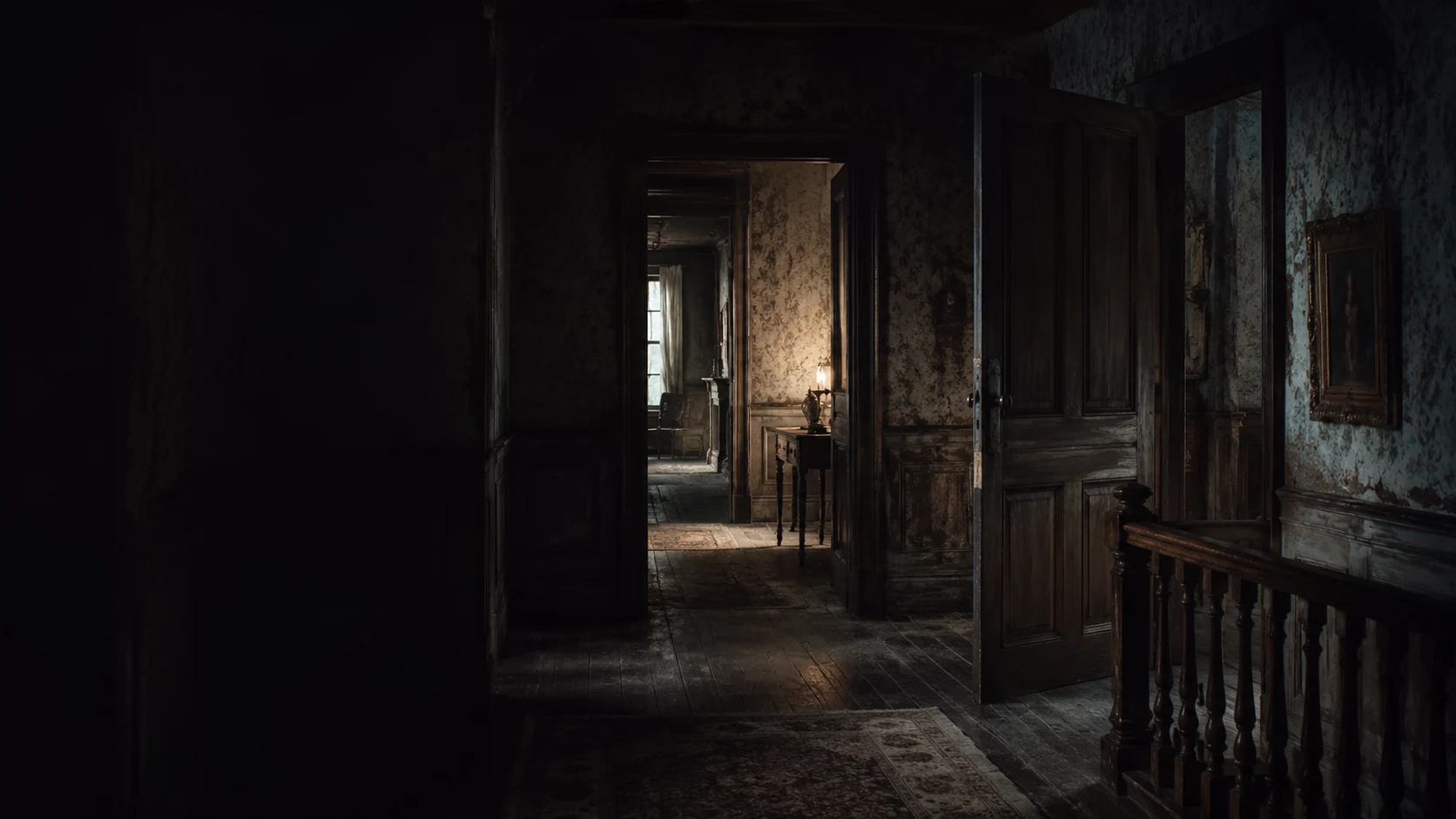
Featured image. An old house corridor hides rooms and sight lines beyond immediate view.
The floor creaks. The corridor is darker than it should be. A staircase turns before you can see where it ends. There is an old door at the far side of the hall, and even though you know perfectly well that nobody is standing behind it, you keep looking at it anyway.
Nothing supernatural has happened.
That is what makes the feeling interesting.
Old houses are unusually good at producing unease before a ghost, murderer or monster enters the story. They can do it with architecture alone. The effect comes from a collision between two ideas: a house is supposed to be one of the most familiar and controllable spaces in human life, yet an unfamiliar old house is full of incomplete information.
We know what a home is. We do not know this home.
A house is supposed to be safe
Domestic space carries expectations. Doors should lead somewhere understandable. Stairs should connect recognizable levels. Bedrooms, kitchens and living rooms belong to a mental category we have used since childhood.
That familiarity matters because gothic unease often begins by damaging something ordinary rather than introducing something completely alien.
The idea is closely related to the uncanny: the disturbing sensation created when something familiar becomes strange, unstable or difficult to classify. Architectural writing on the gothic has repeatedly pointed out how effective houses are at producing this effect because domestic space is normally associated with safety, identity and private life.
A cave can be frightening because it is unknown. A house can be frightening because it should not be.
Old houses give us less visual certainty
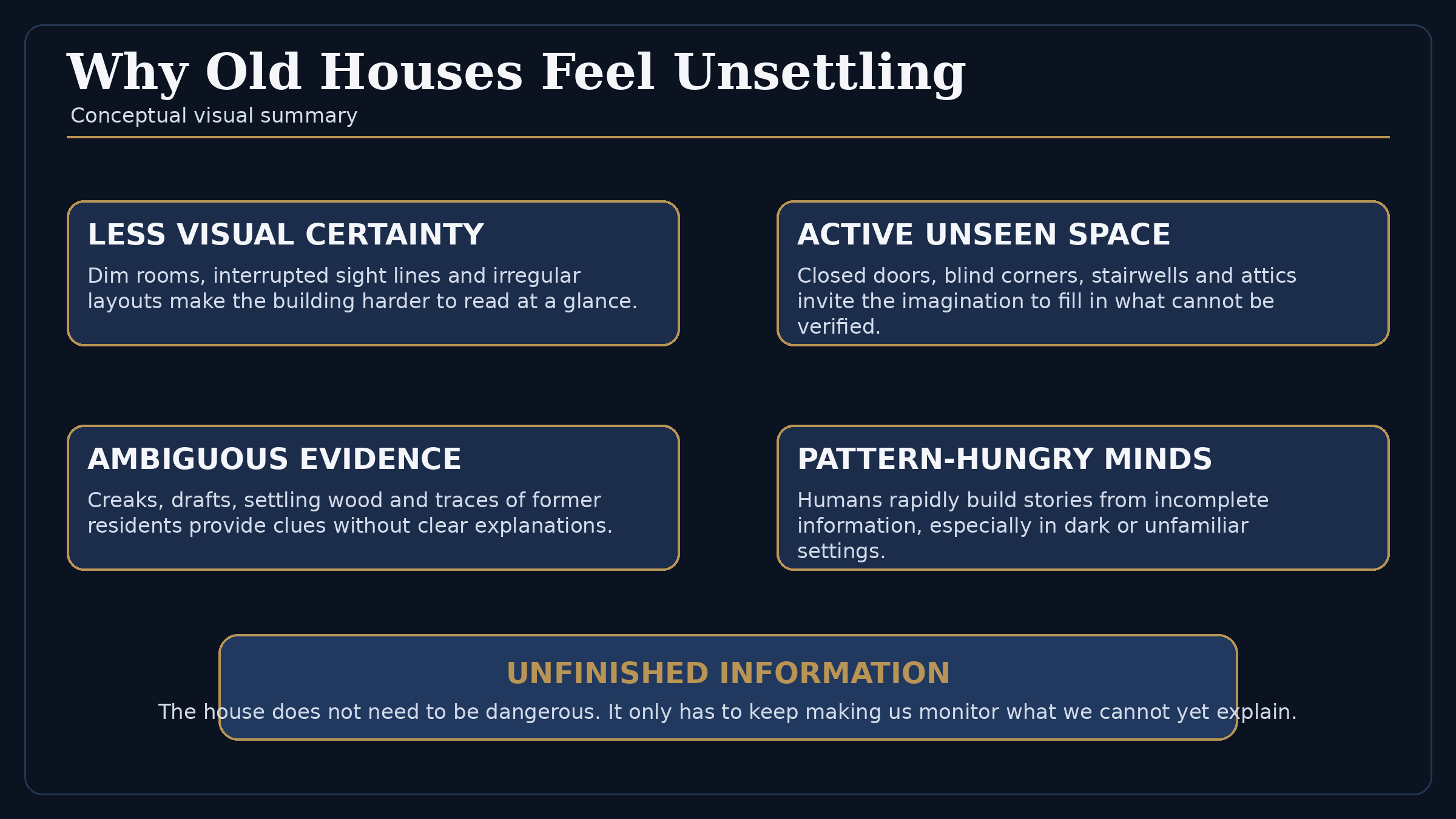
Figure 1. Old houses often feel eerie because several forms of uncertainty accumulate at once.
One reason is extremely practical: many old houses are difficult to read at a glance.
Long corridors, deep rooms, heavy doors, landings, alcoves, staircases, thick walls and irregular additions create interrupted sightlines. You cannot see the entire route ahead. A doorway reveals only part of another room. A staircase disappears around a turn. A hall ends in darkness.
Environmental psychology has studied how visibility affects our response to space. Research using prospect-refuge ideas has found that environments with poor visual prospect and many possible hiding places can be experienced as less restorative and more threatening than spaces with clearer views.
The point is not that humans possess a magical detector for haunted architecture. It is simpler: uncertainty demands attention.
When we cannot easily see what is ahead, our brains have more work to do.
The unseen part of a room becomes active in the imagination
A closed door is physically boring. Psychologically, it is unfinished information.
The same is true of the corner beyond the staircase, the attic above the ceiling, the basement behind the utility door and the section of hallway that falls outside the light.
A visible empty room tells you something. An invisible room leaves possibilities open.
This is where architecture and storytelling begin to overlap. Mystery can make an environment attractive because it suggests that more information is available if we move deeper into the space. But mystery becomes uncomfortable when it arrives without enough legibility or control.
The old house gives us both impulses at once: look closer and do not go in there.
Darkness removes information before it adds fear
Darkness is one of horror's oldest tools, but its first effect is informational.
Low light removes edges, depth, color and detail. A coat on a chair becomes a human shape for half a second. A doorway becomes a black rectangle. Reflections in old glass become difficult to interpret. The sound of a settling wall seems more important because vision is no longer giving us a complete picture.
The brain fills gaps quickly. Most of the time it corrects itself just as quickly.
That tiny interval - the moment when the shape might be a person before becoming a coat again - is enough to produce tension.
An old interior intensifies the effect because the surfaces are already visually complex: patterned wallpaper, carved wood, mirrors, curtains, portraits, moldings and furniture create more ambiguous shapes than a bright, minimal room.
The building makes noises because buildings move
Old houses are rarely silent.
Wood expands and contracts as temperature and humidity change. Pipes move. Heating systems click. Wind alters pressure around windows and chimneys. Floorboards flex. Roof structures respond to weather. Water travels through drains.
None of this requires anything supernatural, but the timing matters.
A sound without an immediately visible source is harder to dismiss than a sound we watch being produced. In daylight, a radiator clicking is a radiator clicking. At two in the morning, a single noise from another floor first arrives as a question.
The house provides an event before it provides an explanation.
Age leaves evidence of people who are no longer there
New houses usually tell a short story. Old houses accumulate layers.
A blocked doorway suggests a previous floor plan. Different wallpaper appears inside a closet. A height mark remains on a doorframe. A fireplace no longer works. A servant stair leads somewhere the modern layout does not seem to need. An old photograph shows the same room arranged around different lives.
These details are not frightening by themselves. They are reminders that the building existed before the current observer and will probably exist after them.
That gives an old house a kind of psychological depth. You are not simply standing in a room. You are standing in a place that has hosted private events you cannot reconstruct.
The missing information invites narrative.
We are extremely good at inventing explanations
Humans do not enjoy unexplained patterns for long.
A noise, a locked door, an abandoned object or an unusual architectural feature produces a small gap in understanding. The mind immediately starts offering possibilities.
Usually the explanation is mundane. Sometimes the imagination supplies a better one.
This does not mean people literally believe every old house is haunted. It means ambiguous spaces are unusually fertile storytelling machines.
A narrow staircase becomes 'the staircase nobody uses.' A sealed room becomes 'the room they closed after something happened.' A portrait becomes evidence that a family stayed too long.
The gothic does not create this tendency. It weaponizes it.
Old architecture can feel out of time
Another source of unease is temporal mismatch.
A Victorian house, medieval manor or decaying farmhouse carries design assumptions from a world that no longer exists. Room hierarchy, servant circulation, heating, privacy, lighting and furniture may all reflect social habits that feel unfamiliar to a modern visitor.
Architectural discussions of the uncanny often emphasize this quality: buildings from another era can feel recognizable as houses while simultaneously expressing a domestic culture that is no longer ours.
The result is a strange double recognition.
We understand the object.
We do not completely understand the life it was built to contain.
Why asymmetry and irregularity matter
Perfectly regular space is usually easier to predict.
Old houses often grow by addition. A wing is built later. A doorway is moved. A staircase changes direction. A room becomes a corridor. Rooflines meet awkwardly. Exterior windows do not always explain the interior plan.
This irregularity gives the building character, but it also makes mental mapping harder.
Environmental preference research often uses concepts such as coherence, complexity, legibility and mystery to describe how easily people can understand a place and how strongly it invites exploration. Mystery and complexity can be pleasurable when a space still feels navigable. When legibility collapses, exploration can become vigilance.
That distinction is practically the blueprint of a good haunted-house story.
The house does not need to be dangerous to make us monitor it
Fear is not always a full alarm response. Sometimes it is simply sustained attention.
You listen for the next creak. You check the dark doorway twice. You notice where the exit is. You keep part of your attention on the staircase while talking to someone in another room.
That low-level monitoring is enough to change the emotional tone of a place.
A comfortable home lets us stop paying attention to the architecture. An unsettling house keeps reminding us that the architecture exists.
This is why horror can delay the ghost
The strongest haunted-house stories often understand that revealing the supernatural too quickly wastes the building.
Before anything impossible happens, the house can already establish uncertainty through distance, darkness, sound, repetition and incomplete visibility.
That is why an empty hallway can be more frightening than a monster standing in it.
A monster answers the question.
The hallway keeps asking it.
The old house is really a machine for unfinished information
Old houses feel eerie not because age itself is frightening and not because people secretly expect every antique building to contain a ghost.
They feel eerie when familiar domestic space becomes difficult to read.
The room is recognizable but not fully visible. The sound is real but its source is elsewhere. The architecture makes sense in pieces but not yet as a whole. The building contains evidence of people we cannot know. The darkness removes just enough information for imagination to participate.
Nothing supernatural has to happen.
The house only has to make us wonder what we have not seen yet.
Sources & further reading
- Gatersleben & Andrews (2013), Health & Place — prospect, refuge, visibility and perceived stress in environments: https://www.sciencedirect.com/science/article/pii/S1353829213000038
- Cornell Journal of Architecture, Issue 10 — architectural uncanny, gothic domestic space, asymmetry, shadow and spatial uncertainty: https://cornelljournalofarchitecture.cornell.edu/issue/issue-10/
- Frontiers in Public Health (2024) — overview of environmental preference factors including coherence, complexity, legibility and mystery: https://pmc.ncbi.nlm.nih.gov/articles/PMC11765425/
- Stamps, A. E. (2004), Journal of Environmental Psychology 24(1), 1-16 - Mystery, complexity, legibility and coherence: a meta-analysis. DOI: 10.1016/S0272-4944(03)00023-9. Publisher page: https://www.sciencedirect.com/science/article/pii/S0272494403000239