
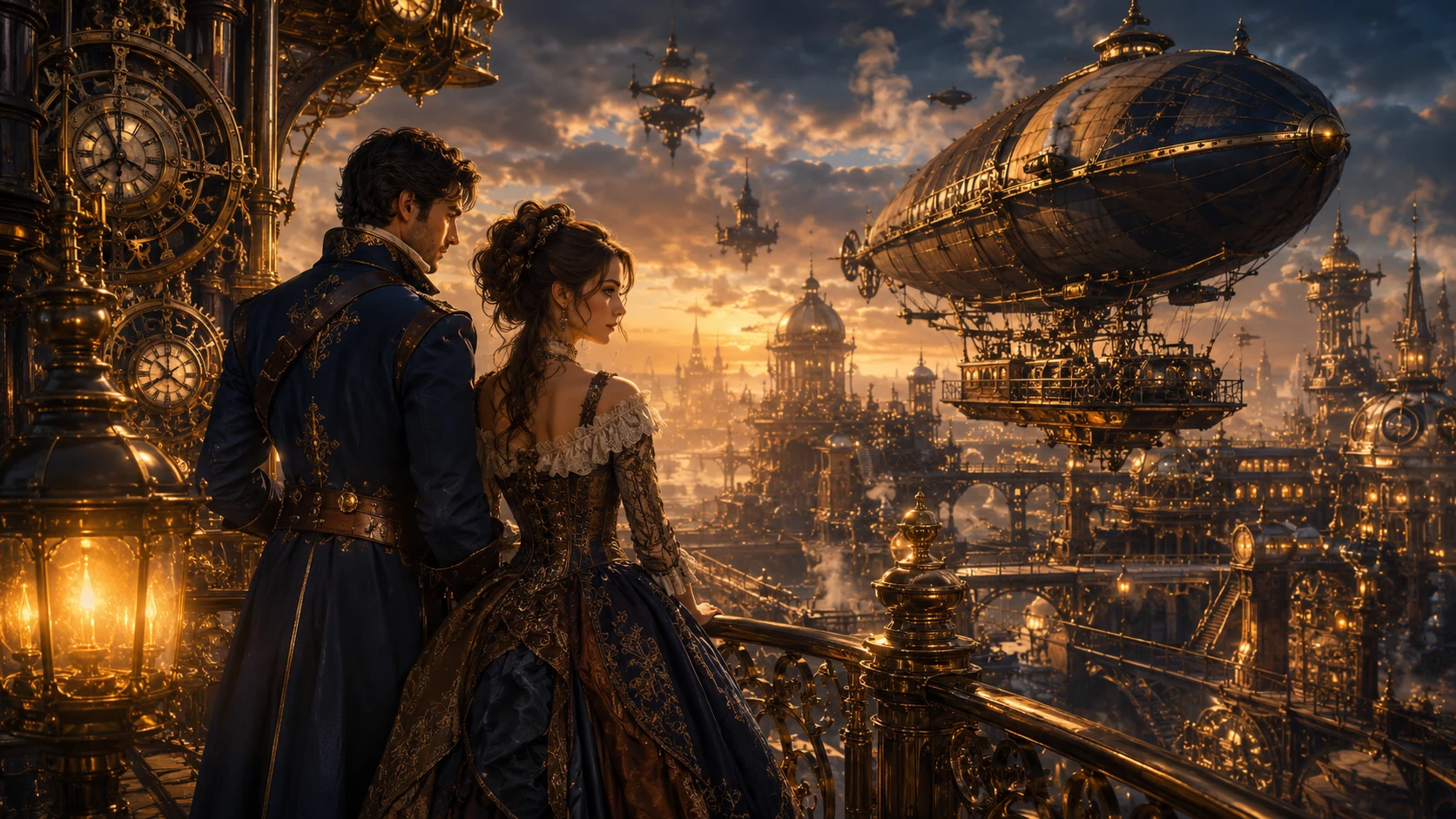
Steampunk romantic fantasy blends an industrial or clockwork-inspired world with fantastic invention and a romance central enough to influence the story’s direction. Steam engines, brass mechanisms, airships, automata, laboratories, and elaborate cities may provide the visual language, but the genre becomes richer when technology changes society rather than acting as decoration.
What “steampunk” contributes
Steampunk often imagines technologies developing along a path associated with steam power, mechanical engineering, or nineteenth-century industrial design. Some stories use alternate history; others build secondary worlds that borrow the texture without pretending to be our past.
The interesting question is what those inventions do to people. Who owns the machines? Who maintains them? Which professions gain status? What happens when a mechanical system becomes essential to medicine, transport, policing, labour, communication, or war?
Where fantasy enters
Not every steampunk story is fantasy. Romantic fantasy steampunk can introduce impossible energy sources, living machines, alchemy, magical engineering, supernatural materials, or technologies that operate according to invented laws. The key is coherence: readers should feel that wonder has rules and consequences.
Why romance belongs naturally in the genre
Industrial settings are full of social boundaries: class, profession, citizenship, ownership, inheritance, and access to technology. Romance can cross or expose those boundaries. An inventor and an aristocrat may want different futures. A bond may be complicated by who controls a patent, a city, a machine, or a body transformed by technology.
Romantic fantasy works best when the relationship changes how the characters understand the world. In steampunk, that can mean confronting the human cost hidden behind mechanical beauty.
Common ingredients
- Clockwork, steam, mechanical or alchemical technologies.
- Cities with distinct industrial identities and social structures.
- Inventors, engineers, guilds, workshops, laboratories, or machine-bound institutions.
- Romance shaped by status, invention, duty, or competing visions of progress.
- A tension between wonder and the cost of the systems producing it.
Steampunk is a set of consequences, not a color palette
Copper pipes, brass goggles and airships are easy signals, but the deeper interest lies in how mechanical invention changes daily life. If a city uses steam-powered public transport, where does its fuel come from? Who repairs its engines? Who bears the pollution? Can the poor afford a ticket? What happens when a strike stops the machines?
Different answers lead to different stories. A workshop run by an independent inventor suggests one kind of romance; a factory city controlled by a hereditary guild suggests another. The technology is doing narrative work when its ownership, limitations and costs place the characters in conflict.
A setting can be inspired by nineteenth-century industrial aesthetics without pretending that historical societies were uniformly glamorous or fair. Questions of labor, class, empire and access to invention can make a world richer than a nostalgic collection of gadgets.
Give extraordinary technology an ordinary maintenance problem
Even invented devices are more convincing when they need something: fuel, a rare mineral, calibration, an operator with special training, or a difficult repair. Limits create dependency and therefore plot.
Illustrative example: A city stays aloft because its engines consume a mineral that can be refined only below ground. The ruling families own the refining towers, while independent pilots transport the raw material. An engineer learns that a safety improvement would reduce production and threaten the owners' profits. A pilot she cares for depends on the existing system to keep their community employed.
The romantic question now intersects with the technical one: can these two people build a future together without accepting a machine that endangers everyone? No amount of extra clockwork decoration would produce that conflict. The structure of the city does.
For more on designing locations around essential systems, see How to Build a Believable Fantasy City.
How fantasy changes the engineering
Steampunk can be grounded in fictional mechanical technology, or it can incorporate explicit magic. The distinction matters because magic may solve some physical problems while introducing new social ones.
If an airship is held aloft by aether rather than conventional lift, the writer need not disguise that as modern engineering. They can establish invented rules: aether must be distilled, has an unstable temperature range or can be controlled only by licensed mechanics. Readers generally accept an impossible power source when the story is clear about what it can and cannot do.
The same principle applies to automatons, artificial hearts or alchemical engines. Ask what the invention enables, what it costs, and what happens when it fails. Those questions make the world consistent, whether its machinery is scientific, magical or openly hybrid.
Our article Soft Magic vs Hard Magic offers another way to think about how much explanation the story needs.
Romantic stakes beyond “opposites attract”
Industrial fantasy settings naturally create conflicting obligations. An aristocrat may own a patent that a mechanic believes should be public. An engineer may work for the military while their partner repairs civilian hospitals. Two inventors may compete to solve the same problem and discover that one method saves money at the expense of workers' safety.
A strong romance gives both people intelligible priorities. Attraction alone will not resolve a disagreement about responsibility. The characters may need to change their assumptions, surrender an advantage or accept consequences that affect people outside the relationship.
That is also how a love story avoids turning invention into background spectacle. A discovery should not merely provide a romantic ride across the skyline; it should change the options available to the couple and the people around them.
Four ways a steampunk romantic fantasy can feel different
Inventor romance centers discovery, collaboration and the risk of an untested machine. Its key question may be whom innovation is meant to serve.
City-of-guilds romance places the relationship inside class structures, licenses, trade secrets and competing families. Political and economic pressure often drives the plot.
Aerial adventure romance emphasizes journeys, crews, airships and dangerous frontiers, with trust tested through shared decisions under pressure.
Clockwork mystery romance focuses on missing blueprints, suspicious inventions, sabotage or a machine with consequences its creator concealed.
The forms can combine, but each foregrounds a different pleasure. A reader seeking a romantic adventure may not want the same pace as somebody looking for detailed workshop politics.
Questions to ask before picking a book
Does the blurb describe a relationship central to the plot, or mainly an adventure with some romantic tension? Is the world alternate history, secondary-world fantasy or a near-magical version of industrial technology? Do machines create genuine constraints? Is the mood whimsical and optimistic, or more concerned with exploitation and danger?
The best clue: When the protagonists fall in love, do their choices change how the invented world operates? If so, the romance and steampunk premise are integrated rather than simply appearing on the same cover.
Heart of Steam
Wonders Workshop presents Heart of Steam as a complete romantic fantasy steampunk trilogy spanning Aetherholm, Velmira, and Lunaris. Its title and visual world place the mechanical and emotional halves side by side: the machinery matters, but so do the hearts living around it.
That balance is a useful way to understand steampunk romantic fantasy as a whole. The machines create possibility. The fantasy expands it. The romance decides what those possibilities mean to the people caught inside them.