
There is a familiar kind of fantasy city: a castle on a hill, a crowded market, a dangerous alley, a tavern with a mysterious stranger, and a sewer system that becomes important exactly when the plot needs an escape route. The skyline is impressive. The city itself feels strangely weightless.
The problem is rarely a lack of detail. It is a lack of consequences. Readers do not need the name of every innkeeper. They need to sense that the city existed yesterday, will exist tomorrow, and would still have problems if the main character never arrived.
A believable city is not a list of interesting locations. It is a system that moves water, food, goods, people, money and authority through a particular piece of geography. Once you decide how that system works, plot opportunities emerge almost automatically.
Quick starting rule: Answer five questions before drawing the first street: Why here? Who feeds it? What does it trade? Who controls movement? What might make it fail?
1. Choose the reason the city exists
Before the cathedral or palace, ask why anybody settled in this exact place. Geography is not destiny, but it changes the price of almost every decision.
Perhaps two rivers meet here, making goods easier to move. Perhaps this is the last safe crossing before a mountain pass. Perhaps a mine draws labor and merchants. Perhaps the settlement began as a fortress, a pilgrimage center or the seat of a ruler who needed subjects nearby.
Give the city one principal advantage and one costly disadvantage. A protected harbor invites shipping but also raiders. A defensible hill limits space and access to water. An oasis offers survival and makes control of wells a political weapon. A city at a crossroads prospers in peace and becomes vulnerable during war.
Your choice should be visible in the architecture. A river town needs landings, ferries and flood defenses. A mountain stronghold needs switchback roads and expensive transport. A pilgrimage city needs lodging, sanitation, crowds and tension between sacred rules and ordinary commerce.
For the way terrain generates historical pressure, see our companion article: How Fantasy Maps Make Imaginary Worlds Feel Real.
2. Follow one loaf of bread into the city
A city cannot live on atmosphere. Someone must feed it.
Imagine an ordinary worker buying bread in the poorest district. Where was the grain grown? How did it arrive? Who milled it? Who stores it when harvests fail? Who takes a fee at the gate? If a caravan road closes, who notices first: bakers, soldiers or the palace?
Answering this chain reveals farms, mills, granaries, warehouses, bakers, transport workers, taxes and black markets without inventing any of them just for decoration.
You can perform the same exercise with clean water, charcoal, lamp oil, medicine, cloth, livestock or building stone. Choose three necessities and trace each from source to household. If one route is blocked, identify the substitute and its price.
You need not calculate a fictional city's exact caloric intake. But scale should have consequences. A settlement of a few thousand people might plausibly depend on a nearby agricultural district. A vastly larger metropolis requires a wider and more dependable supply system, or a convincing magical substitute with costs.
A practical test: Describe how an ordinary person eats breakfast without relying on the protagonist's money or a convenient spell. If you cannot, the city still needs foundations.
3. Build an economy around a real advantage
“Everyone trades here” is not quite an economy. Ask what outsiders actually come to buy, sell, transport or learn.
A city may export salt, dyed cloth, ironwork, glass, ships, manuscripts or trained specialists. It may charge tolls on the only navigable bridge. It may survive because rulers need a neutral market between rival territories. An arcane city might sell weather forecasting or safe passage through magical hazards—but that service still needs labor, infrastructure and rules.
Then ask who benefits and who pays. If the tolls finance the walls, what happens when a second bridge opens upstream? If the city depends on one enchanted mine, what happens when its output falls? If a guild controls food storage, does it compete with the monarch or quietly finance the monarch's soldiers?
Trade creates external relationships. It gives your setting neighbors, rivals, smugglers, migrants and people who have never read the official history of the kingdom. A city that needs other places feels more real than one that contains everything its citizens could ever want.
4. Draw movement before drawing districts
Think first in terms of routes, not decorative neighborhoods. Locate the roads, gates, docks, crossings, public squares and bottlenecks. Only then decide what grows around them.
Markets usually want access to people and goods. Wealthy households may pay for cleaner air, defensible space or proximity to power. Noisy workshops need room and materials. Waste has to go somewhere. A district rebuilt after a fire may look different from the older streets beside it. Migration changes a city's language and food; walls that were once outer defenses can become awkward internal boundaries as the city expands.
Your map should explain daily movement. Can workers cross town before dawn? Does a merchant need three different permits to reach the docks? Are the poor charged to cross the same bridge the nobles use for free? Which street becomes impossible when a festival or procession begins?
The best urban map is a diagram of friction. Where people slow down, wait, bargain or pay, stories begin.
5. Give power an address
Kings and councils do not rule only by giving speeches. Power has offices, records, guards and access points. Somebody issues building permits. Somebody weighs grain at the customs house. Somebody sets market hours. Somebody decides who is allowed inside during a siege.
Choose two or three centers of authority whose interests overlap without fully agreeing. A governor may control troops but need the merchants' taxes. A temple may own wells but depend on the city's engineers. A guild may maintain bridges while making it impossible for rivals to open a competing route.
Avoid giving everyone identical influence. A famous noble might matter in court but be unable to repair a blocked aqueduct. A low-status water inspector might have information that can bring down a dynasty.
The question is not merely who rules? It is who can stop something necessary from happening?
6. Let history leave inconvenient evidence
Believable cities grow by accumulation. Their past should not be confined to murals, legends and old statues.
Maybe the oldest gate faces the wrong direction because the trade road moved. Maybe an abandoned canal divides two neighborhoods. Maybe the grand palace occupies the site of a demolished market whose traders never forgave the ruling family. Perhaps a new bridge redirected commerce and left entire streets poorer.
Give the city one failed project, one inherited institution and one unresolved grievance. A city becomes convincing when yesterday's compromises create today's inconvenience.
This does not require pages of lore. One line can do the work: The Flood Office still collects the bridge tax, though the bridge collapsed sixty years ago. Suddenly you have corruption, bureaucracy, history and a possible rebellion.
7. Decide what the city's magic cannot solve
Magic is not a problem for credible worldbuilding. Magic without consequences can be.
If priests can cure every disease instantly, medical institutions will look unlike ours. If portals make transport nearly free, geography, customs duties and warfare change. If enchanted wells provide endless safe water, control of those wells becomes valuable even if drought disappears. If warding spells protect a city's walls, attackers will seek legal, social or magical loopholes instead of simply building bigger ladders.
Choose one visible benefit, one limitation and one new problem created by your magic system. A portal can shorten a journey but require rare operators. A rain spell can save crops but cause dangerous runoff elsewhere. A truth enchantment can settle disputes but create a terrifying state surveillance apparatus.
For contrasting approaches to magical rules, read Soft Magic vs Hard Magic: Which Does Modern Fantasy Prefer?.
8. Test the city by breaking one system
Now introduce a single disruption: the main bridge fails; the wells are contaminated; a shipping route closes; soldiers seize the granaries; a warding spell stops working. Do not immediately summon a hero. First, follow the consequences.
Who loses income on day one? Who has reserves? Who spreads rumors? What becomes expensive? Who uses the crisis to change the law? What improvised solution appears? A city that reacts through understandable institutions and inequalities will feel alive even if the event is entirely fantastical.
The most useful form of worldbuilding is not the encyclopedia entry about the city. It is the scene that happens when two people need something from the same broken system.
Worked example: Veyr's Reach, a city of tolls and floodgates
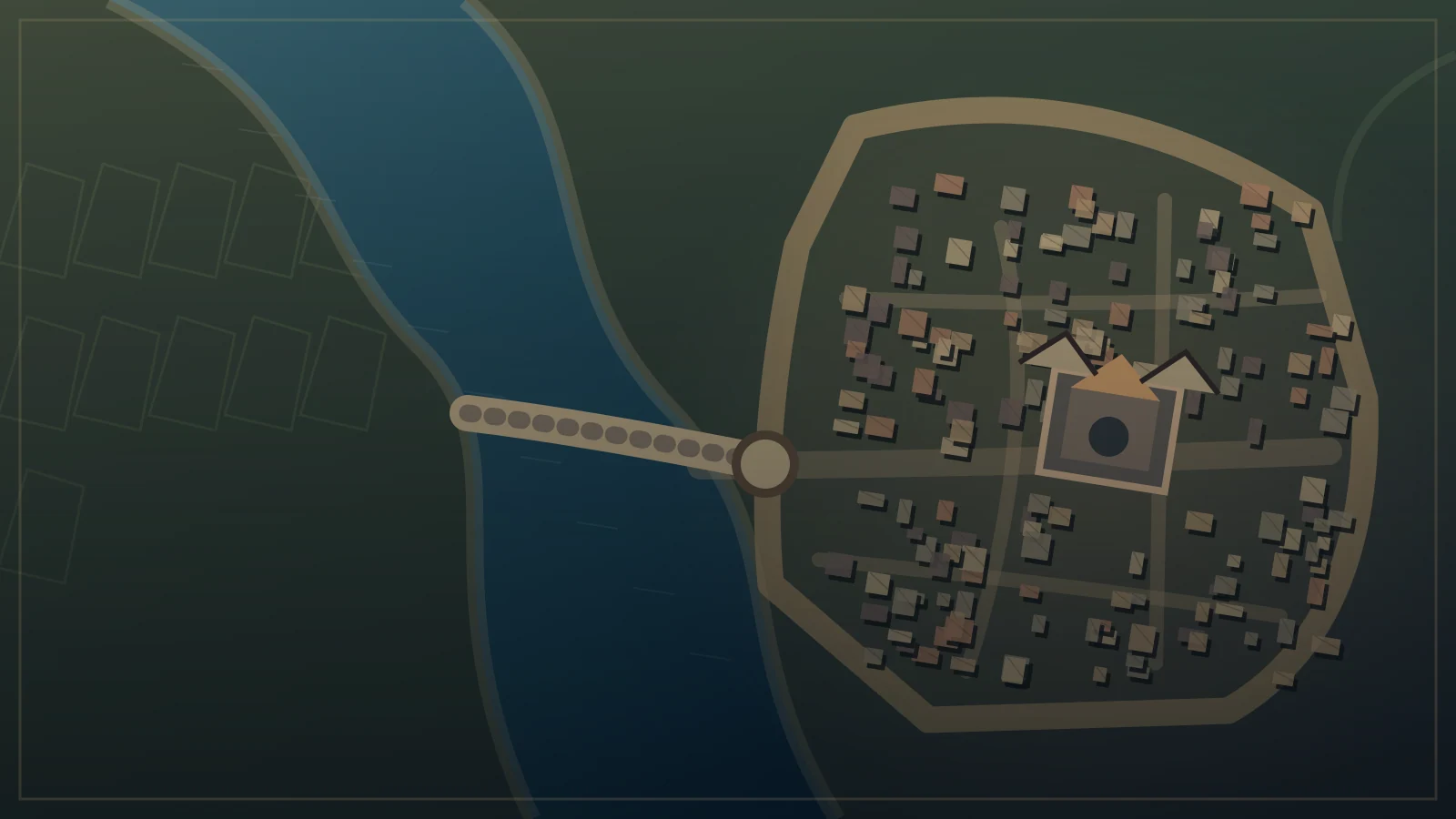
Consider a completely fictional city built where a mountain river crosses a lowland trade road. We will invent Veyr's Reach from only five starting decisions. It does not belong to an existing Wonders Workshop book series.
Why here? The river can be crossed safely at one narrow point during most seasons. A stone bridge made the crossing valuable. A fort became a customs post, and the customs post attracted permanent merchants.
Who feeds it? Grain arrives from upstream farms, fish from marsh settlements and preserved vegetables from higher ground. Three guild-managed granaries sit close to the docks. When flooding interrupts barges, food prices rise before most wealthy households feel any shortage.
What does it trade? Veyr's Reach collects bridge tolls, repairs riverboats and exports blue pigment extracted from nearby clay pits. The pigment makes local merchants wealthy, but overmining has worsened erosion along the riverbanks.
Who controls movement? A merchant council owns the bridge. The governor commands the guard. Neither controls the city's aging floodgates: those are maintained by a hereditary order of engineers with old legal privileges.
What could make it fail? The spring river rises, and the engineers warn that a gate must be opened to save the upper city. Opening it will flood the dye workshops and the poorest neighborhood. Closing it protects the workshops for one more day but risks destroying the bridge foundations.
Notice what happens. A geography choice created trade. Trade created a bridge. The bridge created power. Power created competing institutions. The city's history created a maintenance problem. One flood decision now reveals class, greed, sacrifice and the true cost of survival.
We did not need a list of twenty taverns to find a story. We needed a city with something worth protecting—and people who disagree about what that is.
A 10-minute city-building worksheet
Use this as a compact planning tool before opening your mapping software.
- The city's founding advantage: Why did people choose this site?
- Its unavoidable weakness: What is expensive, scarce or dangerous here?
- Three essential supplies: Where do food, water and fuel come from?
- One export or service: What makes outsiders come here?
- The transport bottleneck: Which gate, bridge, harbor or road matters most?
- Two rival authorities: What can each control, and what does each need?
- An old mistake: Which decision from the past still causes trouble?
- A magical trade-off: What does magic improve, and what new problem follows?
- The first person affected by a crisis: Who notices when the system fails?
- A scene only this city could produce: What conflict would not exist in another setting?
If your answers point to a useful conflict, stop adding decorative lore and write that scene. Worldbuilding becomes memorable when its rules are experienced through action, not announced in a glossary.
The city should work when nobody is watching
A convincing fantasy city does not need exhaustive realism. It needs selective, visible causality. A bridge changes commerce. Commerce changes political power. Power changes who eats during a flood. A magic system changes the cost of every choice it touches.
Readers will happily accept impossible towers and streets lit by captive stars. What breaks their belief is a city with no reason to exist, no way to feed itself, no memory of previous generations and no response to a crisis.
Give your city a living system before you give it a dramatic skyline. The skyline will matter more once readers understand what is at stake beneath it.
Continue exploring: How Fantasy Maps Make Imaginary Worlds Feel Real and Why Rival Houses Work So Well in Fantasy.
Editorial note: Veyr's Reach and its institutions are an original teaching example created for this guide, not lore from any published Wonders Workshop series.