
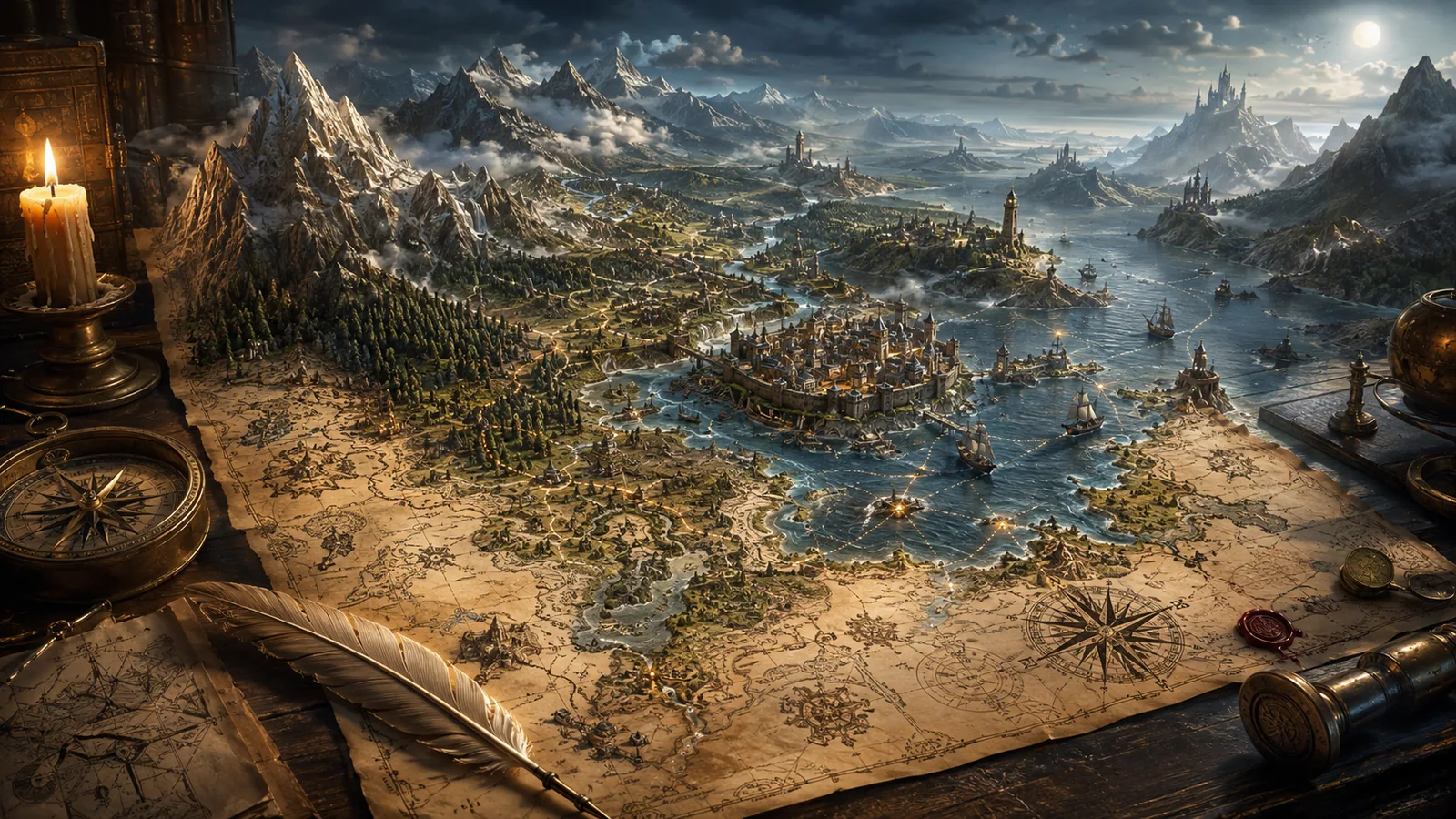
A fantasy map performs a small act of sorcery before the story even begins.
The reader opens the book, sees coastlines, mountain chains, roads, forests, kingdoms, and a few names that mean nothing yet, and immediately assumes that the world continues beyond the first chapter. The map suggests that armies have marched along those roads, that ships have disappeared beyond those capes, and that someone living in the western marshes probably tells a different version of history from someone raised behind the eastern mountains.
None of that may be written on the page. The map makes it feel possible anyway.
This is why a good fantasy map is not simply an illustration. It is a narrative machine. It creates relationships between places, imposes limits on characters, hints at cultures and conflicts, and gives the reader a way to imagine the world as a connected whole. Its power does not come from packing every empty corner with a symbol. It comes from making geography matter.
A map is a promise, not proof
A detailed map can make a fictional world look authoritative, but visual complexity is not the same as credibility. Hundreds of labels, decorative mountains, and curling borders may create the surface of depth without creating any actual relationship between place and story.
The map becomes convincing when the novel keeps its promises. If two cities are separated by a desert, the journey should require time, supplies, knowledge, or risk. If a kingdom is protected by a mountain range, that barrier should affect trade, invasion, language, and political imagination. If an island controls the only safe passage through a dangerous sea, its importance should extend beyond the fact that its name appears in larger lettering.
Readers do not need every geographic decision explained. They do notice when the map and the narrative appear to belong to different worlds. A fortress that is described as remote should not sit beside three major roads and a navigable river unless that contradiction has a reason. A month-long journey should not become a two-day ride when the plot becomes impatient.
The first job of a fantasy map is therefore consistency. It gives the story a spatial memory.
Distance creates consequences
On a blank page, two kingdoms can feel equally close to the protagonist. On a map, distance becomes visible, and visible distance creates expectations.
Travel takes time. Messages arrive late. Weather changes. Horses tire. Armies need food. A wounded character cannot simply cross half a continent because the next scene would be more exciting there. Once the reader understands the scale of the world, distance starts shaping what characters can know and what leaders can control.
This is especially important in stories about war, empire, pilgrimage, trade, or political alliance. A ruler may claim authority over distant provinces while possessing only a fragile road and a chain of unreliable governors. Two allied cities may be separated by a mountain pass that closes each winter. A rebellion may survive not because it has the strongest army, but because the capital cannot move soldiers quickly enough through hostile terrain.
Distance also creates emotional texture. The homeland left behind becomes more powerful when the reader can see how far away it is. The unknown destination becomes more intimidating when the route crosses places with names but no explanations. A map turns departure into separation.
Geography becomes history
Believable fantasy geography does not require the author to become a professional geologist. It requires the landscape to produce consequences that accumulate over time.
Rivers attract settlement because they move water, people, food, and goods. Harbors create opportunities for trade, invasion, piracy, and cultural exchange. Mountain valleys concentrate travel into passes. Islands develop different relationships with defense and commerce than broad inland plains. Fertile regions become prizes. Difficult regions become refuges, borders, sacred places, or sources of valuable materials.
When geography influences where people live and how they survive, history begins to feel inevitable rather than assigned. A wealthy city at a river crossing makes sense before the reader learns its entire past. A borderland filled with ruined forts implies repeated conflict. A chain of coastal towns facing the same sea suggests trade, migration, or a shared danger, even if their rulers hate one another.
The point is not that every world must obey the physical geography of Earth. Magic can reverse rivers, suspend cities above storms, or create a desert in the middle of a rainforest. But extraordinary geography becomes stronger when the world responds to it. If a magical catastrophe created the desert, where did the displaced people go? Who controls the surviving wells? What faiths interpret the event as punishment, liberation, or unfinished prophecy?
Fantasy can break natural law. It should not ignore cause and effect.
Routes turn space into story
Locations become memorable through movement. A map filled with kingdoms is static until someone must cross it.
Roads, rivers, sea lanes, tunnels, passes, portals, and pilgrimage paths determine how the world is experienced. They decide which places meet one another and which remain isolated. They also create natural locations for inns, toll gates, markets, forts, shrines, ambushes, customs posts, and rumors.
A route is never only a line between two points. It is a sequence of dependence. Travelers need shelter, information, guides, animals, ferries, papers, or protection. A government that controls bridges may exercise more practical power than one that claims vast empty territory. A merchant league that controls ports can influence kingdoms without owning much land. A magical gate network can make distant capitals feel like neighbors while turning the regions between them into neglected peripheries.
This is one reason maps help plots feel less arbitrary. The geography creates a limited set of plausible choices. Characters can still surprise us, but they cannot teleport through the consequences of the world unless teleportation is itself part of the system.
Names reveal culture before exposition does
Place names are among the smallest details on a map, but they carry enormous worldbuilding weight.
Names suggest language, conquest, memory, religion, and prejudice. A region where rivers, towns, and mountains share related sounds feels as though its inhabitants have named the landscape over generations. A city with two names may reveal occupation, migration, or competing historical claims. A place called the King's Road tells the reader something different from a place called the Widow's Way, even if both marks indicate the same strip of ground.
Patterns matter more than exotic syllables. If every name is assembled from unrelated apostrophes and dramatic consonants, the map may look fantastical without feeling cultural. Coherence does not require a complete invented language. It requires the sense that nearby names came from people who influenced one another.
Renaming is also political. Conquerors rename cities. Revolutions restore older names. Empires simplify local names for their own records. Communities preserve forbidden names in speech while official maps erase them. The map can therefore show history not only through ruins and borders, but through vocabulary.
Borders expose power
A border looks deceptively simple when it is drawn as a clean line. In a living world, that line may represent a river, a treaty, a wall, a military patrol, an old marriage agreement, a disputed forest, or nothing more than a cartographer's confidence.
Fantasy maps often present political territory as settled fact, but borders are among the best places to introduce uncertainty. Who recognizes the frontier? Who crosses it without permission? Does the state control the entire region it colors, or only the roads and fortified towns? Do nomadic communities, spirits, monsters, or mountain clans accept the categories imposed on them?
These questions make the map more than geography. They make it a document of authority.
A royal map may place the capital at the visual center, enlarge friendly territories, omit rebellious villages, and label disputed land as empty. A sailor's chart may care about currents and reefs while ignoring inland borders. A pilgrim's map may measure distance in shrines rather than miles. When the map has a point of view, even its inaccuracies become useful.
Blank spaces preserve wonder
Worldbuilders often fear empty space. Every island receives a name, every forest gains a ruin, and every corner is assigned a kingdom, species, prophecy, or ancient war. The result can be impressive and strangely lifeless.
A map becomes larger in the imagination when it admits that knowledge is incomplete. Blank spaces create questions. A coastline that disappears into mist suggests danger or ignorance. A region labeled only with an old warning invites speculation. An unmapped interior can imply scale more effectively than twenty tiny landmarks.
The unknown also protects fantasy from becoming a database. Readers enjoy orientation, but they also enjoy the possibility that the world exceeds the information provided. A map should reveal enough to make travel and politics intelligible without converting mystery into inventory.
This is particularly important when the story depends on discovery. If the map already explains every ruin, road, island, and civilization, exploration becomes confirmation. Wonder survives where the map ends.
Impossible geography can still feel true
Discussions of fantasy maps sometimes become a contest in spotting rivers that fork incorrectly or mountains that seem to have been sprinkled across the page. Geographic mistakes can weaken a world, especially when ordinary Earth-like processes are assumed. But strict realism is not the only route to credibility.
The deeper question is whether the geography has an internal explanation and whether the consequences are visible. A river can flow uphill if a magical force pulls it toward a sacred mountain. A circular range can surround the impact site of a fallen god. A floating archipelago can migrate with seasonal winds. These ideas may be physically impossible, yet narratively persuasive if people build settlements, beliefs, economies, and dangers around them.
Accuracy matters most where the world asks the reader to trust ordinary causality. In extraordinary regions, coherence matters more. The map should not apologize for magic. It should show that magic leaves tracks.
Maps change how readers participate
A reader does not look at a fantasy map only once. The map is revisited after a destination is mentioned, before a journey begins, after an army changes direction, or when a forgotten name suddenly becomes important.
That movement between text and map creates a distinctive form of participation. The reader estimates routes, notices proximity, anticipates obstacles, and sometimes discovers implications before the characters do. Scholarly work on literary cartography has emphasized that maps and narratives can operate together, turning abstract spaces into meaningful places through repeated association.
This is why a map can make a world feel remembered rather than merely described. The ruined bridge is no longer an isolated setting after the reader connects it to the border, the river, and the abandoned road. Geography becomes a network of expectations.
The map gives the reader a small share of the worldbuilder's authority. It says: here is enough structure for you to imagine what lies between the scenes.
The most convincing map is the one the story needs
Not every fantasy novel requires a map, and not every fictional map needs continents, scales, compass roses, or complete political borders. A city mystery may need districts and alleys. A sea voyage may need currents, islands, and hazards. A story about exile may benefit from showing one homeland and the enormous distance to another. A tale built around uncertainty may be stronger with a partial, biased, or damaged map.
The best map is not the most detailed one. It is the one that makes the central pressures of the story visible.
If the narrative is about empire, show distance and control. If it is about trade, show routes and bottlenecks. If it is about cultural conflict, let names and borders carry history. If it is about exploration, preserve the unknown. If it is about magic, show where the impossible has altered ordinary life.
A fantasy world feels real when its places are not interchangeable. The mountain matters because it changes who can cross. The river matters because cities grew beside it. The border matters because someone drew it and someone else refuses it. The blank space matters because nobody has returned with a reliable account.
A map does not prove that an imaginary world exists. It shows that the world has consequences - and that is often enough to make the reader believe.
Continue exploring: Soft Magic vs Hard Magic: Which Does Modern Fantasy Prefer? and Dystopia vs Utopia: What Future Is Science Fiction Really Predicting?.
Sources & further reading
- Ekman, Stefan - Map and Text: World-Architecture and the Case of Mieville's Perdido Street Station, Literary Geographies. Argues that the relationship between a fantasy map and its narrative is a vital part of fictional world construction and can turn spaces into meaningful places.
- Piatti, Barbara and Lorenz Hurni (2011/2013) - Cartographies of Fictional Worlds, The Cartographic Journal 48(4). An introduction to literary geography and the ways maps can illuminate the spatial organization of fiction.
- Rossetto, Tania (2014) - Theorizing Maps with Literature, Progress in Human Geography. Reviews the many relationships between maps and literary texts, including maps as analytical, narrative, thematic, and political objects.
- Nicolaisen, W. F. H. (1990) - Maps of Fiction: The Cartography of the Landscape of the Mind, Onomastica Canadiana. Distinguishes maps essential to a story from maps intended primarily to orient the reader and discusses the paradoxical mappability of imaginary landscapes.
- Mantzaris, Thomas (2023) - Understanding Maps after Multimodal Literature: A New Taxonomy, Cartographic Perspectives 101. Examines the intersections of literary narrative, visual design, and map-based storytelling.
- Maxwell, Luke - The Edge of the Imaginary World: The Influences of Imperialism and Expansionism in Secondary World Cartography. Discusses borders, frontiers, otherness, and the political traditions embedded in fantasy maps.
- Wereszczynski, Marcin and Albert Adolf (2023) - The Witcher World Map: People Need Maps of Imaginary Places, Abstracts of the International Cartographic Association 6. A contemporary cartographic study of reader demand for coherent maps of fictional worlds.
- Hickey, Kieran (1988; digitally published 2024) - Of Maps and Hobbits: A Brief Survey of Maps in Fantasy Literature, Chimera: U.C.C. Geographical Journal. Surveys the long relationship between fantasy literature, exploration, and cartographic representation.
- Tolkien's maps and sketches, preserved and exhibited by the Bodleian Libraries and discussed in scholarship on his visual worldbuilding, demonstrate how geography, chronology, and narrative movement can develop together during composition.