
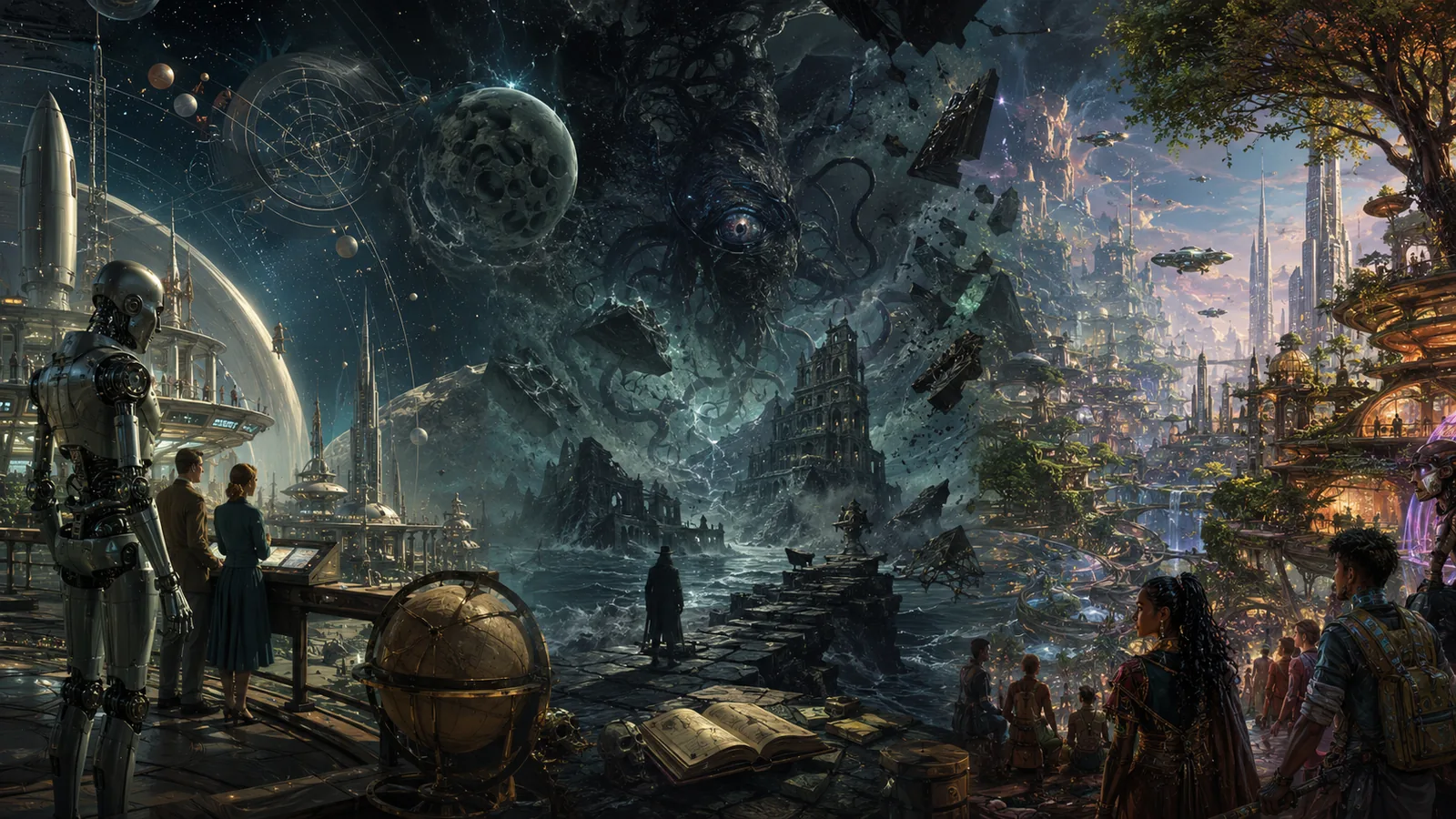
Every generation of genre readers eventually asks the same suspicious question: were the classics better, or are modern writers simply telling different kinds of stories?
The question becomes especially tempting when the names involved are enormous. Isaac Asimov helped turn robots, galactic empires, and predictive history into durable science-fiction structures. H. P. Lovecraft gave modern weird fiction one of its most influential languages of cosmic insignificance. Philip K. Dick made unstable reality, manufactured memory, and uncertain identity feel like everyday conditions rather than abstract philosophy.
Contemporary speculative fiction still lives inside the territory those writers helped map. Yet it often approaches that territory from another direction. The giant system is no longer viewed only from the control room. The unknowable cosmos is no longer automatically imagined through fear of outsiders. The reality crisis is not merely a clever puzzle; it can determine who is believed, who is protected, and who is permitted to define what is real.
Modern genre fiction has not replaced the classics. It has changed the camera angle, widened the cast, blurred the borders between genres, and become more explicit about the human cost of its ideas.
The phrase "founding fathers" hides more than it explains
Asimov, Lovecraft, and Dick are useful landmarks, but calling them the founding fathers of science fiction, horror, or speculative fiction creates a false beginning. These genres did not appear fully formed around a handful of twentieth-century men. Mary Shelley, Edgar Allan Poe, H. G. Wells, Charlotte Perkins Gilman, W. E. B. Du Bois, and many other writers had already used the fantastic to explore science, power, race, gender, empire, and social change.
Even the boundaries between science fiction, fantasy, horror, satire, and the gothic were never as clean as bookstore shelves suggest. Academic work on speculative fiction repeatedly emphasizes hybridity: stories respond to the historical, political, and cultural conditions around them, and their forms change as those conditions change.
The three writers matter not because they invented imagination, but because each crystallized a question that later writers could inherit, resist, or transform.
Asimov made systems feel like characters
Asimov's most influential fiction often begins with a system. In the Robot stories, the Three Laws are not decorative lore. They are a logical machine that produces contradictions, loopholes, and ethical problems. In Foundation, psychohistory turns the rise and fall of civilizations into something that might be modeled, predicted, and managed across centuries.
This approach gave science fiction a powerful pleasure: the pleasure of watching an idea operate. A rule is introduced, pressure is applied, and the reader follows the consequences. The individual character may be important, but the deeper protagonist is often the structure itself: an empire, a law, a technology, a statistical theory, or an institution attempting to outlast human error.
Contemporary science fiction still loves systems. Artificial intelligence, climate infrastructure, surveillance networks, migration, energy, and planetary governance all invite Asimov-sized thinking. The major change is that modern stories are more likely to ask how the system feels from below. Who becomes a data point in the model? Who is treated as an acceptable loss? Who designed the rules, and which lives were never included in the original calculation?
The shift is not from intelligence to emotion. It is from systems viewed as elegant abstractions to systems experienced as lived environments.
Lovecraft made humanity small, but his fears were not neutral
Lovecraft's lasting contribution to weird fiction is the terror of scale. His stories imagine a universe so old, vast, and indifferent that human civilization becomes a temporary misunderstanding. Knowledge does not automatically liberate. Discovery can destroy the comforting belief that humanity occupies the center of reality.
That idea remains extraordinarily fertile. Cosmic horror still works because it attacks the mind's need for proportion and meaning. A door, ruin, signal, organism, or fragment of forbidden history suggests that the world is larger than the categories used to explain it.
But Lovecraft's imagination was also entangled with racist and xenophobic beliefs. Brown University, which holds his papers, explicitly frames contemporary study of his work as requiring attention to the relationship between his fiction and his racial ideology. The fear of contamination, degeneration, hidden ancestry, and unfamiliar peoples cannot always be separated from the prejudices that shaped his worldview.
Modern weird fiction can preserve cosmic uncertainty without preserving that hierarchy. The unknown does not have to be terrifying because it resembles another culture, body, or ancestry. Contemporary writers can instead ask what happens when institutions refuse to understand the unknown, when marginalized people recognize danger before authorities do, or when the supposedly normal world is revealed as the true source of horror.
The cosmic scale survives. The moral center moves.
Philip K. Dick turned reality into a contested resource
Philip K. Dick's worlds rarely remain stable for long. Memories may be implanted. Identities may be artificial. Governments, corporations, religions, media systems, and drugs may manufacture incompatible realities. The ordinary person is forced to decide not only what is true, but whether truth can still be shared.
That question feels increasingly contemporary because reality is now mediated through recommendation systems, synthetic media, targeted information, platform incentives, and personalized feeds. Yet Dick's importance is not that he predicted a specific device. It is that he understood reality as vulnerable to power.
Contemporary speculative fiction extends that insight by asking who is most exposed when shared reality collapses. A wealthy person may buy privacy, verification, or escape. A precarious worker, refugee, disabled person, or politically targeted community may have no such protection. The philosophical problem becomes material: whose testimony is accepted, whose memory is archived, whose identity exists in the database, and who disappears when the record changes?
Dick made readers doubt the floor beneath the story. Modern writers often ask who was already living without a secure floor.
The camera moved from civilization to lived experience
Classic science fiction frequently speaks in the language of civilization: humanity, progress, empire, reason, survival. Those words create scale, but they can also conceal difference. "Humanity" sounds universal until a story reveals which humans are allowed to represent it.
A major development in contemporary genre fiction is the movement from a single supposedly universal viewpoint toward situated experience. N. K. Jemisin's Broken Earth trilogy connects planetary catastrophe to family, oppression, education, and the control of powerful bodies. Nnedi Okorafor's Binti carries science fiction through a culturally specific protagonist rather than treating one version of Western modernity as the default future. Nalo Hopkinson's work demonstrates how science fiction can incorporate epistemologies that rigid genre definitions have sometimes pushed into the category of fantasy.
This does not make contemporary fiction smaller. It often makes scale more convincing. A collapsing planet matters because the reader understands who must cross it, what history shaped the disaster, and why survival is distributed unevenly.
The grand idea remains, but it acquires a body.
The future became plural
Older science fiction often imagined the future as a single road. Industrial growth, space expansion, automation, nuclear power, or centralized planning would transform society in a direction that could be debated but still appeared broadly shared.
Contemporary speculative fiction is more likely to imagine many futures occupying the same moment. One district experiences clean energy as liberation while another experiences extraction. One person experiences artificial intelligence as assistance while another experiences it as surveillance or unemployment. A technology can be utopian for its owner and dystopian for the worker hidden inside the system.
This plurality changes worldbuilding. The question is no longer only "What will happen?" It becomes "What happens to whom, where, under whose authority, and at whose expense?"
That is one reason Afrofuturism, Indigenous futurisms, climate fiction, solarpunk, diasporic science fiction, and other overlapping traditions matter. They do not simply add new decorations to an existing future. They challenge the assumption that one cultural history has the right to define what progress looks like.
Genre borders became more porous
Contemporary writers also move more freely between the categories that publishing uses to organize books. Science fiction borrows from horror, literary fiction, romance, detective fiction, folklore, and historical narrative. Fantasy uses political theory, climate science, body horror, and technological speculation. The weird thrives in the space where no label fully explains what is happening.
This hybridity is not evidence that genres have become meaningless. A genre still makes promises about tone, pressure, and possibility. But modern writers often treat those promises as ingredients rather than prison walls.
The result is a different reading experience. Instead of asking whether a book obeys every rule of science fiction or fantasy, readers may ask what each tradition allows the story to examine. A detective structure can organize a reality crisis. Horror can reveal the emotional cost of technology. Fantasy can make an invisible political system physically visible.
The borders remain useful, but the most interesting stories frequently know where the gates are.
Were the classics less political? No - their politics were easier to mistake for neutrality
Modern genre fiction is sometimes criticized for being more political than older work. That comparison rarely survives close reading. Galactic empires, obedient robots, nuclear anxiety, racial degeneration, corporate manipulation, authoritarian policing, and the definition of the human are political subjects.
The difference is often visibility. A story written from a culturally dominant viewpoint can present its assumptions as common sense. A story that questions those assumptions is more easily labeled political because it makes the hidden framework visible.
Contemporary fiction did not introduce power into speculative literature. It became more willing to identify who holds power, how it is reproduced, and which voices older narratives left outside the frame.
What modern fiction can still learn from the classics
Evolution does not mean automatic improvement. Some classic speculative fiction has an extraordinary commitment to the central idea. The premise is clear, the consequences are pursued, and the story does not apologize for asking the reader to think at enormous scale.
Modern novels can sometimes accumulate so many themes, viewpoints, systems, and hybrid elements that the central pressure becomes diffuse. Representation cannot substitute for structure. Nuance cannot substitute for momentum. Psychological depth does not excuse a world whose rules change whenever the plot needs rescue.
Asimov remains useful when a story needs disciplined consequences. Lovecraft remains useful when scale must destabilize certainty. Dick remains useful when reality itself has become political terrain. The task is not to imitate their limitations, but to understand the precision of their strongest questions.
How to read influential classics without worshipping them
Readers do not need to choose between reverence and cancellation. A classic can be historically important, artistically powerful, ethically compromised, stylistically dated, and still worth examining. Those judgments can coexist.
Read the work closely. Read the context around it. Notice what the story sees clearly and what it cannot see at all. Then read the writers who inherited the idea from another position.
Pair system-building with stories about people trapped inside systems. Pair cosmic horror with weird fiction that refuses xenophobia. Pair unstable reality with narratives about whose reality institutions recognize. The conversation between books is often more revealing than a ranking of old against new.
Genre fiction did not abandon its foundations; it rebuilt them
Asimov asked whether human behavior could be organized by reason, law, and prediction. Lovecraft asked what remains when humanity loses its privileged place in the universe. Philip K. Dick asked whether reality and identity can survive manipulation.
Contemporary writers still ask all three questions.
They also ask who wrote the law, who was excluded from the model, whose fear defined the monster, whose memory counts as evidence, and whether a future can be called progress when its benefits are distributed by power.
That is the real difference between classic and modern genre fiction. The old questions remain alive. More people are now allowed to answer them, contradict them, and build new worlds from the parts that were missing.
Continue exploring: Cyberpunk, Grimdark, and Hard Science Fiction: Three Genres Readers Often Misunderstand and Dystopia vs Utopia: What Future Is Science Fiction Really Predicting?.
Sources & further reading
- The Encyclopedia of Science Fiction - Isaac Asimov. Overview of Asimov's Robot stories, the Laws of Robotics, Nightfall, and the Foundation sequence as major structures in twentieth-century science fiction.
- Brown University Library - H. P. Lovecraft Collection and The Racial Imaginaries of H. P. Lovecraft. Documents Lovecraft's influence on weird fiction and the need to study his work alongside its racial ideology.
- The Encyclopedia of Science Fiction and the official Philip K. Dick site - Philip K. Dick. Background on his recurring concerns with identity, altered memory, politics, religion, and unstable reality.
- Araujo, Naiara and Livia Fernanda Diniz Gomes (2021) - Speculative Fiction: The Process of Hybridization in Science Fiction and Fantasy Literature. Argues that speculative genres change through historical, political, cultural, and literary interaction.
- Oziewicz, Marek - Speculative Fiction, Oxford Research Encyclopedia of Literature. Discusses speculative fiction as a broad discursive space that can challenge Western genre boundaries and make room for marginalized voices.
- McDonald, Jessica (2016) - Beyond Generic Hybridity: Nalo Hopkinson and the Politics of Science Fiction, Canadian Literature. Examines how genre boundaries can privilege Western definitions of science and plausible futures.
- The Hugo Awards - 2016, 2017, and 2018 results. Records the Best Novel wins for N. K. Jemisin's Broken Earth trilogy and the 2016 Best Novella award for Nnedi Okorafor's Binti.
- Toliver, S. R. (2020) - I Desperately Need Visions of Black People Thriving: Emancipating the Fantastic With Black Women's Words. Discusses the importance of speculative futures that provide meaningful windows and mirrors for readers historically excluded by the genre.