
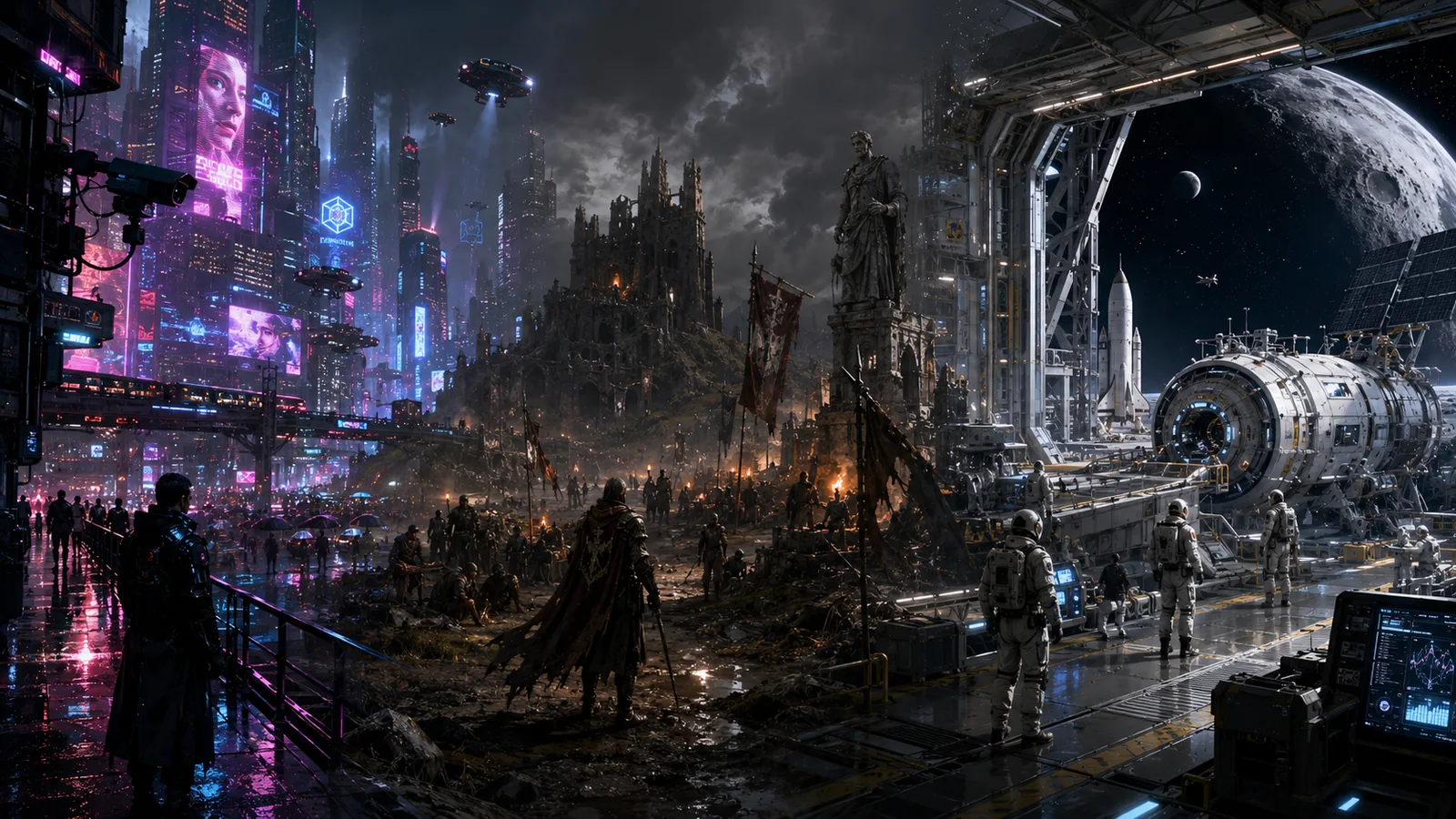
Genre labels are supposed to help readers. Sometimes they do the opposite.
Cyberpunk becomes a color palette of rain, neon, implants, and black coats. Grimdark becomes a synonym for blood, profanity, and unhappy people. Hard science fiction becomes a test of whether the reader can survive three pages of orbital mechanics without blinking.
Those versions are easy to recognize because they reduce each genre to its most visible features. They are also incomplete. A story can contain glowing advertisements and still miss the political tension that makes cyberpunk meaningful. It can be brutally violent without sharing grimdark's view of power and compromised choice. It can explain every machine in exhausting detail while failing to use science as an actual engine of the plot.
The better question is not, "What objects appear in this story?" It is, "What kind of pressure does this story place on its characters and world?"
Cyberpunk, grimdark, and hard science fiction look wildly different, but each is built around a distinctive form of pressure: technological power, moral corrosion, or physical constraint.
Genre is a promise, not a box of decorations
Subgenres work best when they tell readers what kind of experience to expect. A mystery promises that uncertainty will be organized around a question. A romance promises that the central emotional relationship matters to the structure of the ending. A horror story promises sustained confrontation with fear, disgust, dread, or the violation of what should feel safe.
Speculative subgenres make similar promises. They do not require every traditional ingredient, but they usually depend on a recognizable relationship between setting, conflict, and theme.
This matters because visual shorthand is powerful. A filmmaker can create a cyberpunk-looking city in seconds with holograms, crowded alleys, and synthetic eyes. A cover can announce grimdark with a chipped sword and a field of mud. A science-fiction novel can signal seriousness with diagrams and technical vocabulary.
The shorthand may be useful, but it should lead to the deeper question. What does the technology do to power? What does violence do to moral choice? What do the laws of nature permit, forbid, or make painfully expensive?
Cyberpunk is about who controls the future
Cyberpunk emerged as a recognizable movement in the 1980s, with the term associated first with Bruce Bethke's story "Cyberpunk" and then with writers such as William Gibson, Bruce Sterling, Pat Cadigan, Rudy Rucker, John Shirley, and others. Neuromancer became the defining public reference point, but the genre was never only about computers or virtual reality.
Its central tension is the collision of advanced technology with unequal social power. Information networks, artificial intelligence, body modification, pharmaceuticals, surveillance, genetic engineering, and corporate systems do not arrive in neutral societies. They enter worlds already divided by wealth, access, geography, race, labor, law, and political influence.
That is why the familiar phrase "high tech, low life" remains useful. The contrast matters. Cyberpunk asks what happens when extraordinary tools become ordinary while dignity, security, and agency remain scarce.
The protagonist is often not the inventor, president, or chief executive. They are the hacker, courier, mercenary, investigator, outsider, modified worker, addict, fugitive, or disposable specialist moving through systems too large to confront directly. Technology may give them leverage, but it also exposes them to control. The same neural interface that expands perception can become a point of intrusion. The same network that creates freedom can record every movement. The same medical breakthrough that extends life can turn the body into a subscription service owned by someone else.
This is why neon alone cannot create cyberpunk. A clean solar city can be cyberpunk if access to its systems is controlled by an unaccountable elite. A rural landscape can be cyberpunk if agricultural workers are managed through implants, proprietary seeds, predictive surveillance, and debt. The genre is not married to rain. It is married to the question of who benefits when technology becomes intimate.
What cyberpunk is often mistaken for
Cyberpunk is frequently confused with any dystopian story that includes gadgets. Dystopia, however, is broader. It focuses on oppressive or damaged societies. Cyberpunk adds a particular technological and countercultural relationship: people at the margins using, resisting, repurposing, or being reshaped by systems that are simultaneously technological and economic.
It is also possible to imitate cyberpunk aesthetics while removing the "punk." When the story admires corporations, treats inequality as background decoration, and uses augmentation only to make characters look impressive, the result may still be futuristic noir or techno-thriller. It has borrowed the surfaces while softening the conflict that gave those surfaces meaning.
Grimdark is about what power makes people become
Grimdark is harder to define because readers use the word in several ways. Cambridge Dictionary emphasizes morally bad behavior and subject matter that is sad, hopeless, or violent. Recent academic work places violence beside existentialism and the transformation of epic-fantasy characters and spaces. Writers, critics, and genre publications often debate whether hope is absent, damaged, or merely expensive.
A practical definition is this: grimdark places flawed people inside hostile systems where clean choices are rare, power is corrupting or compromised, and moral action carries costs that the world may not reward.
Violence is common because the setting often runs on coercion. But violence is not the genre's deepest feature. The deeper feature is pressure on agency. A character may want to protect a city, family, regiment, kingdom, or ideal, yet every available method requires betrayal, exploitation, surrender, or harm. Institutions are usually decayed, predatory, or self-preserving. Victory may prevent something worse without creating anything good.
That separates grimdark from a simple story about bad people doing bad things. The genre becomes interesting when characters remain understandable under pressure. Their choices should reveal fear, loyalty, ambition, trauma, appetite, pragmatism, or self-deception. Cruelty without psychology is only spectacle.
It also separates grimdark from dark fantasy. Dark fantasy is a wide territory where fantasy intersects with horror, corruption, dread, gothic atmosphere, monstrous forces, or dangerous magic. Grimdark may contain all of those things, but its defining emphasis is often political and moral: broken systems, compromised agency, and the erosion of heroic certainty.
What grimdark is often mistaken for
The most common mistake is assuming that greater misery automatically creates greater maturity. It does not.
A story does not become sophisticated because every institution is evil, every kindness is punished, and every character speaks in threats. If the world is so uniformly corrupt that no choice matters, moral ambiguity disappears. There is nothing to weigh because every option has already been flattened into the same answer.
Strong grimdark needs contrast. Loyalty matters because betrayal is possible. Mercy matters because it is dangerous. Hope matters precisely because the world gives characters reasons to abandon it. Even a very bleak story benefits from showing what could be lost besides blood.
Hard science fiction is about what reality will allow
The term "hard science fiction" appeared in print in 1957 and has never been a perfectly rigid category. The Encyclopedia of Science Fiction summarizes the core idea as fiction that uses established or carefully extrapolated science as its backbone and respects the scientific spirit.
That does not mean every hard-SF story must be a textbook disguised as a novel. It means the scientific conditions matter to causality. Gravity, radiation, distance, energy, biology, communication delay, material strength, ecology, or computation should shape what characters can do and what consequences follow.
In weak imitation, technical detail is ornamental. A character explains a reactor for two pages, but the reactor could be replaced with magic without changing the plot. In stronger hard science fiction, the constraint creates the story. Limited fuel changes the rescue plan. Light-speed delay changes politics. A closed ecosystem changes law, reproduction, food, and class. A planetary atmosphere changes architecture, movement, and survival.
Hard science fiction therefore produces suspense through limits. The drama comes not from breaking the rules whenever convenient, but from finding a solution the rules still permit.
Absolute accuracy is impossible as a universal test. Science changes, authors simplify, and even rigorous stories may include one speculative assumption such as faster-than-light travel. The more useful question is whether the work reasons honestly from its assumptions. Does it treat science as a discipline of consequences, or merely as a vocabulary of authority?
What hard science fiction is often mistaken for
Hard science fiction is often confused with intelligence, seriousness, or quality. Those are separate judgments.
A scientifically careful novel can have flat characters. A socially focused science-fiction novel can be intellectually demanding without emphasizing physics or engineering. The old distinction between "hard" and "soft" sciences has also carried misleading hierarchies, as though astronomy were inherently more rigorous or worthy of fiction than psychology, anthropology, economics, or political theory.
The label should describe what kind of constraints organize the story, not rank the intelligence of the author or reader.
One future city, three completely different stories
Imagine the same setting: a city governed by an artificial intelligence after climate collapse.
A cyberpunk version asks who owns the data, who can alter the system, which bodies receive protection, and how people at the margins survive inside a network built by corporations or the state. The AI is part of an infrastructure of power.
A grimdark version asks what the emergency government forces people to become. Perhaps the city survives only by abandoning districts, rationing citizenship, or using prisoners as labor. The conflict centers on compromised choices, institutional brutality, and whether survival can justify the methods used to achieve it.
A hard-science-fiction version asks whether the city can physically function. How much energy does cooling require? Can desalination meet demand? What happens to food production, waste heat, disease, transport, and communication? The plot grows from the engineering and ecological limits.
The three versions can overlap. A story may be hard cyberpunk if its networks and augmentations are rigorously extrapolated. It may be grimdark science fiction if a hostile interstellar regime destroys moral certainty. It may combine all three if technological power, ethical compromise, and scientific constraint are equally central.
The labels are not fences. They are lenses.
How to choose the genre you actually want
Choose cyberpunk when you want stories about technology as lived politics: bodies, data, corporations, surveillance, identity, labor, and resistance. The pleasure comes from moving through systems that are dazzling, intimate, and predatory at the same time.
Choose grimdark when you want fantasy or speculative fiction that refuses clean heroism and tests how people behave when institutions are hostile, victory is compromised, and hope carries a cost. The pleasure comes from character tension, black humor, moral friction, and the possibility of finding meaning without guarantees.
Choose hard science fiction when you want speculation disciplined by consequences. The pleasure comes from understanding a problem, watching constraints tighten, and seeing invention emerge from what cannot simply be ignored.
None of these genres is automatically better, darker, smarter, or more adult than another. Each can be profound or shallow. Each can use its conventions to examine human beings, or use them as decorative packaging.
The real difference is the question beneath the surface
Cyberpunk asks: when technology enters everything, who gains power over whom?
Grimdark asks: when every choice is compromised, what remains of morality and agency?
Hard science fiction asks: when reality imposes limits, what solutions and consequences follow?
Those questions explain more than any checklist of neon signs, severed heads, or equations. They also explain why the genres continue to overlap and evolve. Readers are not only looking for familiar furniture. They are looking for a particular kind of pressure, a particular kind of uncertainty, and a particular kind of answer.
A subgenre earns its name when its deepest question shapes the world, the plot, and the people forced to live inside both.
Continue exploring: Dystopia vs Utopia: What Future Is Science Fiction Really Predicting? and What Makes Dark Fantasy Truly Dark?.
Sources & further reading
- The Encyclopedia of Science Fiction - Cyberpunk (updated April 7, 2025). Historical overview of the term, its association with Bruce Bethke, Gardner Dozois, William Gibson, Bruce Sterling, and the movement's focus on networks, augmentation, and global power structures.
- Mili, Lakhimai and Rasik Usean F. (2024) - Cyberpunk, Oxford Bibliographies in Literary and Critical Theory. Surveys cyberpunk as a subgenre concerned with high technology, disparity, corporate power, countercultural antiheroes, bodies, memory, and social structures. DOI: 10.1093/obo/9780190221911-0132.
- Koskimaa, Raine (2018) - Has Akira Always Been a Cyberpunk Comic?, Arts 7(3), 32. Discusses competing definitions of cyberpunk and the recurring relationship between high technology and anti-establishment or marginalized characters. DOI: 10.3390/arts7030032.
- Cambridge Dictionary - Grimdark. Defines grimdark as fantasy featuring morally bad behavior and subject matter that is sad, hopeless, or violent.
- Castro-Balbuena, Antonio (2025) - Violence, Fiction and Existentialism: A Comparative Definition of Grimdark Epic Fantasy, Estudios Filológicos 76, 59-77. Frames grimdark through violence, fiction, existentialism, and changes to epic-fantasy characters and narrative spaces. DOI: 10.4067/S0071-17132025000200059.
- The Encyclopedia of Science Fiction - Hard SF (updated April 7, 2025). Defines hard SF through established or carefully extrapolated science, scientific constraint, natural explanations, and respect for the scientific spirit.
- Westfahl, Gary (1993) - The Closely Reasoned Technological Story: The Critical History of Hard Science Fiction, Science Fiction Studies 20(2), 157-175. Traces the critical history of the term from P. Schuyler Miller's 1957 usage and examines scientific accuracy as a genre value. DOI: 10.1525/sfs.20.2.157.