
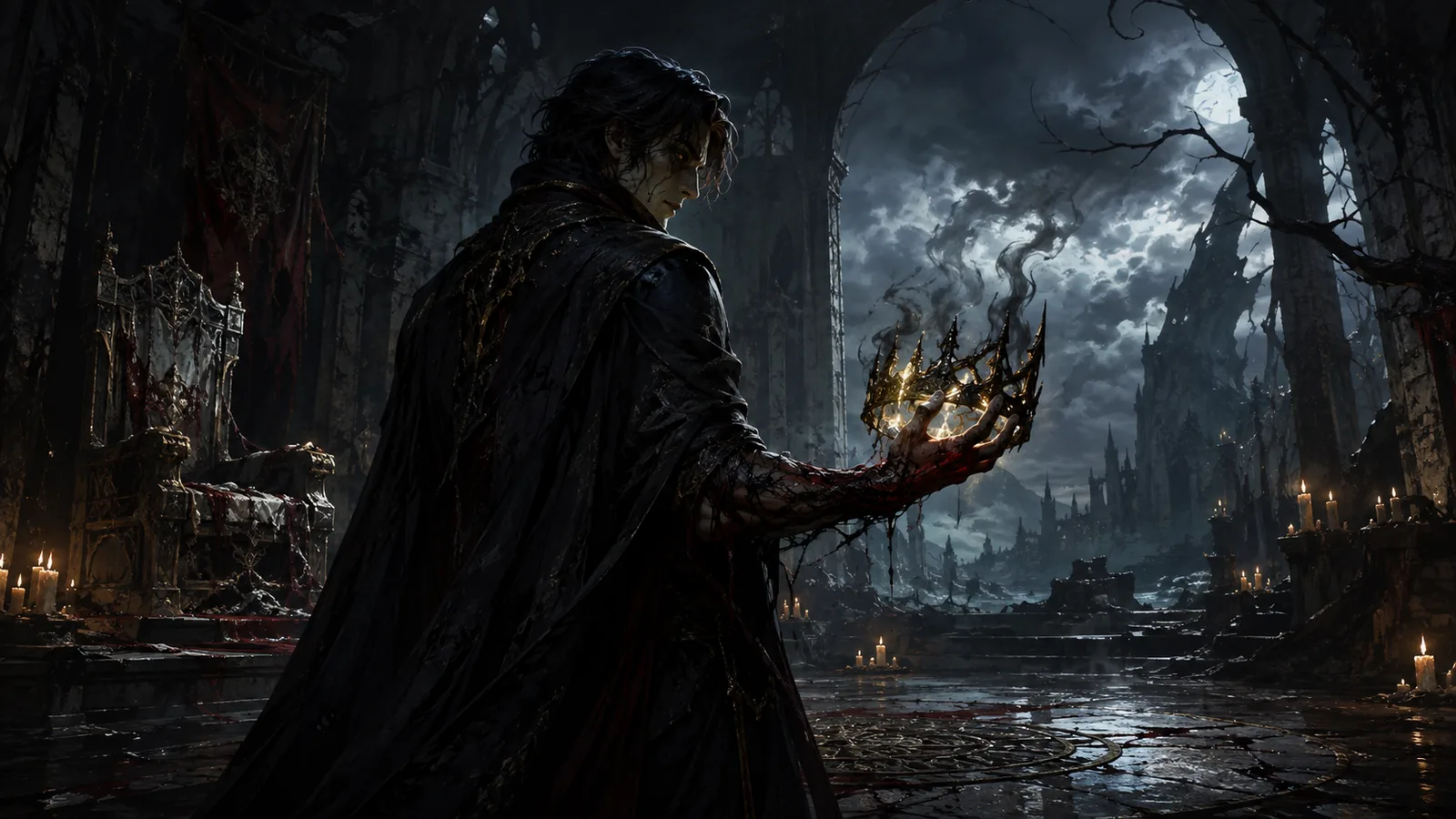
A black castle does not make a fantasy novel dark. Neither does a field of corpses, a villain with antlers, or a prophecy written in blood.
Those images can establish a mood, but mood is easy to imitate. Add rain, ravens, a few executions, and a color palette apparently designed by someone with a personal grudge against daylight. The result may look dark while behaving exactly like conventional heroic fantasy: the chosen one remains morally clean, magic solves the important problems, sacrifice is temporary, and the world rewards the right people at the end.
Dark fantasy asks for more than decoration. It changes the relationship between wonder and safety. The magical world is still seductive, but beauty may conceal appetite. Power may work exactly as promised and still ruin the person who uses it. Victory may be possible, yet the price cannot be returned after the battle.
That is where the darkness lives: not in the number of monsters, but in the consequences the story is willing to keep.
Dark fantasy has never had a perfectly stable border
The term dark fantasy is useful, but it has always been slippery. Critics, publishers, booksellers, and readers have used it for fantasy that incorporates horror, gothic fantasy, supernatural fiction, monster-centered stories, and secondary worlds with unusually bleak or disturbing tones. Roz Kaveney's chapter in The Cambridge Companion to Fantasy Literature emphasizes that the label has shifted over time rather than developing as one fixed category.
That uncertainty is not a failure. Genres are promises, not chemical formulas. A dark fantasy novel may lean toward horror, adventure, romance, myth, historical fiction, or psychological thriller. What matters is the kind of pressure the fantastic elements create.
Ordinary fantasy often asks what becomes possible when magic enters the world. Dark fantasy adds a second question: what becomes impossible to remain once that power is used?
Darkness is not the absence of wonder
The strongest dark fantasy does not eliminate enchantment. It contaminates it.
A forest can be beautiful and hungry. An immortal court can be graceful and incapable of mercy. A magical academy can offer knowledge while teaching students that knowledge belongs to whoever survives the lesson. The attraction matters because darkness without attraction is merely unpleasantness. Readers need to understand why someone would open the door, accept the bargain, wear the crown, or speak the forbidden name.
This mixture of fascination and dread connects dark fantasy to gothic and uncanny traditions. The familiar becomes unstable. The home contains a room that should not exist. The beloved returns with the correct face and the wrong memories. The old ritual protects the village, but nobody can explain what it is protecting the village from - or what it requires in exchange.
Wonder becomes dark when it invites desire before revealing the shape of the cost.
Magic must create pressure, not only spectacle
In lighter adventure fantasy, magic can operate as equipment: a useful ability, a spectacular weapon, or a solution waiting for the correct person. Dark fantasy usually makes power more intimate and more dangerous.
The danger does not require a complicated rulebook. Soft, mysterious magic can be terrifying because nobody understands its intentions. A hard, systematic magic can be equally dark when the rules are clear and the price is unavoidable. A spell that consumes memory is frightening precisely because the caster knows what will happen. A resurrection ritual becomes darker when it succeeds but returns a relationship that can no longer be trusted.
Cost is not the same as inconvenience. A headache after casting is a limitation. Losing the memory of the person you are trying to save is a consequence. A meaningful cost changes identity, loyalty, status, or future possibility. It follows the character after the dramatic scene has ended.
Dark magic is not dark because it glows red. It is dark because using it makes tomorrow narrower.
Moral ambiguity needs real choices
Dark fantasy is frequently associated with morally grey characters, but grey morality does not mean that everyone is equally terrible or that ethics have disappeared.
Moral pressure works only when alternatives exist. A commander who sacrifices a village because there was literally no other possible action may be tragic, but the choice itself contains little ambiguity. A commander who had three options, rejected the slowest one, concealed the risk, and still believes the decision was necessary gives the reader something harder to judge.
The best morally ambiguous decisions protect one value by betraying another. Loyalty conflicts with justice. Mercy endangers the innocent. Truth destroys a fragile peace. Survival requires cooperation with someone whose methods should be opposed. The character is not choosing between a white door and a black door. They are deciding which part of themselves they are willing to damage.
Dark fantasy becomes shallow when cruelty is treated as intelligence and compassion as stupidity. It becomes compelling when kindness is difficult, costly, and still possible.
The world should remember what happened
One of the clearest differences between genuine darkness and decorative darkness is aftermath.
Violence in dark fantasy should leave more than bodies in the scene where it occurred. It changes who controls the road, who inherits the house, which children disappear from the school, which language becomes forbidden, and which survivors can no longer enter a crowded room without checking the exits. A war alters food, law, ritual, architecture, and memory. A magical disaster changes how ordinary people think about magicians long after the crater stops smoking.
This does not require relentless misery. It requires continuity. The story cannot use suffering for intensity and then restore the emotional furniture before the next chapter.
Consequences also create credibility. When institutions adapt, families fracture, rumors spread, and survivors make imperfect accommodations, darkness becomes part of the worldbuilding rather than a temporary filter placed over it.
The most dangerous monsters understand desire
A creature becomes more disturbing when it offers something the victim already wanted.
Dark fantasy monsters are often strongest when they are not obstacles but relationships. The vampire offers intimacy without aging. The faerie court offers beauty without ordinary limits. The cursed sword offers the strength to prevent another defeat. The ancient god offers certainty to a person exhausted by doubt.
The bargain works because the temptation is not foolish. It identifies a wound and promises to close it. The horror comes from the way the promise reorganizes the person who accepts it.
This is also why human institutions can function as monsters. An empire, church, academy, house, or military order may reward ambition while converting every private compromise into public harm. No tentacles are required. The system feeds by persuading people that the next concession will be the last one.
Atmosphere is a system of expectation
Dark fantasy atmosphere is more than fog and old stone. It is the reader's growing belief that the world cannot be taken at face value.
A setting becomes oppressive when details create a pattern. Doors are built with locks on the outside. Every family portrait has one face scratched away. The city celebrates a victory nobody is permitted to describe. Children know a rhyme that adults immediately silence. Each element teaches the reader what kinds of danger are possible before the plot confirms them.
Good atmosphere also varies its pressure. Constant screaming becomes background noise. A warm kitchen, a joke between exhausted companions, or one genuinely safe room can make the surrounding danger feel sharper. Contrast gives darkness scale.
The goal is not to make every page miserable. It is to make safety specific, vulnerable, and worth protecting.
Dark fantasy is not automatically grimdark
Dark fantasy and grimdark overlap, but they are not interchangeable.
Grimdark commonly emphasizes brutality, compromised institutions, cynical power, and protagonists whose victories may reproduce the same damage they oppose. Dark fantasy is broader. It can be tragic or hopeful, intimate or epic, gothic or adventurous. It can contain noble characters without guaranteeing that nobility will protect them.
The presence of hope does not make a story less dark. Tolkien's idea of eucatastrophe depends on the believable possibility of disaster; the upward turn has power because the downward movement was real. Dark fantasy can use a similar contrast. A small act of mercy may matter more in a cruel world than a flawless victory would matter in a safe one.
Nihilism says nothing matters. Darkness says things matter enough to be damaged. Those are not the same promise.
Dark fantasy and horror ask different central questions
The border between dark fantasy and horror is equally porous. Both can use dread, supernatural threat, bodily transformation, isolation, and the uncanny. The difference often lies less in the creature than in the story's center of gravity.
Horror frequently organizes itself around fear, violation, and survival. Dark fantasy usually keeps a stronger investment in the functioning of a fantastic world: its magic, politics, quests, loyalties, and possibilities for action. A haunted kingdom may be horrifying, but the characters may still need to govern it, inherit it, invade it, or decide what kind of kingdom should replace it.
A useful practical test is this: if the terrifying element vanished, would the story still possess a fantasy world with meaningful systems and conflicts? If the answer is yes, the work may lean toward dark fantasy. If the entire structure exists to produce and escalate fear, it may lean more strongly toward horror.
Many of the best works refuse to choose cleanly, which is exactly why the boundary remains productive.
The familiar tropes only work when they change the story
Blood pacts, forbidden books, corrupted kingdoms, bitter prophecies, cursed bloodlines, sacrificial rituals, fallen gods, and final battles with no clean victory are recognizable dark fantasy materials. None of them guarantees depth.
A blood pact matters when it creates an obligation that love cannot cancel. A cursed inheritance matters when refusing it harms people as surely as accepting it. A sacrifice matters when the sacrificed person has a life beyond the function of dying. A bitter ending matters when it completes the moral logic of the story rather than punishing the audience for caring.
Tropes become powerful when they transform relationships. Who now owes whom? Who benefits from the curse? Who knew the price? Who will repeat the ritual because the alternative appears worse? These questions turn imagery into narrative machinery.
What fake darkness looks like
There are several reliable ways to make a story appear darker without making it more meaningful.
One is escalation without consequence: every villain is more sadistic, every death more graphic, every betrayal louder, yet the characters remain emotionally untouched. Another is moral flattening, where every institution is corrupt and every kind action is secretly manipulation. A third is using trauma as a decorative biography that makes a character look dangerous but never shapes behavior, intimacy, or decision-making.
Fake darkness also confuses unpredictability with honesty. A story may kill characters randomly to prove that nobody is safe, but randomness is not automatically realism. Readers do not need safety. They need cause, pressure, and significance.
When darkness becomes a contest to shock the audience, the world starts feeling less dangerous and more desperate for attention.
So what makes dark fantasy truly dark?
Dark fantasy becomes truly dark when the fantastic elements expose costs that ordinary life can hide.
Magic reveals appetite. Immortality reveals what identity cannot survive. Monarchy reveals the violence inside inheritance. Prophecy reveals how easily responsibility can be surrendered to inevitability. Monsters reveal the bargain people were already prepared to make.
The genre does not require hopelessness, but it does require honesty about damage. Choices leave residue. Power changes the user. Institutions remember what they were built to protect and whom they were built to consume. Even a happy ending carries the shape of what almost happened - and what could not be restored.
That is why the darkest fantasy can also contain fierce loyalty, tenderness, humor, and hope. Light matters most when the world has given characters excellent reasons to extinguish it.
The real question is never how much blood appears on the page. It is what the story refuses to wash away.
Continue exploring: Why Morally Grey Characters Are So Hard to Resist and Why Dark Stories Can Feel Comforting When Life Feels Anxious.
Sources & further reading
- Kaveney, Roz (2012) - Dark Fantasy and Paranormal Romance, in The Cambridge Companion to Fantasy Literature, edited by Edward James and Farah Mendlesohn. Cambridge University Press. A discussion of the unstable publishing and critical uses of the dark fantasy label.
- Clute, John, and John Grant, eds. (1997) - The Encyclopedia of Fantasy. Orbit/St. Martin's Press. Includes an influential but contested taxonomy of dark fantasy and related fantastic modes.
- Jackson, Rosemary (1981) - Fantasy: The Literature of Subversion. Methuen. A major theoretical account of fantasy as a mode that exposes cultural absence, desire, and contradiction.
- Todorov, Tzvetan (1975 English translation) - The Fantastic: A Structural Approach to a Literary Genre. Cornell University Press. Useful for understanding hesitation, uncertainty, and the border between natural and supernatural explanation.
- Freud, Sigmund (1919) - The Uncanny. A foundational essay on the disturbing return of what is familiar, repressed, doubled, or made strangely uncertain.
- Tolkien, J. R. R. (1947; later collected in Tree and Leaf) - On Fairy-stories. Particularly relevant to recovery, consolation, dyscatastrophe, and eucatastrophe; the Tolkien Estate's scholarship pages provide a concise overview of these concepts.
- British Library (2023) - Fantasy: Realms of Imagination exhibition materials. Places the modern fantasy tradition in conversation with fairy story, gothic horror, weird fiction, monsters, and uncanny landscapes.
- EBSCO NoveList (2023) - Announcing New Genre: Dark Fantasy. A practical reader-advisory description emphasizing the intersection of fantasy and horror, menacing tones, complex characters, and morally grey protagonists.