
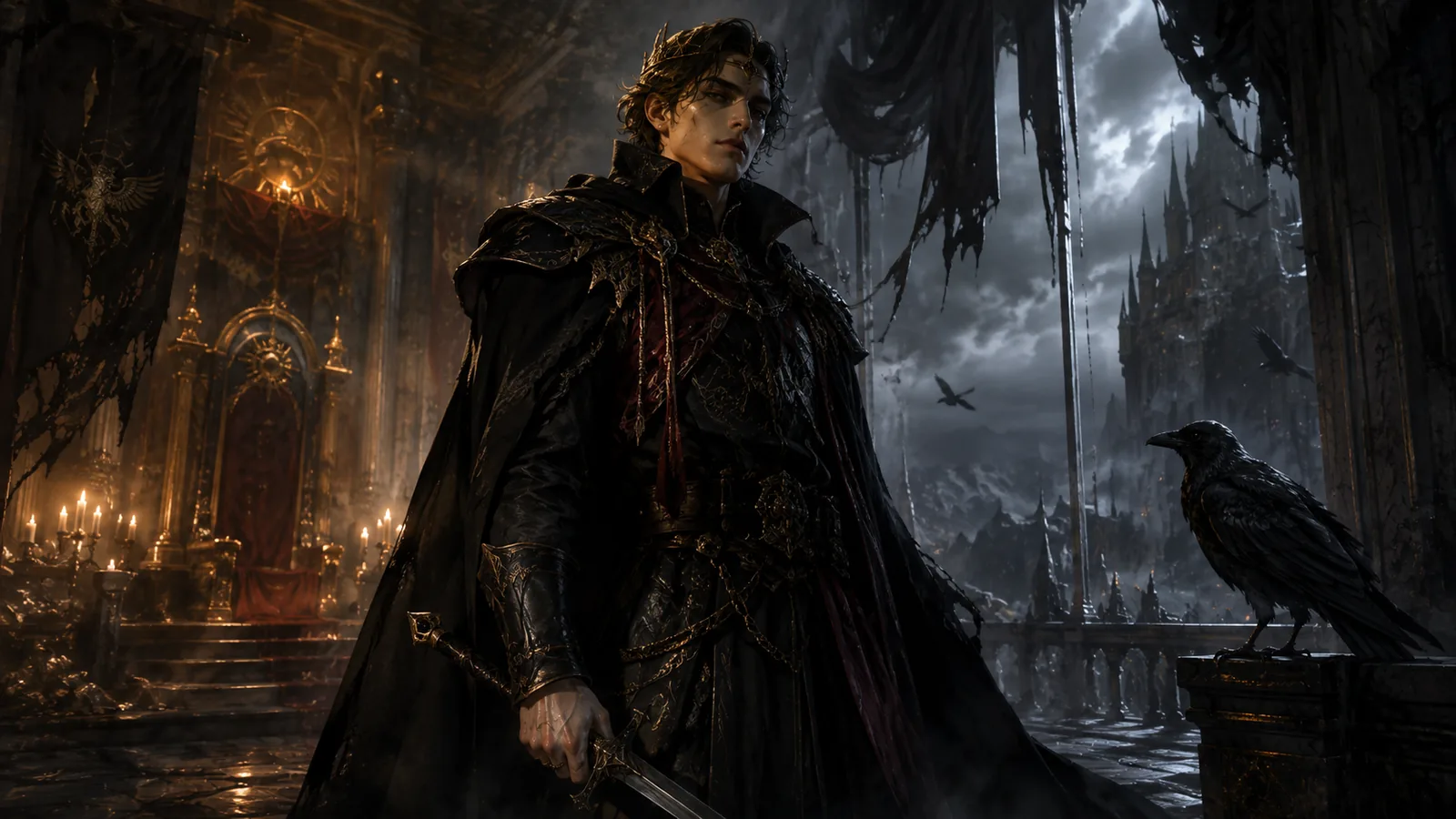
A ruler saves a city by sacrificing the people trapped outside its walls.
A thief protects one child while ruining a hundred strangers. A soldier refuses an immoral order, then carries out a different one because loyalty matters more than innocence. A monster shows tenderness to exactly one person.
Readers know these characters are dangerous. We see the damage they cause. We may even hope someone stops them.
And yet we keep turning the page.
The appeal of morally grey characters is often explained with a shrug: they are more realistic, more interesting, or simply hotter than traditional heroes. Those answers are not entirely wrong, but they are incomplete. Moral ambiguity works because stories can separate understanding from approval. They place us close enough to a character to experience the pressure of a decision, while leaving us far enough away to judge what the decision costs.
That tension creates one of fiction's most powerful questions: how much can we understand before understanding begins to feel like forgiveness?
Morally grey is not another word for villain
A villain can be complex, sympathetic, charming, or even correct about part of the problem. A morally grey protagonist occupies a slightly different position. The story usually gives that character goals we can follow and losses we can feel, while refusing to make every method defensible.
The distinction matters because moral ambiguity is not created by giving a cruel character a sad childhood and declaring the job finished. It comes from conflict between values. The character may protect family but betray strangers, fight oppression while becoming authoritarian, or seek justice through methods that reproduce the harm they hate.
A strong morally grey character has a moral structure. It may be narrow, inconsistent, damaged, or self-serving, but it exists. A random collection of violent acts is not complexity. It is noise.
The story gets the first word
Before readers judge a fictional character, the story decides where we stand.
Point of view determines what we know, when we know it, and whose fear arrives first. If we spend two hundred pages inside one character's mind, we experience insults before retaliation, grief before revenge, and threat before violence. The victim may enter the scene only at the moment the protagonist is already prepared to strike.
That order does not erase responsibility. It changes emotional timing.
Research on antihero narratives suggests that identification can strongly influence character liking. When audiences feel addressed by a character, share a perspective, or experience a sense of complicity, they may identify more deeply even when the character behaves immorally. Fiction does not merely show us an action. It lets us inhabit the chain of thought that made the action feel possible.
This is why the same deed can feel radically different when performed by a distant antagonist or by a protagonist whose fears, loyalties, and rationalizations we have followed for hours.
Understanding is not the same as agreement
Readers often worry that liking an antihero means endorsing what the antihero does. In practice, our responses are more divided.
We can admire courage and condemn the cause. We can enjoy competence while rejecting the goal. We can recognize trauma without treating trauma as permission. We can want a character to survive because survival might create the possibility of change, confession, punishment, or one final decent choice.
Experimental research on morally ambiguous characters has found that audiences can enjoy them even when they are liked less than conventionally good characters. Moral approval is therefore not the only route to engagement. Suspense, transportation, curiosity, and cognitive involvement can remain strong even when affection is complicated.
That complication is the point. A perfect hero asks, "Will goodness succeed?" A morally grey character asks, "Which part of this person will win today?"
Fiction gives us permission to suspend judgment - temporarily
Psychologist Albert Bandura used the term moral disengagement to describe ways people loosen the connection between moral standards and harmful behavior. The concept was developed to explain real conduct, not literary taste, but entertainment researchers have used it to examine how audiences process antiheroes.
Stories can make a character's wrongdoing easier to tolerate by framing it as necessary, minimizing the consequences, shifting responsibility to a corrupt system, comparing it with something worse, or emphasizing the guilt of the target. None of these techniques proves that the action is right. They create enough psychological distance for the audience to remain inside the narrative.
The classic antihero defense is not "this is good." It is "there was no other way," "the enemy was worse," "anyone in that position would have done the same," or "the victim chose the risk."
The most honest stories eventually test those excuses. The weakest ones repeat them until charisma replaces accountability.
Competence is seductive
Morally grey characters are often extremely capable. They see the trap before everyone else, make the decision others avoid, and act while traditional heroes are still arguing about principles.
Competence creates narrative gravity. A person who can change the situation becomes difficult to ignore, even when the change is frightening. Readers may not want to live under the ruthless queen, follow the assassin, or trust the manipulative strategist, but we want to know what happens when they enter the room.
This appeal grows when competence carries a cost. The calculating commander cannot form ordinary relationships. The brilliant investigator destroys trust. The immortal ruler wins every political contest and loses the ability to believe affection is sincere.
Power without cost becomes wish fulfillment. Power with emotional, social, or moral consequences becomes character.
Selective tenderness changes the scale
One of the oldest techniques for humanizing a dangerous character is selective tenderness: the killer feeds a stray animal, the tyrant protects a sibling, the mercenary keeps one promise no matter the price.
This works because cruelty and care seem incompatible, so the contradiction demands interpretation. The tender act suggests the character is capable of recognizing value. The obvious question is why that recognition stops at such a narrow border.
Used well, selective tenderness reveals the limits of the character's morality. Used badly, it becomes a cheap absolution: one rescued child offered as payment for a mountain of bodies.
The difference lies in whether the story remembers the bodies.
Relative morality makes monsters look reasonable
A character is never judged in a vacuum. Fiction surrounds them with alternatives.
Place a ruthless commander beside a genocidal emperor, and ruthlessness begins to resemble restraint. Put a criminal inside a government built on exploitation, and rebellion can make criminality look principled. Give the antihero a code while the villains have none, and the code becomes morally significant even if it is far below the standard readers would accept in ordinary life.
This relative comparison is one reason dark fantasy, crime fiction, political thrillers, and dystopian stories produce so many morally grey protagonists. The world narrows the available choices. The reader is not choosing between purity and corruption. The reader is choosing between forms of damage.
The danger is that a story can manipulate the scale by making everyone else cartoonishly worse. If the protagonist appears decent only because every surrounding character is sadistic, moral complexity has been replaced by a rigged comparison.
Uncertainty keeps the character alive
Traditional heroes often have stable moral identities. We may not know whether they will win, but we usually know what they will refuse to become.
With a morally grey character, identity itself becomes suspense. Will they keep the promise? Will loyalty outweigh ambition? Will they repeat the betrayal? Are they moving toward redemption, deeper corruption, or merely a more honest version of the same code?
This uncertainty creates a special kind of attention. Every small decision feels diagnostic. A refusal, apology, hesitation, or unnecessary act of cruelty becomes evidence in an argument the reader is conducting about who the character really is.
That is why these characters inspire so much discussion. The text does not simply provide a moral verdict. It recruits the audience to build one.
Why flawless heroes sometimes feel less human
A consistently virtuous hero can be compelling. Integrity under pressure is not boring. The problem begins when virtue eliminates conflict.
If the hero always knows the correct choice, never desires the wrong thing, and pays no meaningful price for goodness, morality becomes decoration. The character may represent an ideal without feeling like a person making decisions.
Morally grey characters expose the machinery of choice. They want incompatible things. Their virtues create some of their worst actions: loyalty becomes tribalism, courage becomes recklessness, discipline becomes control, love becomes possession.
That distortion feels recognizably human because real moral failure rarely arrives wearing a label that says evil. It often grows from a value applied too narrowly, too absolutely, or only to people inside the circle.
Consequences are what keep ambiguity from becoming endorsement
A story does not need to punish every antihero with death, imprisonment, or public humiliation. Mechanical punishment is not the same as moral seriousness.
It does need to understand that actions alter the world. Trust should break. Victims should exist as more than scenery. Power should reshape relationships. A character who repeatedly chooses cruelty cannot remain emotionally untouched unless that numbness is itself part of the cost.
Research also suggests that audiences place limits on how far positive feelings can bend moral judgment. Affection can bias evaluation, but the magnitude of a violation still matters. There is a point at which the story's excuses fail.
Good moral ambiguity lives near that boundary. It does not remove the line. It makes us watch the character approach it.
Redemption is powerful because it is uncertain
Many readers root for morally grey characters because they see unrealized possibility.
The character has already shown courage, loyalty, intelligence, or tenderness. Those traits could support a better life if the person widened their moral world. The hope is not that the past disappears. It is that the next choice might break the pattern.
A convincing redemption arc therefore requires more than regret. It requires recognition of harm, changed behavior, sacrifice without guaranteed reward, and acceptance that forgiveness may not arrive.
Not every morally grey character needs redemption. Some are more powerful as tragedies, warnings, or portraits of self-deception. But even then, readers may root for the moment of clarity - the instant when the character finally understands what they became.
How writers make moral ambiguity feel earned
The most effective morally grey characters tend to share several structural qualities.
Their motives are understandable, but not automatically sufficient. Their choices solve one problem while creating another. Their virtues and flaws grow from the same core. Other characters are allowed to disagree intelligently. Victims remain visible. Consequences accumulate. The narrative does not demand a single emotional response.
Most importantly, the story distinguishes explanation from exoneration.
A painful history can explain why a ruler fears weakness. It cannot make every act of repression harmless. Love can explain obsession. It cannot transform possession into devotion. Survival can explain betrayal. It cannot decide whether the betrayed person owes forgiveness.
Readers are more willing to follow darkness when the story trusts them to see it.
We root for possibility, not innocence
Morally grey characters are compelling because they keep several truths alive at once.
A person can be wounded and dangerous. Loyal and selfish. Loving and controlling. Capable of change and still responsible for what came before. Fiction lets us remain with those contradictions longer than ordinary judgment usually allows.
We do not always root for the character to win. Sometimes we root for them to stop. To confess. To choose one person over power. To discover that the excuse they have repeated for years is no longer believable.
The perfect antihero does not make evil look good. They make choice look difficult, consequence unavoidable, and change possible but expensive.
That is much harder to resist than perfection.
Continue exploring: What Makes Dark Fantasy Truly Dark? and Why Dark Stories Can Feel Comforting When Life Feels Anxious.
Sources & further reading
- Krakowiak, K. M., & Oliver, M. B. (2012) - When Good Characters Do Bad Things: Examining the Effect of Moral Ambiguity on Enjoyment. Journal of Communication, 62(1), 117-135.
- Shafer, D. M., & Raney, A. A. (2012) - Exploring How We Enjoy Antihero Narratives. Journal of Communication, 62(6), 1028-1046.
- Krakowiak, K. M., & Tsay-Vogel, M. (2015) - The Dual Role of Morally Ambiguous Characters: Examining the Effect of Morality Salience on Narrative Responses. Human Communication Research, 41(3), 390-411.
- Janicke, S. H., & Raney, A. A. (2015) - Exploring the Role of Identification and Moral Disengagement in the Enjoyment of an Antihero Television Series. Communications, 40(4), 485-495.
- Oliver, M. B., Bilandzic, H., & Cohen, J. (2019) - A Penchant for the Immoral: Implications of Parasocial Interaction, Perceived Complicity, and Identification on Liking of Anti-Heroes. Human Communication Research, 45(2), 169-201.
- Sanders, M. S. (2019) - Detecting the Boundaries of Disposition Bias on Moral Judgments of Media Characters' Behaviors Using Social Judgment Theory. Journal of Communication, 69(4), 418-444.
- Bandura, A. (1999) - Moral Disengagement in the Perpetration of Inhumanities. Personality and Social Psychology Review, 3(3), 193-209.