
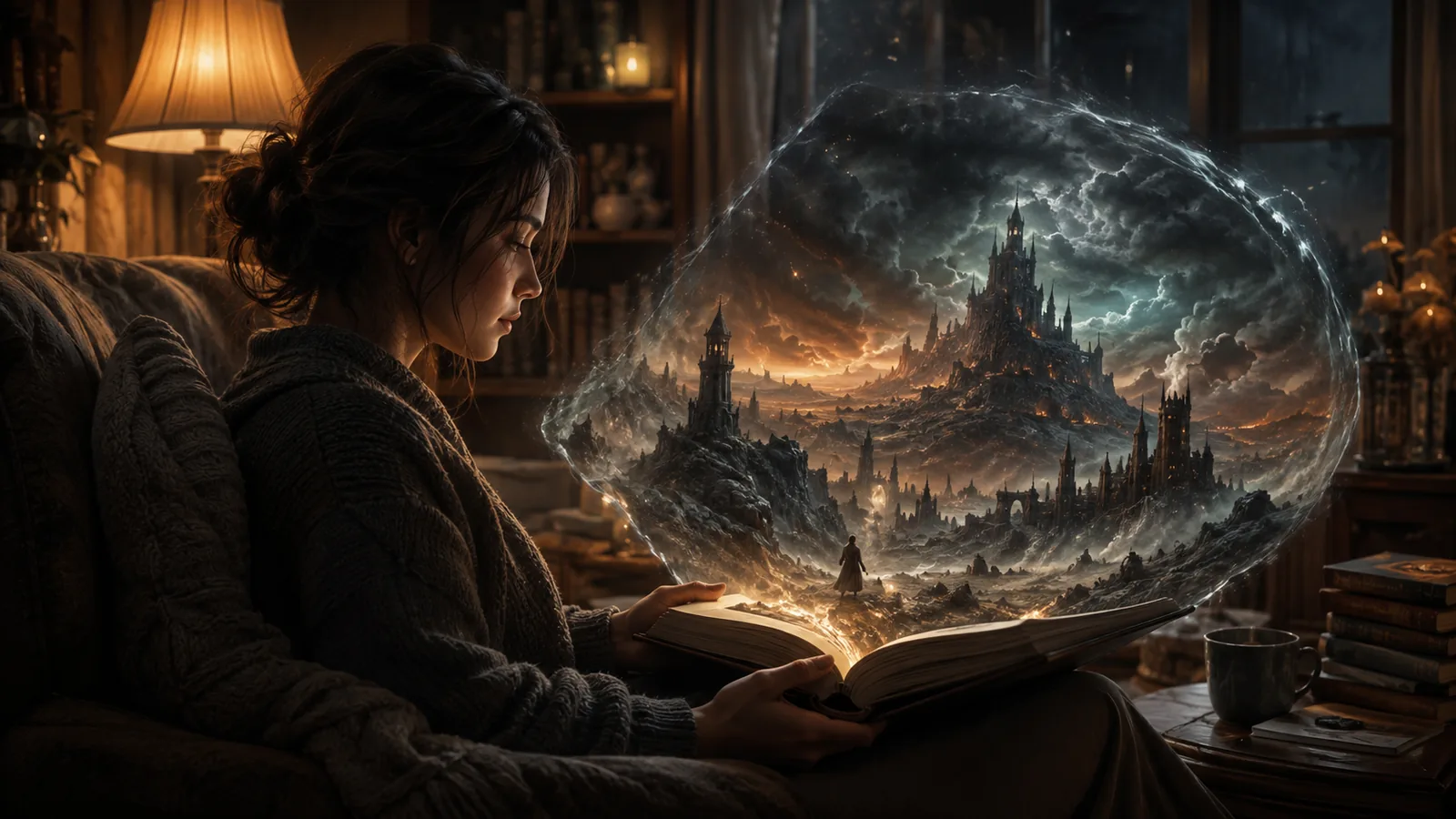
When the world feels unstable, the obvious reading choice should be something gentle.
Yet many people do the opposite. They reach for haunted houses, collapsing civilizations, impossible plagues, doomed expeditions, brutal kingdoms, and stories in which the future has gone terribly wrong. During anxious periods, horror and dystopia do not disappear from reading lists. They often become more attractive.
At first, this seems irrational. Why add fictional fear to real stress? Why spend an evening inside an apocalypse when the news already feels close enough to one?
The answer is not that dark stories magically cure anxiety. They do not, and they affect readers differently. Their comfort comes from something more precise: fiction can transform a vague, uncontrolled feeling into a designed experience. The danger has a name. The world has rules. Someone is making choices. The final page exists.
Real anxiety is often frightening because it has no clear border. Dark fiction draws one.
Fictional fear comes with an exit
The most important difference between a frightening story and a frightening life is control.
A reader can close the book. A viewer can pause the film. Even when the fictional world feels overwhelming, the experience takes place inside a frame chosen by the audience. The monster may be terrible, but it cannot enter the room. The plague may spread across continents, but it stops when the chapter stops.
Researchers describe this kind of voluntary engagement as recreational fear: a mixed state in which fear and enjoyment can coexist because the threat is experienced as play rather than immediate danger. A field study conducted in a haunted attraction found that enjoyment was highest not at the lowest or highest levels of fear, but around a personal 'just right' zone. Too little fear was dull. Too much became unpleasant. Between them was intensity without helplessness.
Books offer especially fine control over that intensity. Readers choose the pace, reread a confusing paragraph, skim a gruesome detail, or step away. The story can produce genuine dread while preserving a deeper signal of safety: this is happening in imagination, and participation remains voluntary.
That combination makes darkness easier to approach. It is fear with a door behind it.
Dark stories give shapeless anxiety a shape
Everyday anxiety is often diffuse. It can be attached to work, money, health, technology, climate, politics, family, or a future that refuses to become predictable. The mind senses danger without knowing exactly where to point.
Dark fiction converts that uncertainty into an object. The haunted house contains the past. The tyrant represents concentrated power. The monster embodies hunger, contamination, grief, invasion, or loss of control. The dystopian state turns invisible systems into uniforms, cameras, checkpoints, and laws. The apocalypse gives collapse a date, a cause, and a visible landscape.
This does not make the fictional danger simple. Good dark stories preserve ambiguity. But they organize it. They allow a reader to think, 'This is what the threat looks like here. These are its rules. These are the choices available.'
A fear that has form can be examined. It can be anticipated, interpreted, argued with, and sometimes defeated. Even when the ending is tragic, the narrative provides sequence: before, during, after. Real anxiety often feels endless because it does not announce which stage we are in.
Stories impose structure on dread, and structure can feel like relief.
We are curious about danger for a reason
The attraction to dark material is not necessarily a sign that something is wrong with the audience. Psychologists use the term morbid curiosity to describe an interest in information involving death, violence, harm, or threat. In this context, 'morbid' does not mean unhealthy. It identifies the subject of the curiosity.
Behavioral studies have shown that people sometimes choose intense negative information even when neutral alternatives are available. Other research has found that decisions to view morbid images can involve reward-related brain systems. The negative content is unpleasant, but it is also information-rich. It may reveal what happened, why it happened, who caused it, and what could happen next.
Dark stories satisfy that information-seeking impulse without requiring direct exposure to danger. A psychological thriller lets us study deception. A horror story makes us watch a boundary fail. An apocalypse asks what systems survive when normal rules disappear. A dystopia examines how ordinary conveniences can become instruments of control.
Curiosity does not erase fear. It changes the reader's position from passive target to active observer. Instead of merely feeling that something is wrong, the reader looks closer.
Apocalypse offers rehearsal without prophecy
One influential explanation for the appeal of frightening fiction is threat simulation. Stories let audiences model dangerous situations at low cost. They can watch characters gather information, make plans, misjudge risks, cooperate, betray one another, and adapt when the first plan fails.
A study conducted during the COVID-19 pandemic reported that horror fans showed greater psychological resilience, while fans of pandemic, zombie, alien-invasion, and apocalyptic genres reported greater preparedness as well as resilience. The researchers interpreted the pattern as consistent with the idea that frightening fiction may provide practice with dangerous scenarios.
That finding is interesting, but it should not be turned into a universal law. A 2026 study of university students living through chronic political, economic, and war-related instability in Lebanon found strong links between morbid curiosity and preferences for dark genres, but no positive association between those preferences and resilience. Context mattered. Fictional rehearsal may work differently during a temporary crisis than during prolonged real-world danger.
The careful conclusion is that apocalyptic stories can provide a mental model, not immunity. They allow readers to imagine scarcity, uncertainty, and collective failure while still standing outside the disaster. The value may lie less in learning how to survive a specific catastrophe and more in rehearsing a general question: what would I notice, protect, abandon, or become if ordinary life stopped working?
Dark worlds restore agency
Anxiety frequently involves the anticipation of harm combined with uncertainty about what can be done. Dark fiction may be bleak, but it is rarely motionless. Characters search, flee, investigate, fortify, bargain, resist, sacrifice, or make disastrous decisions. They act.
Agency does not require a happy ending. A doomed character can still choose how to face the end. A citizen trapped in a dystopia can recognize the system even if escape is impossible. A survivor can protect one person when the world cannot be saved. A gothic protagonist can open the locked room instead of spending the entire novel pretending it is not there.
These choices matter because the reader experiences fear through a sequence of decisions. The story asks not only, 'What is happening?' but also, 'What can be done now?' That question is often more psychologically manageable than a general feeling of powerlessness.
Dark fiction can also make failure informative. A character's mistake reveals a rule. A betrayal clarifies a relationship. A collapsed plan narrows the possibilities. Even disaster produces knowledge, and knowledge is one form of agency.
The ending creates a boundary real life may not provide
A dark story can be emotionally intense because the reader knows, somewhere beneath the tension, that the experience is finite.
The final confrontation may not restore the world. The monster may survive. The empire may win. The survivors may discover that safety was an illusion. But the narrative still arrives somewhere. The author selects a last image and closes the sequence.
That closure distinguishes a story from doomscrolling. Endless streams of alarming information rarely offer proportion, completion, or a stable point of view. Each update opens another uncertainty. Dark fiction, by contrast, shapes attention. It decides what belongs to the story, what the threat means, and when the experience is complete.
This is one reason a devastating novel can leave a reader calmer than an hour of fragmented headlines. The novel may be darker, but it is not endless. It contains the fear instead of continually refreshing it.
Fear can create emotional contrast
Relief is stronger when it follows tension. Safety feels more noticeable after danger has been imagined. Ordinary rooms, familiar voices, warm food, and quiet streets can acquire new weight after a story has temporarily removed them.
This contrast does not mean readers enjoy suffering. It means emotions are experienced relationally. Darkness changes the value of light. A brief act of loyalty matters more in a cruel world. A peaceful morning feels precious after a night spent reading about a siege. Hope becomes visible when the story makes it difficult.
The same principle explains why many memorable dark stories are not emotionally flat. They contain humor, tenderness, beauty, and companionship precisely because the surrounding world threatens those things. Readers are not always seeking despair. Often they are seeking proof that something remains worth protecting inside it.
A story can therefore be comforting without being comfortable.
Dark fiction can provide a language for difficult feelings
Some emotions are easier to discuss through metaphor than direct confession. A curse can represent inherited pain. A haunted house can hold memory that a family refuses to name. A body-transforming monster can express fear of illness or loss of identity. A surveillance state can dramatize the feeling of being watched, measured, and judged by systems too large to confront directly.
The metaphor creates distance without making the emotion unreal. Readers can recognize themselves without being forced to describe themselves. They can say, 'This story understands the feeling,' even when the plot is impossible.
Fiction also supplies shared references. Two readers may disagree about politics, psychology, or personal experience yet still discuss the choices made by a character during a collapse. The invented world becomes neutral territory for talking about trust, fear, sacrifice, control, and responsibility.
Sometimes the comfort is not that the story solves a feeling. It is that the feeling is no longer private or formless.
When dark stories do not help
None of this means that everyone should read horror when anxious. The same material that feels containing to one person may feel intrusive or exhausting to another. Intensity, timing, personal history, current stress, and the reader's sense of control all matter.
A useful test is not whether a story is objectively dark. It is what happens to the reader afterward. Does the experience feel absorbing, clarifying, energizing, or complete? Or does it prolong distress, disturb sleep, trigger unwanted memories, or make ordinary life harder to reenter?
The distinction between chosen fear and unwanted overwhelm is central. Recreational fear depends on safety, control, and an intensity that remains tolerable. Once those conditions disappear, the same story may stop feeling like play.
Dark fiction is also not a substitute for mental health care. It can be meaningful entertainment, a form of reflection, or a temporary way to redirect attention. It is not evidence-based treatment for an anxiety disorder, trauma, or depression, and readers should not force themselves through material that makes them feel worse.
The comfort is not in the catastrophe
People do not necessarily turn to dark stories because they want the world to end. They turn to them because fictional catastrophe makes fear legible.
The story gives danger a body, uncertainty a sequence, and helplessness a set of choices. It permits curiosity without direct risk. It creates tension inside a frame the reader can leave. It provides an ending when real life continues without one.
This is why horror, dystopia, and apocalypse can become strangely attractive during anxious times. Their darkness is not always an escape from reality. Sometimes it is a model of reality with sharper edges - one that can be examined from a safe distance and returned to the shelf.
The comfort is not that terrible things happen. It is that, for a few hundred pages, terror has rules - and the reader still has the power to close the book.
Continue exploring: What Makes Dark Fantasy Truly Dark? and Why Morally Grey Characters Are So Hard to Resist.
Sources & further reading
- Scrivner, Coltan; Johnson, John A.; Kjeldgaard-Christiansen, Jens; and Clasen, Mathias (2021) - Pandemic Practice: Horror Fans and Morbidly Curious Individuals Are More Psychologically Resilient During the COVID-19 Pandemic, Personality and Individual Differences 168, 110397. A survey study associating horror fandom with resilience and prepper-genre fandom with preparedness and resilience during the early pandemic. DOI: 10.1016/j.paid.2020.110397.
- Affan, Rawad et al. (2026) - Horror Fandom, Morbid Curiosity, and Psychological Resilience amid War Conflict and Economic Crisis among University Students in Lebanon, BMC Psychology 14, 1037. Found strong links between morbid curiosity and dark-genre preferences but no positive association with resilience in a chronic multi-crisis context. DOI: 10.1186/s40359-026-04792-z.
- Andersen, Marc Malmdorf et al. (2020) - Playing With Fear: A Field Study in Recreational Horror, Psychological Science 31(12), 1497-1510. Found an inverted-U relationship between fear and enjoyment in a haunted attraction, supporting the idea of a personally 'just right' fear level. DOI: 10.1177/0956797620972116.
- Oosterwijk, Suzanne (2017) - Choosing the Negative: A Behavioral Demonstration of Morbid Curiosity, PLOS ONE 12(7), e0178399. Demonstrated that participants deliberately chose to view negative social information involving death, violence, or harm. DOI: 10.1371/journal.pone.0178399.
- Oosterwijk, Suzanne et al. (2020) - Choosing to View Morbid Information Involves Reward Circuitry, Scientific Reports 10, 15291. Examined the neural and decision-making processes involved in voluntarily seeking negative information. DOI: 10.1038/s41598-020-71662-y.
- Martin, G. Neil (2019) - (Why) Do You Like Scary Movies? A Review of the Empirical Research on Psychological Responses to Horror Films, Frontiers in Psychology 10, 2298. Reviews competing explanations for horror enjoyment and emphasizes individual differences and mixed evidence. DOI: 10.3389/fpsyg.2019.02298.
- Wimmer, Lena et al. (2024) - Cognitive Effects and Correlates of Reading Fiction: Two Preregistered Multilevel Meta-Analyses, Journal of Experimental Psychology: General 153(6), 1464-1488. Found small average cognitive benefits of fiction reading while emphasizing that broad claims require caution. DOI: 10.1037/xge0001583.
- Schwering, Steven C. et al. (2022) - Exploring the Relationship Between Fiction Reading and Emotion Recognition, Affective Science. Reported associations between fiction reading experience and recognition of complex emotions in context. PMID: 36043173.