
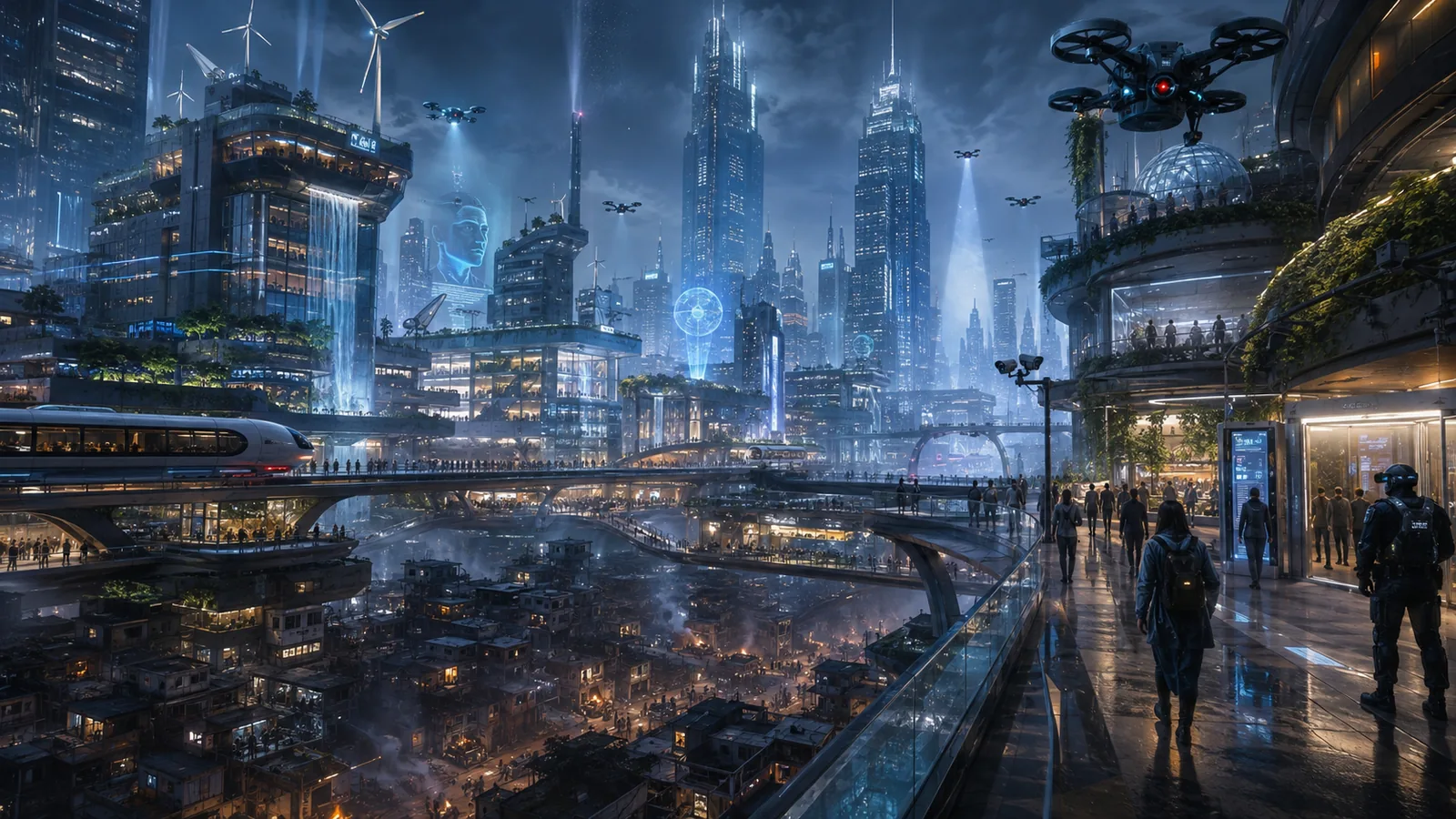
The future has an annoying habit of arriving as a bundle deal.
A phone can place a library, a camera, a map, a translator, and nearly everyone you know in one pocket. The same device can record location, behavior, purchases, social relationships, and attention. A network can help a dissident reach the world, help a family find shelter before a storm, or help an institution observe people at a scale no secret police of the twentieth century could afford.
So which future did science fiction predict: utopia or dystopia?
Both - and neither. Science fiction is most useful when it stops behaving like a catalogue of inventions and starts behaving like a laboratory for consequences. It does not merely ask whether a technology can exist. It asks who owns it, who understands it, who is excluded from it, and what happens when convenience becomes infrastructure and infrastructure becomes power.
The future emerging around us is not a clean victory for paradise or collapse. It is a patchwork in which utopian capacities and dystopian incentives frequently run through the same cable.
Science fiction is not a crystal ball
Popular discussions often reward science fiction for guessing correctly. A writer imagined video calls, artificial intelligence, genetic engineering, or a permanent flow of advertising, and the story is treated as prophecy. The resemblance can be fascinating, but it also misunderstands what speculative fiction usually does best.
Prediction tries to identify what will happen. Speculation asks what might happen if a visible tendency continues, combines with another force, or falls under a particular kind of control. The difference matters. A novel can be technologically wrong and socially perceptive. It can miss the shape of a device while understanding the appetite that will build it.
That is why George Orwell remains relevant without having predicted smartphones, and why Aldous Huxley remains relevant without designing an attention economy. Their lasting power comes from models of authority, distraction, conformity, language, pleasure, and fear. The machinery changes. The incentives are disturbingly portable.
Science fiction predicts futures least reliably when it describes hardware and most reliably when it describes what powerful institutions may want hardware to do.
Utopia and dystopia are arguments about systems
Utopia is often mistaken for a place where every problem has disappeared. Dystopia is treated as the same picture after someone turns off the lights and hires more guards. Both definitions are too simple.
A serious utopia is not merely comfort. It is an argument about how work, care, housing, knowledge, ownership, conflict, and responsibility could be organized differently. A dystopia is not merely suffering. It is a system that presents its suffering as necessary, efficient, natural, or invisible.
This is why the boundary between them depends on perspective. A perfectly ordered city may look utopian from the observation tower and dystopian from the district whose residents cannot leave. A society freed from dangerous labor may appear humane until the people who own the machines also own access to food, housing, and political voice. A medical system capable of predicting illness can extend life, discriminate against risk, or do both at once.
The question is not whether a future contains advanced technology. The question is how that future distributes agency.
Why dystopia often feels more prophetic
Dystopias possess a structural advantage: conflict is visible. A camera follows the person resisting the system, not the thousands of maintenance workers quietly keeping clean water available. Oppression generates plot. Competent public administration rarely gets a dramatic soundtrack.
Fear also compresses complexity. It is easier to imagine one tyrant activating a surveillance network than millions of people exchanging privacy for convenience, businesses monetizing the resulting data, governments purchasing access, and algorithms turning scattered records into decisions. The dictator is narratively efficient. The supply chain is usually more realistic.
Dystopian fiction also extrapolates from harms that already have victims. Readers recognize censorship, forced labor, environmental sacrifice zones, racial classification, reproductive control, and manufactured scarcity because none of them needed science fiction to be invented. A futuristic setting can make an old mechanism visible again by removing the language that once made it seem ordinary.
Dystopia feels prophetic because it often describes the future tense of a present injustice.
Surveillance arrived through convenience, not a single telescreen
Classic surveillance dystopias imagined centralized observation: the state watches, the citizen obeys, and privacy disappears under direct coercion. Modern surveillance is frequently more fragmented and more intimate. People carry sensors voluntarily because those sensors are useful. Private platforms collect behavior for commercial reasons. Public agencies may seek access through law, purchase, partnership, or technical exploitation.
The United Nations has repeatedly treated privacy in the digital age as a human-rights problem, and its reporting on the surveillance industry has emphasized weak transparency, limited public scrutiny, and inadequate accountability. The warning is not that every connected device creates a dictatorship. It is that data collected for one purpose can migrate into another system whose incentives the user never approved.
The dystopian feature is not simply being seen. It is losing the ability to know who is seeing, what conclusion is being drawn, and how to challenge it. The utopian counterpart is not a world without data. It is a world where collection is limited, oversight is real, security is strong, and people retain meaningful rights over decisions made about them.
Artificial intelligence makes the old question faster
Stories about artificial intelligence often focus on consciousness: will the machine awaken, rebel, love, suffer, or decide that humanity is inefficient? Real systems can transform society long before any machine becomes a person.
The immediate issue is delegated judgment. Algorithms can rank applicants, detect fraud, recommend medical attention, filter information, guide weapons, allocate attention, or identify patterns too large for a human team to process. Each use can be valuable. Each can also scale error, conceal responsibility, and make a contested political choice look like a neutral technical result.
UNESCO's global Recommendation on the Ethics of Artificial Intelligence centers human dignity, rights, transparency, fairness, and human oversight. The European Union's AI Act and the United Nations Global Digital Compact likewise show that governance is not an afterthought to the technology story; it is the story. Regulation may succeed, fail, arrive unevenly, or create new problems, but its existence proves that societies are not passive audiences waiting for a prewritten future.
The most credible AI dystopia is not a robot announcing tyranny. It is an institution saying that no person is responsible because the system produced the answer. The corresponding utopia is not a benevolent superintelligence. It is accountable automation that expands human capacity without erasing human appeal, judgment, or dignity.
Climate fiction is becoming less speculative - and more politically revealing
Climate dystopias once seemed to belong safely to distant centuries: drowned coastlines, mass displacement, failed harvests, unlivable heat, and governments protecting borders more aggressively than people. The distance has narrowed.
The World Meteorological Organization's State of the Global Climate 2025 report confirms that 2015 through 2025 were the hottest eleven years on record and documents continuing ocean warming, ice loss, and destructive extreme events. The dystopian element is not only the physical danger. It is the unequal map of exposure. People who contributed least to a crisis often possess the fewest resources to escape, insure, rebuild, or influence policy.
Yet climate technology also demonstrates why a purely dystopian reading is incomplete. Forecasting, satellite observation, resilient infrastructure, renewable energy, and early warning systems are forms of collective foresight that previous societies could barely imagine. The United Nations reports that disaster mortality is dramatically lower where robust multi-hazard warning systems exist. The International Energy Agency expects global renewable capacity to roughly double from 2025 to 2030, led largely by solar power.
Those facts do not cancel the crisis. They reveal the central tension of climate science fiction: humanity can understand the danger and build part of the response while still failing to distribute protection quickly or fairly enough.
The connected world is both liberation and exclusion
A utopian network connects knowledge, education, medicine, culture, and political participation. A dystopian network manipulates attention, spreads disinformation, concentrates wealth, and turns disconnection into social exile. The real network does all of these things.
The International Telecommunication Union estimated that about six billion people were online in 2025, an extraordinary expansion of access within a single generation. It also reported that roughly 2.2 billion people remained offline, with persistent gaps in affordability, skills, quality, geography, and security. Even successful technology can produce a new inequality: not simply access versus no access, but fast versus slow, safe versus exposed, creator versus raw material.
Science fiction often represents inequality through walls, levels, planets, or sealed cities because spatial division is easy to see. Digital division is harder. Two people may use the same platform while possessing radically different control over what it extracts from them and what opportunities it provides.
The question is no longer whether the world will be connected. It is what kind of citizenship connection will require.
Utopia is not perfection; it is maintained possibility
Dystopia is easy to recognize after the prisons are built. Utopia is harder to recognize because it often looks like maintenance: reliable water, public health, accessible education, clean energy, fair procedures, safe transit, protected time, and institutions capable of learning from failure.
This makes utopian fiction difficult but essential. A perfect society has no tension and usually no credibility. A living utopia must contain disagreement, scarcity, grief, ambition, and error while refusing to treat domination as the only realistic way to manage them. Writers such as Ursula K. Le Guin and Octavia E. Butler made utopian thought more interesting by showing communities that are incomplete, contested, compromised, or dependent on continuous moral labor.
The opposite of dystopia is not a flawless machine. It is a society that can identify harm, hear the people experiencing it, and alter its systems before suffering becomes sacred tradition.
A believable utopia therefore needs politics. It needs procedures for conflict, limits on power, and room for people to say no.
The future will probably be a patchwork
The cleanest fictional futures are often geographically or socially uniform. Everyone lives under the same regime. Every city uses the same technology. One discovery changes civilization in the same way everywhere.
Reality is messier. A medical breakthrough can coexist with inaccessible care. A low-carbon power grid can coexist with climate displacement. Advanced automation can shorten one person's workweek while making another person's employment more precarious. Strong privacy rights can exist beside an economy designed to reward relentless data collection.
This unevenness explains why people can sincerely describe the same period as miraculous and catastrophic. Their evidence may come from different positions inside the same system.
Science fiction that understands this does not ask whether humanity enters utopia or dystopia on a particular date. It asks which groups receive the utopian version of a technology, which groups receive the dystopian version, and what political choices maintain the difference.
What science fiction predicts best
Science fiction rarely predicts the future as an event. It predicts pressure.
It predicts that institutions will use new capacities to pursue old goals. It predicts that convenience can become dependency, that emergency powers can outlive emergencies, that inequality changes the meaning of invention, and that people will accept astonishing systems when those systems arrive gradually and solve a real problem.
It also predicts that humans organize, adapt, care for strangers, build public goods, regulate dangerous practices, and imagine arrangements that once sounded impossible. Utopian thinking is not optimism without evidence. It is the refusal to treat the current distribution of power as a law of nature.
The most honest answer to dystopia versus utopia is therefore uncomfortable: science fiction is not choosing our future for us. It is showing us the architecture of choices that are already being made.
The gadget is rarely the prophecy. The prophecy is who gets to decide what the gadget is for.
Continue exploring: Cyberpunk, Grimdark, and Hard Science Fiction: Three Genres Readers Often Misunderstand and From Asimov and Lovecraft to Today: How Genre Fiction Changed.
Sources & further reading
- Fitting, Peter (2010) - Utopia, Dystopia and Science Fiction, in The Cambridge Companion to Utopian Literature, edited by Gregory Claeys. Cambridge University Press. A useful overview of the central relationship between science fiction and modern utopian/dystopian writing.
- Sargent, Lyman Tower (1994) - The Three Faces of Utopianism Revisited, Utopian Studies 5(1). An influential clarification of utopia as literature, social theory, and intentional community rather than a synonym for impossible perfection.
- Le Guin, Ursula K. (1982) - A Non-Euclidean View of California as a Cold Place to Be. A foundational argument for non-authoritarian, process-based, and culturally plural forms of utopian imagination.
- World Meteorological Organization (2026) - State of the Global Climate 2025. Current evidence on temperature, ocean heat, cryosphere loss, and the social impacts of extreme weather.
- International Telecommunication Union (2025) - Global Connectivity Report 2025 and Facts and Figures 2025. Data on global internet access, digital divides, affordability, skills, security, and infrastructure.
- UNESCO (2021/2022) - Recommendation on the Ethics of Artificial Intelligence. Global principles and policy actions centered on human rights, transparency, fairness, accountability, and human oversight.
- United Nations Human Rights Council / OHCHR (2019 and 2022) - Reports on the surveillance industry and the right to privacy in the digital age. Analysis of transparency, accountability, encryption, data collection, and human-rights risks.
- European Union (2024-present implementation) - Regulation (EU) 2024/1689, the Artificial Intelligence Act. A risk-based legal framework intended to promote human-centric AI while protecting safety and fundamental rights.
- United Nations (2024) - Global Digital Compact. A global framework for digital cooperation, inclusion, data governance, and international governance of artificial intelligence.
- International Energy Agency (2025) - Renewables 2025. Forecasts strong global growth in renewable capacity through 2030, led primarily by solar photovoltaics.
- United Nations - Early Warnings for All. Current reporting on multi-hazard warning coverage and the relationship between early warning systems and lower disaster mortality.