
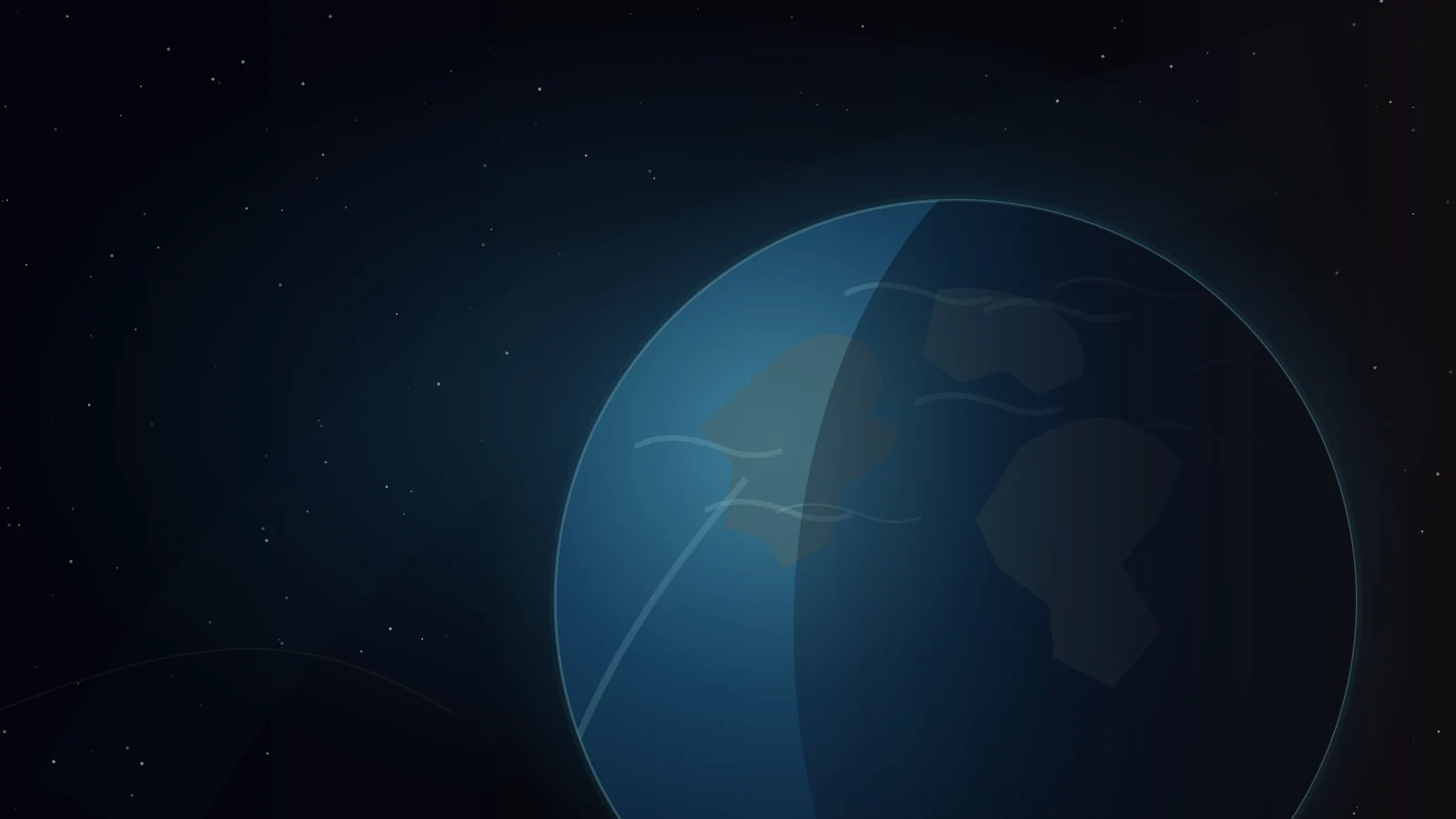
Imagine stepping outside on an ordinary afternoon. The weather forecast is normal. There are clouds, traffic, birds, sunlight on the pavement. Then, without warning, the Sun ceases to exist. What happens next? Surprisingly, for a little while, nothing you can see.
This thought experiment is a useful way to discover how much of Earth is borrowed from one star. We borrow its light, most of the energy entering our climate system, the base of most food webs, and the gravitational force that keeps our planet in its orbit. Remove all of that and the catastrophe is not a single cinematic explosion. It is a sequence of failures unfolding on different clocks.
The short answer: Earth's surface would ultimately become lethally cold for ordinary life, agriculture would collapse, and modern civilization could not function normally. Yet life would not necessarily disappear everywhere. Some organisms already live without sunlight, and limited human survival might be possible for a time with powerful independent energy systems. No reliable, universal countdown applies to the whole planet.
First, decide what “the Sun disappears” means
There are two very different stories hidden inside the same question.
Scenario A: the Sun physically vanishes. Its light and gravitational influence are lost. Earth would no longer follow its previous orbit around the Sun. In an idealized version with no other major forces, it would continue roughly along the direction it was moving at the moment the change reached us. The Moon would not simply fly away from Earth, because Earth's own gravity would still exist. These are consequences of the scenario, not a prediction that our real Sun could vanish without explanation.
Scenario B: sunlight is blocked, but the Sun remains. Earth stays in orbit. Darkness might come from some impossible opaque barrier or a science-fiction event, but the Sun's gravitational pull is still there. The ecological and temperature crisis could resemble Scenario A in important ways, while the planetary dynamics are very different.
Confusing the two produces one of the most common mistakes in disaster fiction: treating “no sunlight” and “no Sun” as identical. A credible story chooses one and follows through.
The first eight minutes would feel completely normal
Light takes roughly eight minutes and twenty seconds to travel from the Sun to Earth. We are always seeing sunlight that began its trip minutes ago. In the physical-disappearance scenario, the change in the Sun's gravitational field would also propagate outward rather than being felt instantaneously.
For those final minutes, the sky would look familiar. No observer on Earth could watch the Sun vanish at the moment it happened at the star itself. The last sunlight was already on its way.
Then the daytime sky would darken. The Moon would not provide its familiar reflected sunlight. Other planets, normally visible because they reflect the Sun, would also lose that illumination once the change reached them. Stars would remain, as would any remaining artificial lights on Earth. The atmosphere would not abruptly disappear, and people would not freeze in one heartbeat.
That ordinary-looking delay is arguably the strangest part: the universe can change before a distant observer receives the news.
Darkness arrives immediately. Deep cold does not.
The moment direct sunlight stops, solar heating stops. That does not mean every surface instantly falls to the temperature of space. Soil, buildings, air and especially oceans hold energy. They release it at different rates, while winds and ocean circulation redistribute what remains.
In the early hours, the first noticeable changes would be sensory and practical: an impossible night, temperatures beginning to fall, rapidly altered electricity demand, traffic disruption, and public uncertainty. Regions already experiencing winter or extreme cold would face immediate additional stress. Others would still have residual warmth.
Over days and weeks, widespread freezing would intensify. How quickly a specific city cooled would depend on its starting weather, land cover, nearby water, cloudiness, insulation and the way the atmosphere responded. A precise worldwide 'temperature after seven days' is not an established forecast for a physically impossible event. Numbers circulated online are often simplified illustrative models; they should not be mistaken for measured outcomes.
In the long run the surface would lose almost all the warmth it normally receives from the Sun. Earth's interior produces geothermal heat, but that heat flow is far too small to maintain today's global surface climate. The oceans would begin freezing at the top, not transform into solid ice in an instant. An ice layer would slow further heat exchange and help insulate the water underneath, so deep liquid reservoirs could persist much longer than exposed surface habitats.
Food becomes the central emergency
We often imagine cold as the decisive danger. For a civilization of billions, food may be an even more complex crisis.
Most ecosystems depend directly or indirectly on photosynthesis: organisms capture sunlight and use that energy to produce organic matter. Shut off that incoming energy, and the continuing production of plant biomass rapidly becomes impossible in ordinary outdoor conditions. Existing crops do not vanish on the spot, and stored food does not spoil because the sky turned black, but future harvests would fail without artificial light and heat.
That difference between stored calories and new calories is crucial. Warehouses, seed stores, grain silos, refrigeration networks and livestock feed would all become strategic resources. So would the electricity needed to keep food safe, treat water and grow new plants indoors.
A sealed greenhouse might sound like an answer. But a greenhouse without sunlight is not a greenhouse in the familiar sense; it is an indoor farm whose lighting, heating, pumps and nutrient cycles must be powered by something else. Scaling that system to a large population would be an industrial undertaking, not simply a matter of installing grow lights in every basement.
And the damage would not stay on land. Marine food webs that depend on sunlit surface waters would be disrupted. Ecosystems would respond unevenly, but removing the source of most new biological production would eventually echo through fish, birds, grazing animals, predators and humans alike.
Would the air run out of oxygen?
No—not on the first night, and not because photosynthesis halted for a few hours.
Earth's atmosphere contains a very large existing reservoir of oxygen. Breathing organisms would continue to consume oxygen even without new photosynthesis, but the timing and chemistry of long-term atmospheric changes are much more complicated than the immediate loss of light. Human settlements would face acute problems with energy, food, temperature, transport and clean water long before it made sense to describe the entire planetary atmosphere as suddenly unbreathable.
An underground shelter, however, is a different scale. Its occupants would need deliberate ventilation, air handling, carbon-dioxide control and backup power. A planet's oxygen inventory and the breathing safety of one sealed room are not the same problem.
Some life already lives without sunshine
At the bottom of the ocean, certain ecosystems get their primary energy not from sunlight but from chemical reactions. Near hydrothermal vents and cold seeps, microorganisms perform chemosynthesis, supporting communities that can include tubeworms, mussels and other animals.
These communities do not prove that most marine life could survive a vanished Sun. They prove a narrower and more fascinating point: sunlight is not the only possible foundation for a food web. Their energy sources, environmental conditions and connections to the wider ocean are very different from those of coral reefs or surface plankton.
Some subsurface microbial communities also obtain energy from chemical processes unrelated to sunlight. The survival of any particular habitat would depend on local water, chemistry, heat and long-term stability. The most plausible survivors of an unlit Earth might be microscopic organisms far from the surface, not movie-style creatures roaming frozen cities.
This is why the question matters beyond disaster fiction. When scientists investigate possible life in worlds with oceans beneath ice, they do not look only for beaches and blue skies. They also ask whether water, chemical energy and favorable environments can coexist without sunlight at the surface.
Could humans build a permanent refuge?
A short-term refuge is easier to imagine than a self-sufficient human civilization.
A serious shelter would need independent power, reliable heat, water purification, air circulation, medical supplies, waste processing, agriculture, replacement components and trained people who know how to maintain every system. Solar panels would no longer help. Nuclear facilities and some geothermal systems could provide alternatives, but each has fuel, maintenance, engineering and distribution limits. Fossil fuels are finite; other systems depend on geography or infrastructure.
One dramatic-looking bunker is not enough. The hardest question is whether the community can replace broken equipment and keep a productive food system running after its initial stores are depleted. A settlement that needs imported electronics, specialized medicine or replacement filters from a destroyed global supply chain is not yet independent.
The generation-ship problem becomes unexpectedly relevant: a shelter on darkened Earth would also need to become a tiny closed civilization. Its engineering might be easier in some respects because Earth still has gravity, water and minerals; its surrounding environment would be far more hostile than the surface people were used to.
Four claims worth questioning
- “Everyone would freeze instantly.” No. Thermal inertia matters. Cooling would be severe but uneven over time.
- “All life needs sunlight.” No. Chemosynthetic ecosystems demonstrate an important exception.
- “The Moon would disappear too.” Not literally. Without sunlight it would lose its familiar visible illumination, but the body would remain.
- “A few grow lights could feed the world.” Artificial agriculture requires an enormous, continuous chain of energy and equipment. A workable system for a small facility cannot be assumed to scale to billions.
The most unsettling part is the dependency chain
In a realistic account, the loss of the Sun does not simply change the scenery. It reveals that cities are agreements between infrastructure systems that usually work without us noticing.
A streetlight needs a power plant. The power plant needs maintenance. The maintenance crew needs food, heat and transport. The farm needs light and water. Water treatment needs electricity. The hospital needs all of them. Remove the energy source that quietly supports most biological production, and the danger cascades through the network.
That is a better science-fiction story than a single dramatic temperature number. The real suspense would be deciding what must stay running today so that anything can still run next month.
Verdict: Earth's ordinary surface biosphere and civilization could not continue as we know them. Limited human enclaves might endure with extraordinary engineering and sustained independent energy; some microorganisms could survive for far longer in chemically powered habitats. The Sun is not merely a bright object in our sky. It is a hidden part of almost every ordinary thing we do.
Continue exploring: Could 10,000 People Survive on a Generation Ship? and What Would First Contact Actually Look Like?.
Editorial note: The disappearance of the Sun is an impossible-to-model thought experiment, not a real forecast. The scientific facts above are established; the sequence of events and possible human refuges are reasoned scenario analysis.
Sources & further reading
- NASA Science — The Sun — the Sun's gravitational role and its relationship with Earth's climate.
- NASA Science — Sun Facts — distance, energy and why life on Earth depends on our star.
- NASA — Voyager 1: What Is a Light-Day? — the approximate eight-minute-twenty-second light-travel time.
- NOAA Ocean Exploration — Photosynthesis and Chemosynthesis — how ecosystems can draw energy from sunlight or chemical reactions.
- NOAA Ocean Exploration — Hydrothermal Vents and Volcanoes — sunless deep-ocean habitats and chemical energy.