
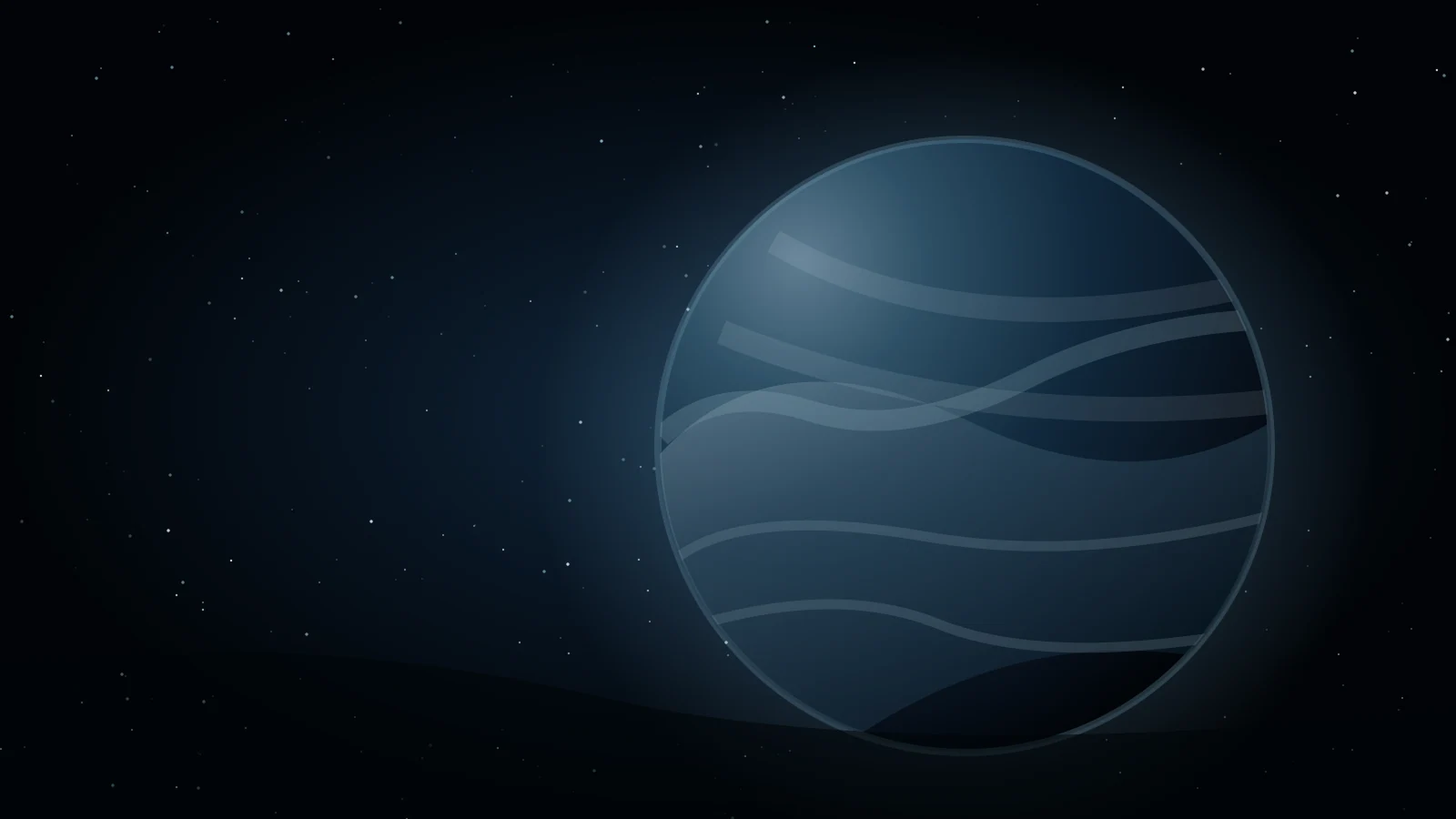
Imagine standing on a world where the Sun never rises.
There is no dawn, no blue sky, and no familiar constellation of seasons. The nearest stars are remote points of light. Beneath your feet lies a frozen surface, and the planet itself is drifting through interstellar space with no parent star to orbit. In the ordinary picture of a living world, this place seems disqualified before the search even begins.
But perhaps the interesting part is not the surface. Perhaps it is what might survive underneath.
Astronomers call worlds traveling through space without a host star rogue planets or free-floating planets. Their existence is a serious subject of observation, and their possible habitability is a subject of scientific modeling. A world with no sunshine is not automatically a world with no energy. That difference matters enormously — although it does not mean anyone has discovered life on one.
What exactly is a rogue planet?
Most planets we talk about belong to a system. Earth orbits the Sun; Jupiter and Neptune do too. A rogue planet is not gravitationally bound to a star. It travels through the galaxy on its own, even though its motion is still influenced by the wider gravitational field of the Milky Way.
Some may have formed around stars before being thrown out by gravitational encounters with other planets or passing objects. Others may have formed independently through processes resembling the birth of very low-mass stars. The dividing line between a planet and a brown dwarf — an object heavier than typical planets but unable to sustain ordinary hydrogen fusion like a star — can also make classification difficult.
That complexity is one reason rogue worlds are scientifically valuable. They are clues to how planetary systems form, become unstable, and rearrange themselves. NASA has identified free-floating planets as targets for gravitational microlensing surveys, including work associated with the Nancy Grace Roman Space Telescope. These surveys can reveal otherwise invisible objects because gravity bends the light from stars behind them.
A rogue planet does not have to glow brightly to betray its presence. It only has to cross the right line of sight at the right moment.
Why its surface would be an extremely hostile place
Without a nearby star, a planet loses the continuous external energy source that keeps Earth's surface relatively warm. A rocky world that once had surface oceans would, under many plausible conditions, see those oceans freeze from above. Surface temperatures could become extraordinarily low, and an atmosphere might partly collapse or condense depending on its composition and the planet's thermal history.
None of that resembles the landscapes in most cinematic science fiction. You would not expect open beaches, clouds warmed by sunshine, or forests finding their way toward a hidden daylight. A human visitor would face darkness, extreme cold, and a dangerous environment even before accounting for the difficulty of reaching the planet.
The important qualification is that surface habitability is not the same thing as habitability everywhere. On Earth, life reaches places sunlight never touches. And liquid water can sometimes persist below ice even where a surface remains frozen.
A planet can carry some of its own heat
Earth has internal heat. Some comes from energy left over from the planet's formation and differentiation; some comes from radioactive decay inside its rocks. This heat drives geological processes and contributes to conditions deep below the surface.
Could a rogue planet retain enough of that energy to stop all its water from freezing solid?
A scientific study by Dorian Abbot and Eric Switzer, published in The Astrophysical Journal Letters in 2011, examined this possibility. Their proposed 'Steppenwolf' world was a starless planet whose geothermal heat could support a buried liquid ocean beneath insulating layers of ice and, in some scenarios, frozen atmospheric material. Their calculations showed how planetary mass, water inventory, insulation, and other properties could change the result.
It was a model, not the discovery of an inhabited planet. Yet the distinction between 'physically impossible' and 'possible under particular assumptions' is a major one. The paper offered a testable way of thinking about starless oceans rather than simply imagining them.
There are also reasons to treat the numbers carefully. Heat production changes as a planet ages. An ocean's survival depends on how quickly energy escapes through ice, whether the planet has enough water, and what its interior is made of. A rogue world could have the wrong combination of conditions and freeze completely.
A useful comparison: oceans that never see sunlight
Our own solar system gives us better-known examples of concealed water. Jupiter's moon Europa and Saturn's moon Enceladus are important targets in the search for potentially habitable environments. Their oceans are not warmed primarily by sunshine in the way Earth's surface is. Internal processes — especially tidal heating, where gravitational interactions flex a moon's interior — matter enormously.
NOAA describes hydrothermal ecosystems in Earth's deep ocean, where microbes obtain energy from chemical reactions rather than photosynthesis. Those ecosystems remind us that sunlight is not the only way an environment can support living organisms.
But it would be a mistake to conclude that a rogue planet works exactly like Europa. A free-floating planet may lack a giant host planet to create strong tidal flexing. Some rogue planets could have their own moons, potentially producing other arrangements of tidal heating, but that is an additional condition, not a guarantee.
The comparison establishes a possibility: liquid water and biologically useful energy can exist in darkness. It does not establish that life will appear wherever those ingredients are found.
What would life have to live on?
If an isolated planet carried an ocean underneath its ice, an organism would need an available energy source. Sunlight-driven photosynthesis would not work deep below an opaque frozen shell. Chemical energy might be more promising.
On Earth, certain microorganisms use reactions involving compounds such as hydrogen and sulfur to obtain energy. An analogous metabolism might be conceivable where a planet's water interacts with reactive rocks, minerals, and sources of heat. Whether a specific rogue planet could maintain the necessary chemical disequilibrium for millions or billions of years would depend on conditions we have not observed.
And there is another unanswered question: Could life begin there, or could life that evolved earlier merely survive there?
Those are not the same problem. A planet expelled from its original system might already possess microorganisms before its surface freezes. An object born without a star would face a different chemical and thermal history. Both scenarios are interesting; neither has direct observational confirmation.
'Potentially habitable' is a description of possible environmental conditions. It is not evidence that organisms are present.
What about rogue planets with moons?
A rogue giant planet might travel with one or more moons. Such a system invites a different possibility: tidal forces could warm a moon's interior, while an atmosphere or an insulating layer helps retain energy.
Research reported in 2026 has explored whether certain moons around free-floating planets could maintain liquid water for extremely long periods under modeled conditions. That does not mean such moons have been found to host living oceans. It means researchers are investigating another way to avoid the simplistic equation 'no star equals no liquid water.'
In a starless system, the natural drama may be underground: a dark ocean under ice, warmed not by a day-night cycle but by gravity and geology.
How could we detect a world we cannot easily see?
Rogue planets create an observational challenge because they have no host star to illuminate them and may emit little detectable radiation of their own. Their location, mass, temperature, and composition can all be difficult to determine.
Gravitational microlensing is one way forward. When a foreground object briefly lines up with a distant star, its gravity bends and magnifies the star's light. A free-floating planet may therefore leave a temporary brightness signal even when the planet itself remains unseen. NASA describes microlensing as a key technique for expanding the census of isolated worlds.
Discovering a rogue planet is only the beginning. Measuring whether it has an atmosphere, an ice shell, or a hidden ocean is a much more demanding problem. Finding biological activity beneath kilometers of ice, across interstellar distances, would be more difficult still.
So a headline announcing a new rogue planet should not be confused with evidence of an alien ecosystem. The gap between detecting a mass and diagnosing its biology is enormous.
The bigger surprise: the habitable zone may not tell the whole story
When we search for other Earths, we often talk about a star's habitable zone: the region where conditions might permit liquid water on a planet's surface, given a suitable atmosphere. It is a useful concept. It is not a complete definition of every place liquid water could exist.
NASA has discussed how icy exoplanets outside a conventional habitable zone might still harbor internal oceans under the right conditions. A starless planet pushes that thought even further: what if some potentially habitable places do not orbit stars at all?
That would not make Earth-like planets irrelevant. It would expand the map of where scientists might ask the question.
The scientific discipline is in resisting an easy leap from 'water may persist' to 'aliens probably live there.' A hidden ocean may have no accessible nutrients, no lasting chemical energy, or an environment unsuitable for life as we know it. Much remains unknown.
Why rogue worlds belong in science fiction
Most interstellar stories are oriented toward something bright: a destination star, a habitable planet, a colony that looks up at a new sunrise. Rogue planets offer almost the opposite promise. They are worlds with history but no familiar sky.
Think of a civilization crossing the darkness and detecting a faint gravitational anomaly. It finds a planet that has wandered alone for billions of years. The surface is sterile ice; beneath it lies a vast sea whose chemistry may have changed for ages without ever touching a sunlit atmosphere. The central question is no longer whether explorers can plant a flag. It is whether they have the right to disturb an environment they barely understand.
The physics does not provide a ready-made alien city. It provides something better for fiction: limits, uncertainty, consequences, and a reason to be curious.
So could life exist on a planet without a star?
Possibly, but we do not know. Free-floating planets are real targets of astronomical research. Models show ways that internal heat and insulating ice could preserve liquid water on particular starless worlds. Examples from Earth's deep ocean demonstrate that biology does not always require direct sunlight.
None of that amounts to a confirmed living rogue planet. We have not observed one with a verified subsurface biosphere, or even established the full environment of such a world in detail. A cold, dark planet could be utterly lifeless.
Yet the idea matters because it asks a more careful question than 'Is there another Earth?' It asks how little light a world might need — and how many unfamiliar places the search for life could eventually include.
The universe may contain more kinds of worlds than the categories we invented while looking at our own sky.