
The fastest way to start an argument about an adaptation is to ask whether it was faithful to the book. The question sounds objective. Count the missing scenes, compare the dialogue, list the characters who were combined, and announce a verdict.
But adaptations are rarely disappointing because they removed exactly the wrong percentage of the source. They disappoint when the changes damage the reason the story mattered in the first place. A film can preserve nearly every major event and still feel emotionally false. A television series can rearrange entire arcs and still feel unmistakably loyal to the original.
The useful question is not, “How much changed?” It is, “What did the adaptation understand?”
Dune, The Sandman, and The Witcher illustrate three different adaptation problems: how to turn interior thought into image, how to make an episodic and formally unusual work function as television, and how to convert short stories spread across decades into a converging serialized narrative. None can be solved by placing the book beside the script and copying harder.
Faithfulness is a feeling before it is a measurement
Adaptation studies has spent decades challenging the idea that fidelity is a simple scale from accurate to inaccurate. A novel, comic, film, and television series do not deliver information in the same way. Moving a story between them requires selection, compression, expansion, rearrangement, and invention.
Readers still use the word faithful because they are protecting something real. They may be protecting a character’s moral logic, the atmosphere of the world, the rhythm of the relationships, the political argument, or the emotional promise made by the ending. Those elements are harder to count than scenes, but they are often what fans notice most strongly.
A line of dialogue can be removed without changing a character. A spectacular new sequence can alter that character completely. Fidelity is therefore less like photocopying and more like conservation: the adapter must decide which structures carry the identity of the work and which can be rebuilt without destroying it.
Every medium makes different things easy
Novels can move through memory, explanation, contradiction, and private thought with almost no friction. A sentence can reveal what a character wants, what they pretend to want, and what they refuse to admit. Comics can control the relationship between image, caption, panel size, page turn, and visual repetition. Film can use scale, sound, performance, editing, and a single unforgettable image. Television can accumulate relationships over hours, but it must repeatedly create episode-level momentum.
These strengths create corresponding weaknesses. A film cannot comfortably reproduce hundreds of pages of political context. A television episode cannot pause for every piece of background that a reader absorbed gradually. An actor’s silence may communicate more than a paragraph, but only if the production has built the image, performance, and sound around that silence.
That is why an adaptation that copies the source too literally can feel strangely lifeless. The information survives, but the storytelling mechanism does not.
The first job is to identify the story engine
Before deciding what to cut, an adaptation needs to know what makes the story move. The engine is not the premise. “A young heir enters a desert conflict” is a premise. The engine of Dune includes Paul’s transformation under political, ecological, religious, and colonial pressure. “The king of dreams escapes captivity” is a premise. The engine of The Sandman is the way stories, obligations, and human lives expose Dream’s inability to change.
The engine usually contains four linked elements: what the protagonist wants, what pressure prevents them from getting it, what moral choice the story keeps forcing, and what emotional experience the audience has been promised.
Once that engine is clear, scenes can be combined or relocated without becoming arbitrary. When it is unclear, even beautiful production design becomes decoration around a plot that no longer knows why it exists.
Dune: translate interiority instead of narrating around it
Frank Herbert’s Dune contains political calculation, ecological explanation, prophetic vision, and long passages of interior thought. Denis Villeneuve’s films could not preserve all of that language without turning the experience into continuous voice-over or exposition.
The adaptation instead converts much of Paul’s interior experience into scale, rhythm, framing, sound, and repeated visual motifs. Villeneuve and cinematographer Greig Fraser have described the importance of showing the impact of Arrakis on Paul rather than simply explaining it. A reflection on a windshield, the physical discipline of the desert, the overwhelming presence of machinery, and the sound of ritual can perform work that the novel accomplishes through thought.
This approach is not neutral. Some political complexity and character material is compressed, and Villeneuve has openly described adaptation as requiring choices that distort the book so it can fit film. The result works for many viewers because the films do not pretend nothing was lost. They replace one kind of access with another: less direct explanation, more sensory and emotional immersion.
The lesson is not that every adaptation should become monumental. It is that subtraction needs a replacement. Remove inner monologue, and the screen must create another path into the character.
The Sandman: change the delivery system, preserve the strange rhythm
The Sandman presented almost the opposite problem. Its source is already visual, but its structure is unusually fluid. The comics move between horror, mythology, historical tale, intimate character study, and stories in which Dream is barely present. Captions and thought bubbles can move across time and consciousness without asking actors to say everything aloud.
The television adaptation keeps much of the imagery and spirit while making practical structural changes. Netflix’s own production material describes characters and arcs being combined, the Corinthian receiving a larger season-long function, and Matthew the raven becoming a more important companion because Dream needs someone to speak to on screen. The famous diner story also required performance and staging to replace information delivered by narration in the comic.
Those changes demonstrate a useful principle: being faithful to form does not mean preserving every device. It means recreating the experience produced by those devices. The comic can isolate an issue like a short story. Television must also persuade the viewer to continue into the next episode. A recurring antagonist or companion can provide continuity without erasing the anthology-like quality that makes the material distinctive.
A weak adaptation would smooth away the strangeness until the story became ordinary prestige fantasy. A strong one changes enough machinery to let the strangeness survive.
The Witcher: structure can be bold and still require orientation
The early Witcher books complicate adaptation because they begin as interconnected short stories before developing into a longer saga. A television series also wants its major characters present from the beginning, even when the source introduces them at different times.
The first season solved that problem by following Geralt, Yennefer, and Ciri across three timelines that eventually converge. Netflix’s official timeline confirms that the season spans decades, while showrunner Lauren Schmidt Hissrich has explained that the structure was designed to make separate stories feel like one emerging narrative.
It is an ambitious solution. It gives Yennefer and Ciri independent arcs and turns convergence into the season’s organizing pleasure. It also reveals an important adaptation risk: complexity that feels elegant on a writer’s board may demand more orientation on screen. Viewers cannot flip backward as easily as readers, and visual continuity can make different periods appear simultaneous unless the series teaches the audience what clues to watch.
The lesson is not that nonlinear adaptation is a mistake. It is that structural ambition creates an obligation. The more an adaptation rearranges chronology, the more clearly it must establish cause, consequence, and temporal difference.
Adaptations fail when they preserve events but lose motivation
Fans often complain about a missing scene when the deeper problem is a changed chain of motivation. A character reaches the same destination, but for a reason that contradicts the person readers knew. A betrayal still occurs, but the adaptation removed the relationship that made it painful. A victory remains, but the cost that gave it meaning has disappeared.
Plot points are visible, so they attract most of the debate. Motivation is the hidden architecture connecting them. When that architecture changes, the adaptation may resemble the source in screenshots while feeling like a different story in motion.
This is also why adding action rarely repairs weak adaptation. Action can increase pace, but it cannot restore a missing moral dilemma. Lore can explain the world, but it cannot replace a damaged relationship. A familiar costume can reassure the eye while the character inside it behaves according to another narrative logic.
Tone is a contract, not a color palette
Dark fantasy is not preserved by adding black costumes. A thriller is not preserved by adding twists. Science fiction is not preserved by displaying technology. Tone emerges from what the story treats as important, how long it stays with consequences, what kind of behavior it rewards, and whether violence, wonder, humor, or grief has weight.
An adaptation can reproduce locations perfectly and still violate the tonal contract. If a reflective novel becomes relentlessly frantic, if a morally ambiguous story becomes a simple hero narrative, or if an intimate horror story becomes spectacle without vulnerability, viewers may call it unfaithful even when the names and events remain.
The most successful adaptations understand that tone lives in pacing and consequence. Production design supports that work; it cannot do it alone.
Fans and newcomers are watching different versions of the same scene
A newcomer asks, “Does this make sense?” A reader asks an additional question: “Does this understand what I loved?” The adaptation has to answer both.
Explaining everything for newcomers can suffocate mystery. Depending on prior knowledge can make the story feel like an expensive illustration for existing fans. The ideal adaptation creates a complete dramatic experience while allowing recognition to function as an extra layer rather than an entrance requirement.
This balance is especially difficult when marketing promises fidelity. The more a production emphasizes respect for the source, the more every major change will be judged as part of that promise. Changes are not automatically betrayal, but they need to reveal a coherent interpretation rather than convenience, trend chasing, or uncertainty about the material.
A practical test for a strong adaptation
Instead of counting omissions, ask six questions.
What is the emotional engine? Which desire, fear, relationship, or moral pressure makes the story move?
What can the new medium do better? Is the adaptation using performance, sound, image, editing, episode structure, or scale as storytelling rather than decoration?
What was removed, and what replaced its function? If inner thought, context, or a relationship disappears, where does that meaning now live?
Do the characters still make decisions for recognizable reasons? A changed event can work; a changed personality requires a new dramatic foundation.
Does the adaptation preserve the tonal contract? The world may look correct while its pacing, consequences, and values feel completely different.
Can newcomers follow the story without homework while readers still recognize its identity?
An adaptation does not need perfect answers to all six questions. It does need to know that these are the questions it is answering.
The best adaptations are arguments about the source
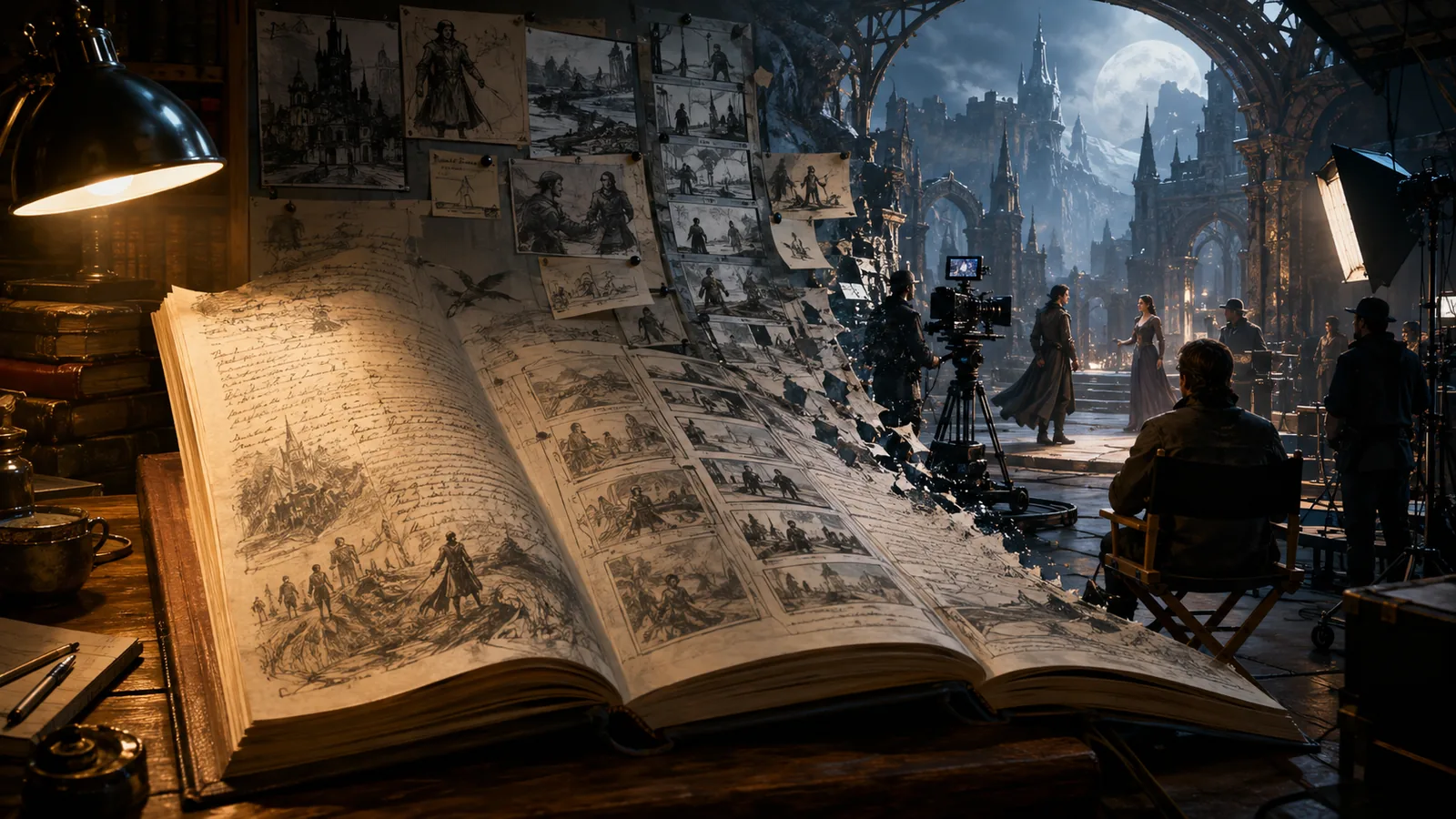
A screen adaptation is not the book with moving pictures. It is a reading of the book made public through another medium.
Dune argues that Herbert’s interior and political world can be experienced through physical scale, sound, and transformation. The Sandman argues that radical visual fidelity can coexist with structural invention. The Witcher argues that scattered beginnings can be reorganized around convergence, while also showing how much guidance a complex structure may require.
The adaptations that endure are not always the ones that change least. They are the ones whose changes reveal a clear understanding of the original engine. They know what must survive, what must transform, and what new cinematic or televisual language can make the story alive again.
That is why some adaptations feel faithful even when they surprise us—and why others feel wrong while repeating everything we remember.
Continue exploring: How Unreliable Narrators Manipulate the Reader and What Makes Dark Fantasy Truly Dark?.
Sources & further reading
- Leitch, Thomas - “Adaptation and Fidelity,” The Oxford Handbook of Adaptation Studies (2017). Surveys the long debate over whether fidelity is a useful or sufficient way to evaluate adaptation.
- Boyd, Brian - “Making Adaptation Studies Adaptive,” The Oxford Handbook of Adaptation Studies (2017). Argues for moving beyond exact fidelity toward the creative problem-solving required by a new artistic environment.
- Associated Press (2024) - “In Dune: Part Two, filmmaker Denis Villeneuve realizes a lifetime dream.” Villeneuve discusses the choices and distortions required to fit Frank Herbert’s novel into film form.
- Vanity Fair (2021) - “A Deep Dive Into the Visceral Cinematography of Dune.” Villeneuve and Greig Fraser explain how images and physical experience replace much of the novel’s interior monologue.
- Netflix Tudum (2022) - “How Does The Sandman Series Connect to Neil Gaiman’s Comics?” Details combined arcs, the expanded Corinthian, the larger role of Matthew, and updates made for television.
- Netflix Tudum (2022) - “The Sandman 24 Hour Diner Scene: Neil Gaiman Explains.” Discusses the challenge of replacing captions and narration with acting, staging, and screen time.
- Netflix Tudum (2023) - “The Complete Witcher Timeline From Blood Origin and Beyond.” Confirms the three timelines and multi-decade span used in The Witcher Season 1.
- TV Guide (2019) - “The Witcher Showrunner on How She Adapted the Books for the Netflix TV Show.” Lauren Schmidt Hissrich explains the decision to interweave the characters and timelines while adapting the early short-story collections.
- Pial, Tanzir et al. (2023) - “Analyzing Film Adaptation through Narrative Alignment.” A study of 40 adaptations examining omission, dialogue, narrative order, and other measurable changes between books and films.